UNIST site map
- Admissions
-
Academics
- Colleges and Schools
-
Academic Affairs
- Academic Calendar
- Academic Curriculum
- Requirements for Graduation
- Browse Open Courses
- Undergraduate Administration
-
Graduate Academic Affairs
- Tuition Fee Payment
- Academic Leave of Absence/ Academic Return
- Voluntary Withdrawal/ Expulsion
- Change of Major
- Change of Degree Program/ Dropping of Degree Program
- Class Period/ Attendance Period/ Academic Year・Semester
- Course Registration
- Course Drop
- Attendance/ Grade/ Exam
- Credit Transfer/ Credit Carryover
- Academic Forms
- Education Support
-
Research/Industry
- Research Aims
- Research Findings
- Researcher Search
-
Research Organizations
- UNIST Multi-Interdisciplinary Institute
- IBS Research Groups
-
UNIST Labs
- Department of Mechanical Engineering
- School of Energy and Chemical Engineering
- Department of Civil
- Department of Materials Science and Engineering
- Department of Nuclear Engineering
- Department of Industrial Engineering
- Department of Design
- Department of Biomedical Engineering
- Department of Biological Sciences
- Department of Electrical Engineering
- Department of Computer Science and Engineering
- Department of Mathematical Sciences
- Department of Chemistry
- Department of Physics
- School of Business Administration
- Graduate School of Carbon Neutrality
- Graduate School of Artificial Intelligence
- Research Support
- University-Industry Relations
- Campus Life
- News Center
- About UNIST
-
etc
- UNIST Bulletin
- Work-Life Balance Support System
- UNIST Gender Equality Plan
- Faculty Invitation for Tenure Track
- Faculty Invitation for Non-Tenure Track
- Board Meeting Minutes
- University Council Meeting Minutes
- Administrative Service Charter
- Privacy Policy
- Copyright Policy
- Rejection of Unauthorized Email Collection
- Operation and Management Policy for Video Information Processing Devices
- Information Disclosure


Connection Points of Knowledge, Everything About UNIST
Try searching.
Recommended search terms


- portal
- U Academics Innovation Center
- Leadership Center
- Dormitory
- Academic Information Center
- International Students Support
- Browse Open Courses
- Course Registration
- Graduation Requirements for Graduation
- Academic Leave of Absence/ Academic Return
- Military Service
- Certificate Issuance
- Academic Calendar
- Scholarships
- Campus Map
- Campus Life Guidebook
- Health Care Center
- Human Rights Center
- portal
- Job Opening
- Announcement for Bid
- UNIST AI Services
- UNIST Daycare Center
- Sports Center
- UI Downloads
- Announcement
- Recruitment of Professors (Non-tenure)
- Faculty Invitation for Tenure Track
- UNIST Academic Information Center
- Office of Research Facilities and Training
- Office of Research Affairs
- Rule Management System
- Academic Calendar


This is a collection of menus necessary for UNIST students .
students
- portal
- U Academics Innovation Center
- Leadership Center
- Dormitory
- Academic Information Center
- International Students Support
- Browse Open Courses
- Course Registration
- Graduation Requirements for Graduation
- Academic Leave of Absence/ Academic Return
- Military Service
- Certificate Issuance
- Academic Calendar
- Scholarships
- Campus Map
- Campus Life Guidebook
- Health Care Center
- Human Rights Center


This is a collection of menus necessary for prospective UNIST Students .
prospective Students


This is a collection of menus necessary for UNIST Faculty & Staff .
Faculty & Staff
- portal
- Job Opening
- Announcement for Bid
- UNIST AI Services
- UNIST Daycare Center
- Sports Center
- UI Downloads
- Announcement
- Recruitment of Professors (Non-tenure)
- Faculty Invitation for Tenure Track
- UNIST Academic Information Center
- Office of Research Facilities and Training
- Office of Research Affairs
- Rule Management System
- Academic Calendar


NEWS CENTER
Discover not only Research Findings and event news, but also the diverse facets of UNIST presented by reporters and writers.
News Center

UNIST News
UniSim-SLAM Keeps Robots on Track in Unfamiliar Spaces
Accepted to ECCV 2026, the new SLAM system combines rapid tracking with multi-view refinement, reducing trajectory error by up to 45.9%.
- Research
- JooHyeon Heo
- 2026.10.08
- 100

Abstract
Robots navigating unfamiliar environments must track their position while continuously mapping the space around them. AI has made both tasks faster, but a persistent trade-off remains: using more camera views can improve accuracy, but requires more processing time.
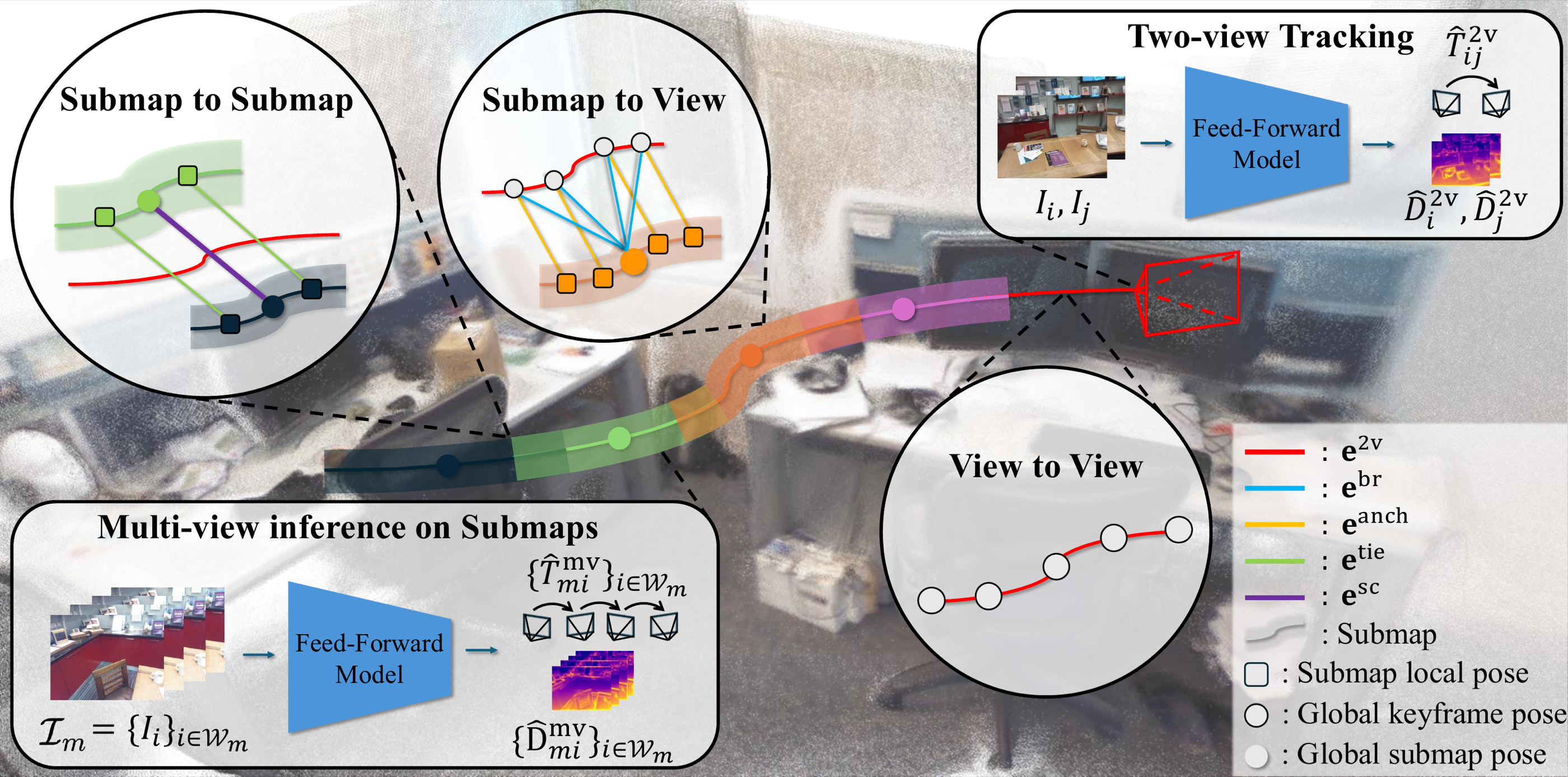
Professor Kyungdon Joo and his research team from the Graduate School of Artificial Intelligence at UNIST have developed UniSim-SLAM, a system that combines rapid camera tracking with periodic multi-view refinement. The approach allows robots to update their position quickly while correcting errors that would otherwise accumulate as they move.
Known as simultaneous localization and mapping (SLAM), the underlying technology enables robots and other autonomous systems to determine their location while reconstructing their surroundings. Recent AI-based approaches can infer 3D geometry directly from camera images, but small differences between successive estimates can compound over long sequences, gradually pushing the reconstructed path away from the robot's actual trajectory.
UniSim-SLAM tackles the problem by giving fast tracking and detailed reconstruction different roles. It compares two camera views at a time to track movement, then periodically brings multiple views together to refine the local 3D map. A unified optimization framework aligns estimates produced at different scales and orientations, keeping the reconstructed environment and camera trajectory consistent over time.

On two standard indoor benchmarks achieved, UniSim-SLAM state-of-the-art results in the uncalibrated setting. With the previous best Compared methods, it reduced trajectory error by 38.5% on TUM RGB-D and 45.9% on 7-Scenes.
The system was also considerably faster than a multi-view alternative evaluated in the study. VGGT-SLAM required 3.41 seconds to produce a result, compared with 0.197 seconds for UniSim-SLAM. The new approach also improved the accuracy of 3D reconstruction.
“UniSim-SLAM brings fast tracking and accurate multi-view analysis into the same system,” said Professor Joo. “This could benefit applications that need reliable localization and real-time 3D reconstruction, from robotics and autonomous driving to augmented reality.”
The study, with Inha Lee of UNIST as first author, was presented at the European Conference on Computer Vision (ECCV 2026), held September 8–12 in Malmö, Sweden. The work was supported by the Ministry of Science and ICT (MSIT) through the Institute of Information & Communications Technology Planning & Evaluation (IITP), including the Artificial Intelligence Graduate School Program at UNIST and programs in collaborative AI and spatial immersive technologies, as well as the InnoCORE program.
Journal Reference
Inha Lee, Dongjae Jeong, Junhee Lee, and Kyungdon Joo, "UniSim-SLAM: Feed-Forward SLAM with Unified Sim(3) Optimization," ECCV'26 (2026).
Related Links
Related Photo