UNIST site map
- Admissions
-
Academics
- Colleges and Schools
-
Academic Affairs
- Academic Calendar
- Academic Curriculum
- Requirements for Graduation
- Browse Open Courses
- Undergraduate Administration
-
Graduate Academic Affairs
- Tuition Fee Payment
- Academic Leave of Absence/ Academic Return
- Voluntary Withdrawal/ Expulsion
- Change of Major
- Change of Degree Program/ Dropping of Degree Program
- Class Period/ Attendance Period/ Academic Year・Semester
- Course Registration
- Course Drop
- Attendance/ Grade/ Exam
- Credit Transfer/ Credit Carryover
- Academic Forms
- Education Support
-
Research/Industry
- Research Aims
- Research Findings
- Researcher Search
-
Research Organizations
- UNIST Multi-Interdisciplinary Institute
- IBS Research Groups
-
UNIST Labs
- Department of Mechanical Engineering
- School of Energy and Chemical Engineering
- Department of Civil
- Department of Materials Science and Engineering
- Department of Nuclear Engineering
- Department of Industrial Engineering
- Department of Design
- Department of Biomedical Engineering
- Department of Biological Sciences
- Department of Electrical Engineering
- Department of Computer Science and Engineering
- Department of Mathematical Sciences
- Department of Chemistry
- Department of Physics
- School of Business Administration
- Graduate School of Carbon Neutrality
- Graduate School of Artificial Intelligence
- Research Support
- University-Industry Relations
- Campus Life
- News Center
- About UNIST
-
etc
- UNIST Bulletin
- Work-Life Balance Support System
- UNIST Gender Equality Plan
- Faculty Invitation for Tenure Track
- Faculty Invitation for Non-Tenure Track
- Board Meeting Minutes
- University Council Meeting Minutes
- Administrative Service Charter
- Privacy Policy
- Copyright Policy
- Rejection of Unauthorized Email Collection
- Operation and Management Policy for Video Information Processing Devices
- Information Disclosure


Connection Points of Knowledge, Everything About UNIST
Try searching.
Recommended search terms


- portal
- U Academics Innovation Center
- Leadership Center
- Dormitory
- Academic Information Center
- International Students Support
- Browse Open Courses
- Course Registration
- Graduation Requirements for Graduation
- Academic Leave of Absence/ Academic Return
- Military Service
- Certificate Issuance
- Academic Calendar
- Scholarships
- Campus Map
- Campus Life Guidebook
- Health Care Center
- Human Rights Center
- portal
- Job Opening
- Announcement for Bid
- UNIST AI Services
- UNIST Daycare Center
- Sports Center
- UI Downloads
- Announcement
- Recruitment of Professors (Non-tenure)
- Faculty Invitation for Tenure Track
- UNIST Academic Information Center
- Office of Research Facilities and Training
- Office of Research Affairs
- Rule Management System
- Academic Calendar


This is a collection of menus necessary for UNIST students .
students
- portal
- U Academics Innovation Center
- Leadership Center
- Dormitory
- Academic Information Center
- International Students Support
- Browse Open Courses
- Course Registration
- Graduation Requirements for Graduation
- Academic Leave of Absence/ Academic Return
- Military Service
- Certificate Issuance
- Academic Calendar
- Scholarships
- Campus Map
- Campus Life Guidebook
- Health Care Center
- Human Rights Center


This is a collection of menus necessary for prospective UNIST Students .
prospective Students


This is a collection of menus necessary for UNIST Faculty & Staff .
Faculty & Staff
- portal
- Job Opening
- Announcement for Bid
- UNIST AI Services
- UNIST Daycare Center
- Sports Center
- UI Downloads
- Announcement
- Recruitment of Professors (Non-tenure)
- Faculty Invitation for Tenure Track
- UNIST Academic Information Center
- Office of Research Facilities and Training
- Office of Research Affairs
- Rule Management System
- Academic Calendar


NEWS CENTER
Discover not only Research Findings and event news, but also the diverse facets of UNIST presented by reporters and writers.
News Center

UNIST News
New Study Reveals How Nearby Fat Cells Help Breast Cancer Resist Treatment
Published in STTT, the study links TRAP1 inhibition to improved chemotherapy response in breast cancer.
- Research
- JooHyeon Heo
- 2026.08.18
- 232
Abstract
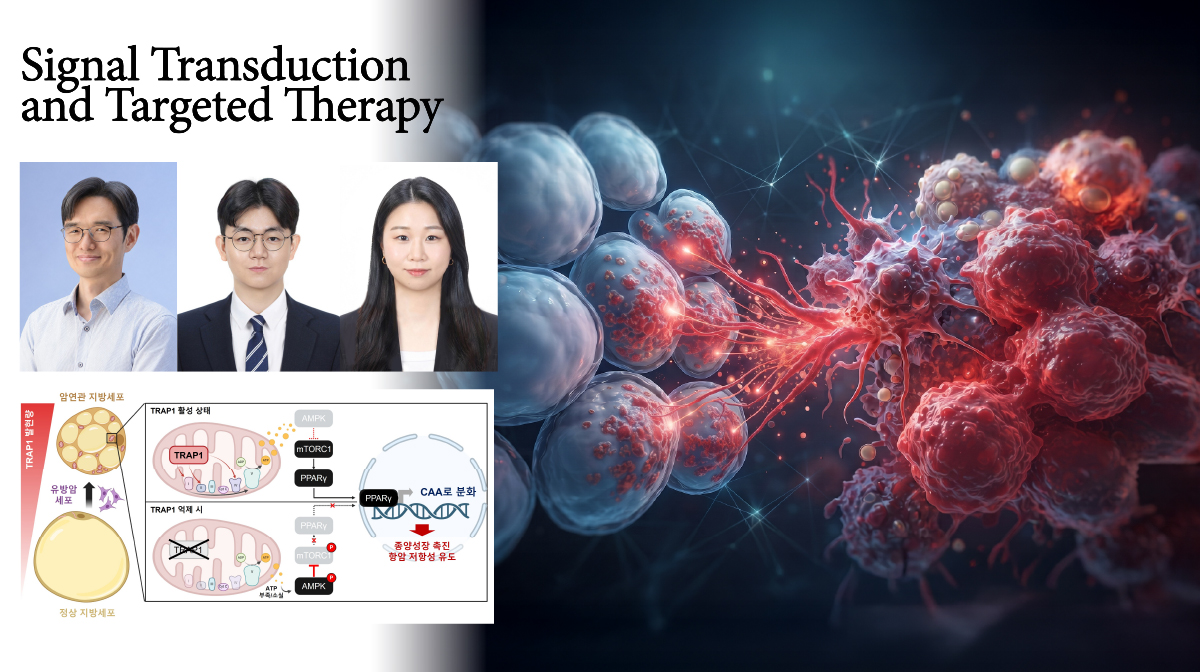
Breast tumors can reshape the fat cells around them, creating an environment that helps cancer cells survive and resist chemotherapy. Researchers at UNIST and the National Cancer Center (NCC) have identified a mitochondrial protein that helps drive this transformation—and shown in mice that blocking it can make tumors more responsive to treatment.
Led by Professor Byoung Heon Kang of the Department of Biological Sciences at UNIST and Professor Sun-Young Kong of NCC, the team found that TRAP1 plays a key role in converting normal fat cells into cancer-associated adipocytes (CAAs). These altered cell release factors that support tumor growth and protect cancer cells from chemotherapy.
The researchers found that TRAP1 sustains mitochondrial energy production in fat cells, keeping the mTOR–PPARγ pathway active and allowing them to acquire cancer-supporting properties. Blocking TRAP1 disrupts mitochondrial function and activates AMPK, an energy sensor that suppresses this transformation. In tissue samples from 31 patients with breast cancer, TRAP1 expression in fat surrounding tumors was 3.03 times higher than in normal adipose tissue.
The team also identified complement factor D (CFD) as an important link between the altered fat cells and cancer cells. CAAs secrete CFD, which activates survival signals in breast cancer cells and makes them less susceptible to chemotherapy. Blocking this TRAP1-driven communication reduced that protective effect.
In mice, genetically removing TRAP1 suppressed the transformation of adipocytes and reduced tumor weight by as much as 56% compared with controls. Drug-based inhibition produced similar results: combining the TRAP1 inhibitor gamitrinib with cisplatin reduced tumor weight by 76% compared with untreated mice. Another inhibitor, SB-U015, also enhanced the effects of cisplatin and paclitaxel without evident toxicity in the experimental models.
“Our study shows how adipocytes surrounding breast tumors can contribute to chemotherapy resistance,” said Professor Kong. “Further studies are needed to evaluate the clinical potential of TRAP1 inhibitors, not only for patients who respond poorly to existing treatments but also for cancers that develop in close contact with adipose tissue, including ovarian, pancreatic, and prostate cancers.”
Professor Kang added, “These findings suggest that the cells surrounding a tumor can be important therapeutic targets alongside the cancer cells themselves. By disrupting the metabolic changes in nearby adipocytes, we may be able to improve the effectiveness of existing anticancer drugs.”
Professor Kang has transferred the technology arising from the research to SmartinBio, a UNIST faculty startup, where further development of anticancer drug candidates is underway.
The study was co-first authored by Dr. Nam Gu Yoon and Dr. So-Yeon Kim of UNIST and published online in Signal Transduction and Targeted Therapy (STTT) on July 28, 2026. The research was supported by the National Research Foundation of Korea (NRF), the National Cancer Center, and the Korea Drug Development Fund (KDDF).
Journal Reference
Nam Gu Yoon, So-Yeon Kim, So-Youn Jung, et al ., “The pro-tumorigenic functions of cancer-associated adipocytes are dependent on the mitochondrial chaperone tumor necrosis factor receptor-associated protein 1,” STTT., (2026).
Related Links