UNIST site map
- Admissions
-
Academics
- Colleges and Schools
-
Academic Affairs
- Academic Calendar
- Academic Curriculum
- Requirements for Graduation
- Browse Open Courses
- Undergraduate Administration
-
Graduate Academic Affairs
- Tuition Fee Payment
- Academic Leave of Absence/ Academic Return
- Voluntary Withdrawal/ Expulsion
- Change of Major
- Change of Degree Program/ Dropping of Degree Program
- Class Period/ Attendance Period/ Academic Year・Semester
- Course Registration
- Course Drop
- Attendance/ Grade/ Exam
- Credit Transfer/ Credit Carryover
- Academic Forms
- Education Support
-
Research/Industry
- Research Aims
- Research Findings
- Researcher Search
-
Research Organizations
- UNIST Multi-Interdisciplinary Institute
- IBS Research Groups
-
UNIST Labs
- Department of Mechanical Engineering
- School of Energy and Chemical Engineering
- Department of Civil
- Department of Materials Science and Engineering
- Department of Nuclear Engineering
- Department of Industrial Engineering
- Department of Design
- Department of Biomedical Engineering
- Department of Biological Sciences
- Department of Electrical Engineering
- Department of Computer Science and Engineering
- Department of Mathematical Sciences
- Department of Chemistry
- Department of Physics
- School of Business Administration
- Graduate School of Carbon Neutrality
- Graduate School of Artificial Intelligence
- Research Support
- University-Industry Relations
- Campus Life
- News Center
- About UNIST
-
etc
- UNIST Bulletin
- Work-Life Balance Support System
- UNIST Gender Equality Plan
- Faculty Invitation for Tenure Track
- Faculty Invitation for Non-Tenure Track
- Board Meeting Minutes
- University Council Meeting Minutes
- Administrative Service Charter
- Privacy Policy
- Copyright Policy
- Rejection of Unauthorized Email Collection
- Operation and Management Policy for Video Information Processing Devices
- Information Disclosure


Connection Points of Knowledge, Everything About UNIST
Try searching.
Recommended search terms


- portal
- U Academics Innovation Center
- Leadership Center
- Dormitory
- Academic Information Center
- International Students Support
- Browse Open Courses
- Course Registration
- Graduation Requirements for Graduation
- Academic Leave of Absence/ Academic Return
- Military Service
- Certificate Issuance
- Academic Calendar
- Scholarships
- Campus Map
- Campus Life Guidebook
- Health Care Center
- Human Rights Center
- portal
- Job Opening
- Announcement for Bid
- UNIST AI Services
- UNIST Daycare Center
- Sports Center
- UI Downloads
- Announcement
- Recruitment of Professors (Non-tenure)
- Faculty Invitation for Tenure Track
- UNIST Academic Information Center
- Office of Research Facilities and Training
- Office of Research Affairs
- Rule Management System
- Academic Calendar


This is a collection of menus necessary for UNIST students .
students
- portal
- U Academics Innovation Center
- Leadership Center
- Dormitory
- Academic Information Center
- International Students Support
- Browse Open Courses
- Course Registration
- Graduation Requirements for Graduation
- Academic Leave of Absence/ Academic Return
- Military Service
- Certificate Issuance
- Academic Calendar
- Scholarships
- Campus Map
- Campus Life Guidebook
- Health Care Center
- Human Rights Center


This is a collection of menus necessary for prospective UNIST Students .
prospective Students


This is a collection of menus necessary for UNIST Faculty & Staff .
Faculty & Staff
- portal
- Job Opening
- Announcement for Bid
- UNIST AI Services
- UNIST Daycare Center
- Sports Center
- UI Downloads
- Announcement
- Recruitment of Professors (Non-tenure)
- Faculty Invitation for Tenure Track
- UNIST Academic Information Center
- Office of Research Facilities and Training
- Office of Research Affairs
- Rule Management System
- Academic Calendar


NEWS CENTER
Discover not only Research Findings and event news, but also the diverse facets of UNIST presented by reporters and writers.
News Center

UNIST News
Cold-Sensitive Epigenetic Pathway Regulates Heat Production in Fat
Their findings have been published online in Metabolism on July 1, 2026.
- Research
- JooHyeon Heo
- 2026.08.12
- 1163
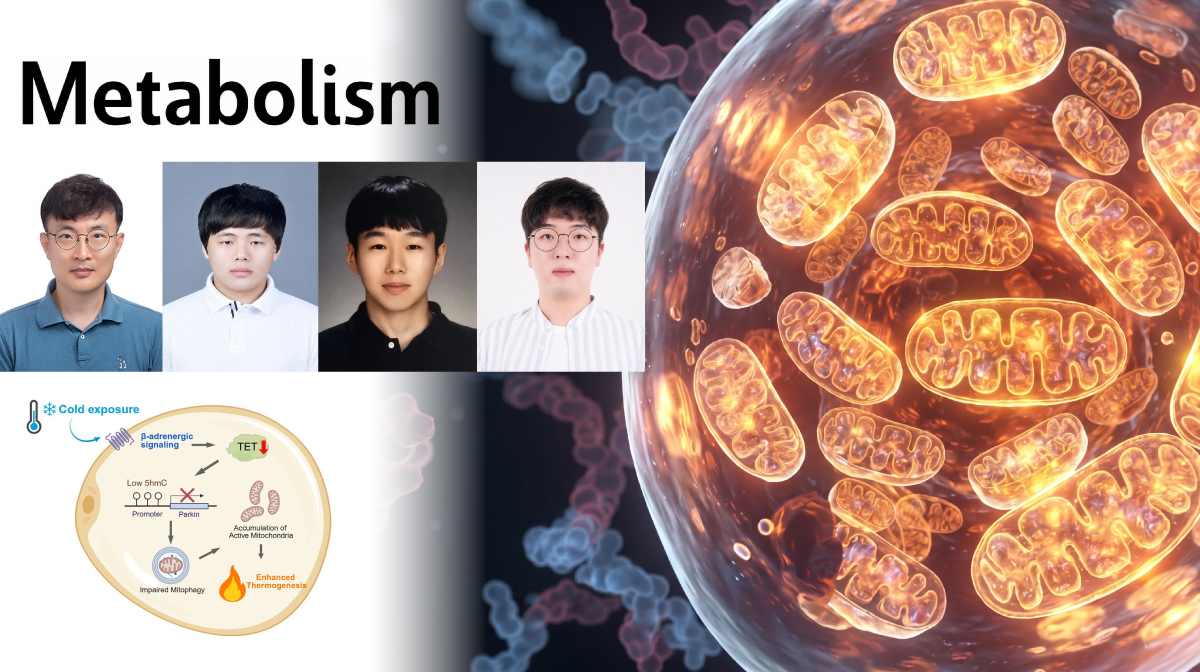
Abstract
Cold exposure prompts fat cells to burn more energy and generate heat. Researchers at UNIST have identified a molecular pathway that helps these cells retain more mitochondria, sustaining their heat-producing capacity.
Led by Professor Myunggon Ko of the Department of Biological Sciences at UNIST, the team found that TET proteins, a family of enzymes that regulate DNA modifications, control the expression of Parkin, a key protein involved in mitochondrial removal. When cold reduces TET levels in fat cells, Parkin levels also fall, allowing more metabolically active mitochondria to remain.
Published in the July 2026 issue of Metabolism , their findings reveal a previously unknown link between environmental temperature and mitochondrial quality control in adipose tissue.
White fat primarily stores excess energy, while brown fat burns energy to produce heat. Under cold conditions, some white fat cells can acquire heat-producing properties, becoming beige fat. This transition is accompanied by an increase in mitochondria, which supply the energy needed for heat production.
The researchers found that cold suppresses TET expression in both white and brown adipose tissue through β-adrenergic signaling. Levels of 5-hydroxymethylcytosine (5hmC)—a DNA modification associated with TET activity—also decline.
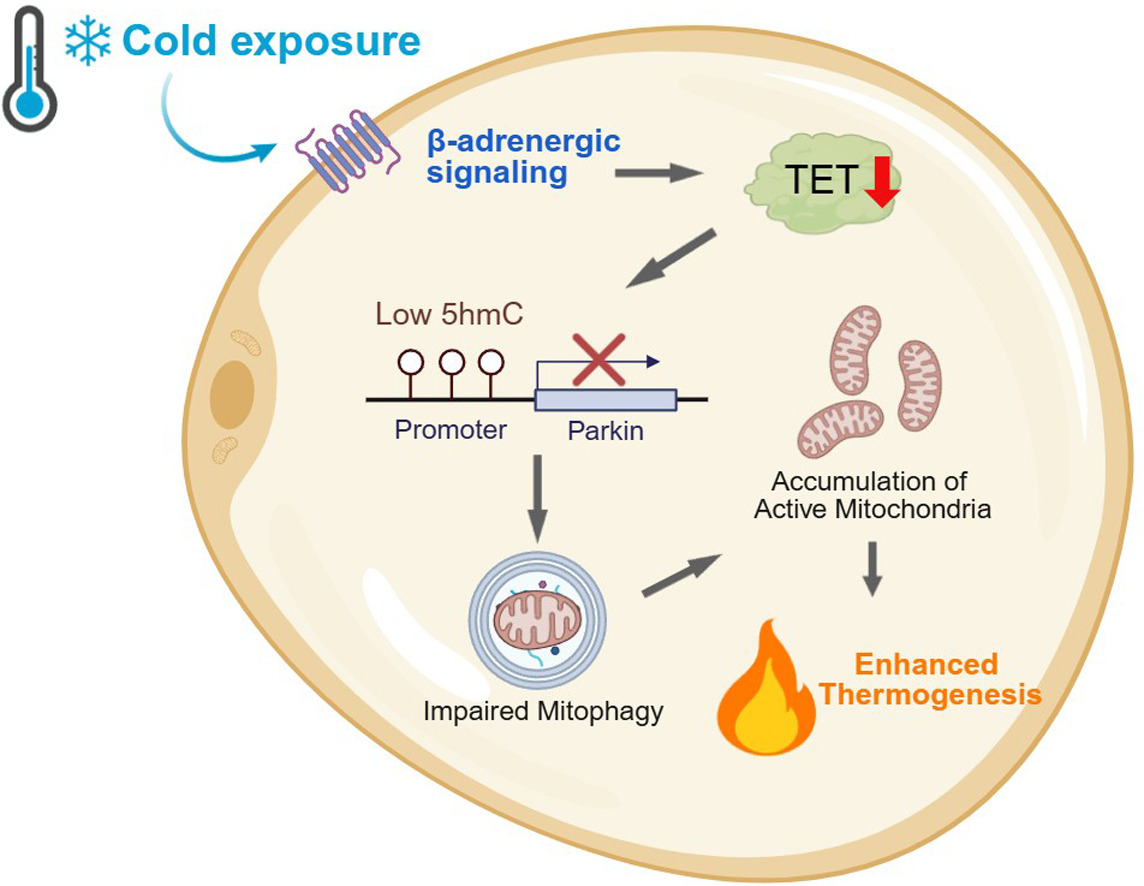
TET proteins normally act at the Prkn gene promoter, where they help maintain Parkin expression by converting 5-methylcytosine to 5hmC. When TET levels fall, methylation increases at the promoter and Parkin expression declines.
Parkin plays a central role in mitophagy, the process cells use to selectively remove mitochondria. With less Parkin available, mitophagy slows, allowing more mitochondria to accumulate in fat cells. The effect was evident in mice lacking all three TET proteins specifically in adipose tissue. Compared with control mice, they showed increased becoming of white fat, greater brown-fat activation, higher energy expenditure, and better tolerance to cold. Their adipose tissue also contained less Parkin, along with increased mitochondrial DNA and proteins involved in cellular respiration.
Cell-based experiments further confirmed Parkin's role in the pathway. Restoring functional Parkin in TET-deficient adipocytes largely returned mitochondrial abundance and oxygen consumption to normal levels, while a catalytically inactive form of Parkin did not. This showed that Parkin is a key link between TET activity and mitochondrial turnover.
“Cold-induced increases in mitochondria and thermogenesis in adipose tissue have been well documented, but the upstream mechanism controlling these changes has remained unclear,” said Professor Ko. “Our findings identify TET proteins as part of that regulatory system and reveal how changes in Parkin-mediated mitochondrial turnover contribute to the thermogenic response.”
Professor Ko added that understanding this pathway could inform future research into metabolic diseases such as obesity and type 2 diabetes, where increasing energy expenditure in adipose tissue has been explored as a potential therapeutic strategy.
The study was supported by the Ministry of Science and ICT (MSIT) and the National Research Foundation of Korea (NRF), among other funding sources.
Journal Reference
Seongjun Byun, Chan Hyeong Lee, Kyumin Jang, et al., “A thermosensitive TET–Parkin epigenetic axis couples mitochondrial quality control to adaptive thermogenesis in adipose tissue,” Metabolism, (2026).
Related Links
Related Photo