UNIST site map
- Admissions
-
Academics
- Colleges and Schools
-
Academic Affairs
- Academic Calendar
- Academic Curriculum
- Requirements for Graduation
- Browse Open Courses
- Undergraduate Administration
-
Graduate Academic Affairs
- Tuition Fee Payment
- Academic Leave of Absence/ Academic Return
- Voluntary Withdrawal/ Expulsion
- Change of Major
- Change of Degree Program/ Dropping of Degree Program
- Class Period/ Attendance Period/ Academic Year・Semester
- Course Registration
- Course Drop
- Attendance/ Grade/ Exam
- Credit Transfer/ Credit Carryover
- Academic Forms
- Education Support
-
Research/Industry
- Research Aims
- Research Findings
- Researcher Search
-
Research Organizations
- UNIST Multi-Interdisciplinary Institute
- IBS Research Groups
-
UNIST Labs
- Department of Mechanical Engineering
- School of Energy and Chemical Engineering
- Department of Civil
- Department of Materials Science and Engineering
- Department of Nuclear Engineering
- Department of Industrial Engineering
- Department of Design
- Department of Biomedical Engineering
- Department of Biological Sciences
- Department of Electrical Engineering
- Department of Computer Science and Engineering
- Department of Mathematical Sciences
- Department of Chemistry
- Department of Physics
- School of Business Administration
- Graduate School of Carbon Neutrality
- Graduate School of Artificial Intelligence
- Research Support
- University-Industry Relations
- Campus Life
- News Center
- About UNIST
-
etc
- UNIST Bulletin
- Work-Life Balance Support System
- UNIST Gender Equality Plan
- Faculty Invitation for Tenure Track
- Faculty Invitation for Non-Tenure Track
- Board Meeting Minutes
- University Council Meeting Minutes
- Administrative Service Charter
- Privacy Policy
- Copyright Policy
- Rejection of Unauthorized Email Collection
- Operation and Management Policy for Video Information Processing Devices
- Information Disclosure


Connection Points of Knowledge, Everything About UNIST
Try searching.
Recommended search terms


- portal
- U Academics Innovation Center
- Leadership Center
- Dormitory
- Academic Information Center
- International Students Support
- Browse Open Courses
- Course Registration
- Graduation Requirements for Graduation
- Academic Leave of Absence/ Academic Return
- Military Service
- Certificate Issuance
- Academic Calendar
- Scholarships
- Campus Map
- Campus Life Guidebook
- Health Care Center
- Human Rights Center
- portal
- Job Opening
- Announcement for Bid
- UNIST AI Services
- UNIST Daycare Center
- Sports Center
- UI Downloads
- Announcement
- Recruitment of Professors (Non-tenure)
- Faculty Invitation for Tenure Track
- UNIST Academic Information Center
- Office of Research Facilities and Training
- Office of Research Affairs
- Rule Management System
- Academic Calendar


This is a collection of menus necessary for UNIST students .
students
- portal
- U Academics Innovation Center
- Leadership Center
- Dormitory
- Academic Information Center
- International Students Support
- Browse Open Courses
- Course Registration
- Graduation Requirements for Graduation
- Academic Leave of Absence/ Academic Return
- Military Service
- Certificate Issuance
- Academic Calendar
- Scholarships
- Campus Map
- Campus Life Guidebook
- Health Care Center
- Human Rights Center


This is a collection of menus necessary for prospective UNIST Students .
prospective Students


This is a collection of menus necessary for UNIST Faculty & Staff .
Faculty & Staff
- portal
- Job Opening
- Announcement for Bid
- UNIST AI Services
- UNIST Daycare Center
- Sports Center
- UI Downloads
- Announcement
- Recruitment of Professors (Non-tenure)
- Faculty Invitation for Tenure Track
- UNIST Academic Information Center
- Office of Research Facilities and Training
- Office of Research Affairs
- Rule Management System
- Academic Calendar


NEWS CENTER
Discover not only Research Findings and event news, but also the diverse facets of UNIST presented by reporters and writers.
News Center

UNIST News
Beyond the Obvious
How looking closer led to this month's biggest discoveries.
- Research
- JooHyeon Heo
- 2026.08.01
- 6263

《Editor's Note: The biggest scientific advances do not always come from discovering something new. Sometimes, they begin by seeing familiar problems in a new light. This month's stories invite us to look beyond the obvious. Across artificial intelligence, semiconductor materials, nanotechnology, and biomedical science, UNIST researchers examined assumptions, structures, and interactions that can easily go unnoticed—but often determine how a system behaves. Their findings show how a deeper understanding of what is already there can open new directions for discovery.》
Questioning Assumptions
“The first answer is not always the right one.”
Scientific discovery often begins by asking whether the original question was complete. Several AI studies featured this month did just that, revisiting assumptions about how machines learn, forget, reason, and communicate.
In federated learning, researchers found that differences in camera viewpoints—not only privacy constraints or data distribution—can significantly affect how well AI models learn together. Another team showed that machine unlearning involves more than simply removing data: forgetting can unintentionally alter knowledge that should remain. Elsewhere, a new communication framework showed that effective cooperation among AI agents depends less on exchanging more information than on exchanging the right information.
Other studies reconsidered how AI systems reason across multiple views of the same scene and explored how quantum computing could reduce the cost of training robust AI models. Different problems, but a common starting point: questioning the assumptions built into them.
Together, these studies point to a simple lesson: better answers often begin with better questions.
■ Rethinking Federated Learning: Camera Viewpoints Matter (CVPR 2026)
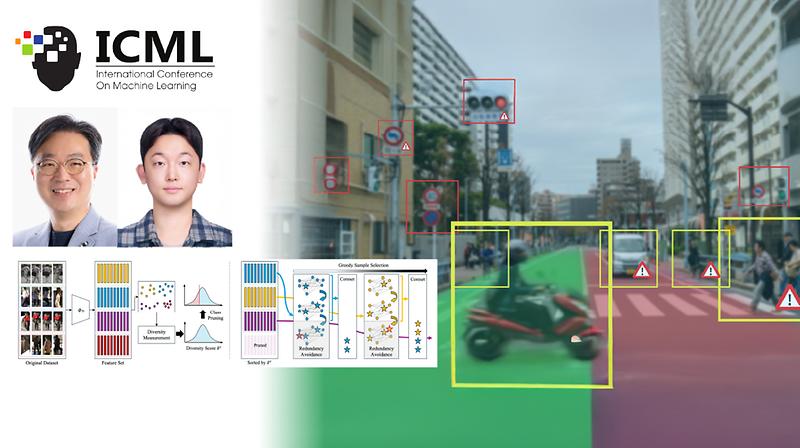
■ Making AI Forget—Without Losing What Matters (ICML 2026 )
■ Smarter Communication for Collaborative AI (ICML 2026)
■ Rethinking Multiview Reasoning (ICML 2026)
■ Quantum Algorithm Cuts the Cost of Training Robust AI (ICML 2026)
Looking Beneath the Surface
“The smallest details often hold the biggest clues.”
Across materials science, biology, nanotechnology, and semiconductor engineering, UNIST researchers examined structures and interactions that are easy to miss but can have an outsized influence on how materials, devices, and biological systems behave.
In semiconductor research, the spacing between neighboring atoms emerged as a critical factor in controlling material properties and device performance. At the nanoscale, researchers examined how the surface chemistry of quantum dots influences their behavior in imaging. Another study turned to microscopic wrinkles, showing how their geometry can reshape optical properties.
The same attention to underlying mechanisms extended to biology, where researchers found that familiar forms of cell death do not always follow the pathways scientists expect.
Together, these studies show how seemingly minor details—from atomic spacing and surface chemistry to microscopic geometry and cellular mechanisms—can fundamentally change our understanding of a system. Sometimes, the most consequential discoveries begin with something that was there all along, waiting to be examined more closely.
■ Atomic Precision for Better Semiconductors (Chem. Mater., 2026)
■ A New Perspective on QD Imaging (Nano Converg., 2026)
■ Wrinkles that Reshape Photonics (Adv. Funct. Mater., 2026)
■ When Cell Death Follows Different Rules (Cell Death Differ., 2026)
Across very different fields, these studies share a common instinct: question the assumption, examine the detail, and look again. What appears familiar can still hold unanswered questions. Looking beyond the obvious is not simply how these discoveries were made. It is how scientific discovery moves forward.
Explore the latest issue and follow 『The UNIST Brief』 on LinkedIn to stay updated.
Related Links