UNIST site map
- Admissions
-
Academics
- Colleges and Schools
-
Academic Affairs
- Academic Calendar
- Academic Curriculum
- Requirements for Graduation
- Browse Open Courses
- Undergraduate Administration
-
Graduate Academic Affairs
- Tuition Fee Payment
- Academic Leave of Absence/ Academic Return
- Voluntary Withdrawal/ Expulsion
- Change of Major
- Change of Degree Program/ Dropping of Degree Program
- Class Period/ Attendance Period/ Academic Year・Semester
- Course Registration
- Course Drop
- Attendance/ Grade/ Exam
- Credit Transfer/ Credit Carryover
- Academic Forms
- Education Support
-
Research/Industry
- Research Aims
- Research Findings
- Researcher Search
-
Research Organizations
- UNIST Multi-Interdisciplinary Institute
- IBS Research Groups
-
UNIST Labs
- Department of Mechanical Engineering
- School of Energy and Chemical Engineering
- Department of Civil
- Department of Materials Science and Engineering
- Department of Nuclear Engineering
- Department of Industrial Engineering
- Department of Design
- Department of Biomedical Engineering
- Department of Biological Sciences
- Department of Electrical Engineering
- Department of Computer Science and Engineering
- Department of Mathematical Sciences
- Department of Chemistry
- Department of Physics
- School of Business Administration
- Graduate School of Carbon Neutrality
- Graduate School of Artificial Intelligence
- Research Support
- University-Industry Relations
- Campus Life
- News Center
- About UNIST
-
etc
- UNIST Bulletin
- Work-Life Balance Support System
- UNIST Gender Equality Plan
- Faculty Invitation for Tenure Track
- Faculty Invitation for Non-Tenure Track
- Board Meeting Minutes
- University Council Meeting Minutes
- Administrative Service Charter
- Privacy Policy
- Copyright Policy
- Rejection of Unauthorized Email Collection
- Operation and Management Policy for Video Information Processing Devices
- Information Disclosure


Connection Points of Knowledge, Everything About UNIST
Try searching.
Recommended search terms


- portal
- U Academics Innovation Center
- Leadership Center
- Dormitory
- Academic Information Center
- International Students Support
- Browse Open Courses
- Course Registration
- Graduation Requirements for Graduation
- Academic Leave of Absence/ Academic Return
- Military Service
- Certificate Issuance
- Academic Calendar
- Scholarships
- Campus Map
- Campus Life Guidebook
- Health Care Center
- Human Rights Center
- portal
- Job Opening
- Announcement for Bid
- UNIST AI Services
- UNIST Daycare Center
- Sports Center
- UI Downloads
- Announcement
- Recruitment of Professors (Non-tenure)
- Faculty Invitation for Tenure Track
- UNIST Academic Information Center
- Office of Research Facilities and Training
- Office of Research Affairs
- Rule Management System
- Academic Calendar


This is a collection of menus necessary for UNIST students .
students
- portal
- U Academics Innovation Center
- Leadership Center
- Dormitory
- Academic Information Center
- International Students Support
- Browse Open Courses
- Course Registration
- Graduation Requirements for Graduation
- Academic Leave of Absence/ Academic Return
- Military Service
- Certificate Issuance
- Academic Calendar
- Scholarships
- Campus Map
- Campus Life Guidebook
- Health Care Center
- Human Rights Center


This is a collection of menus necessary for prospective UNIST Students .
prospective Students


This is a collection of menus necessary for UNIST Faculty & Staff .
Faculty & Staff
- portal
- Job Opening
- Announcement for Bid
- UNIST AI Services
- UNIST Daycare Center
- Sports Center
- UI Downloads
- Announcement
- Recruitment of Professors (Non-tenure)
- Faculty Invitation for Tenure Track
- UNIST Academic Information Center
- Office of Research Facilities and Training
- Office of Research Affairs
- Rule Management System
- Academic Calendar


NEWS CENTER
Discover not only Research Findings and event news, but also the diverse facets of UNIST presented by reporters and writers.
News Center

UNIST News
Adaptive Wireless Charging for Implantable Medical Devices
Their findings were published in IEEE TCAS-I on June 19, 2026.
- Research
- JooHyeon Heo
- 2026.08.11
- 1041
Abstract
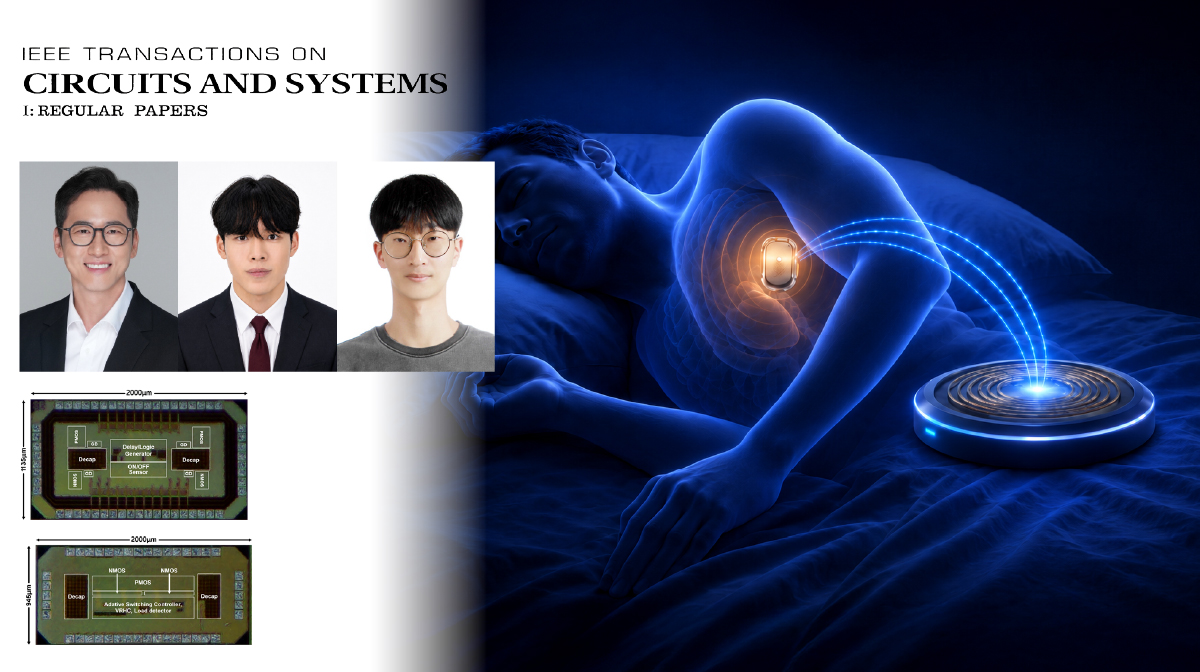
Implantable medical devices must continue operating reliably despite the body's constant movement—from walking and breathing to simply changing position during sleep. But those everyday movements can disrupt wireless charging by altering the alignment between the external charger and the implanted device.
Researchers at UNIST have developed a wireless power transfer system that adapts to changes in body movement and device power demand. By maintaining stable power delivery while reducing unnecessary energy loss and heat generation, the system could make long-term wireless powering of implantable medical devices more practical.
Many implantable medical devices alternate between active treatment and standby modes, causing their power requirements to change over time. At the same time, body movement can shift the distance or alignment between the transmitter and receiver coils, reducing wireless charging efficiency. Together, these challenges make it difficult to deliver stable power when and where it is needed.
Led by Professor Franklin Bien of the Department of Electrical Engineering, the team designed the system to distinguish changes in device power demand from changes in coil alignment caused by body movement. Rather than relying solely on signal strength, it detects characteristic changes in communication between the transmitter and receiver, allowing it to switch reliably between high- and low-power modes as charging conditions change.
The researchers also developed a new Voltage-Racing Hysteretic Controller (VRHC) to stabilize the receiver's output voltage. Instead of comparing voltages directly, the new controller detects voltage changes by measuring tiny differences in signal propagation time within the circuit. This allows it to respond more quickly and keep the output voltage remarkably stable.
In laboratory tests, the system remained stable across transmission distances ranging from 7 mm to 20 mm. Even when the implanted device's operating current increased sharply from 6 mA to 16 mA, it maintained a constant 3.3 V output with a voltage ripple of only 18 mV. The system achieved a peak end-to-end power transfer efficiency of 69.1%, representing an improvement of up to 51.3 percentage points over a comparable design without the adaptive mode-switching technology.
“Wireless charging systems need to adapt as conditions change, whether because a patient moves or a device's power demand shifts,” said Professor Bien. "By continuously adjusting power delivery in real time, our system improves both efficiency and stability. We hope it will help make implantable medical devices more practical for long-term use."
The study was co-first authored by Sungmin Shin and Seongbin Kwon of UNIST. The research was supported by the Ministry of Science and ICT (MSIT) and the Institute for Information & Communications Technology Planning & Evaluation (IITP), and published in IEEE Transactions on Circuits and Systems I: Regular Papers (IEEE TCAS-I) on June 19, 2026.
Journal Reference
Sungmin Shin, Seongbin Kwon, Kiju Lee, et al ., "A Wireless Power Transfer System With Adaptive Mode-Switching Insensitive to Coupling Variations Achieving Low Ripple and High Efficiency," IEEE TCAS-I, (2026).
Related Links





-
Smarter Design Method Improves Efficiency of In-Memory Computing Chips
-
Solution-Processed Semiconductor Enables High-Performance RF Switches for 6G and Satellite Communications
-
New Wearable Patch Combines Multimodal Sensing with On-Chip AI
-
New Semiconductor Device Brings Communication and AI Computing onto a Single Chip