UNIST site map
- Admissions
-
Academics
- Colleges and Schools
-
Academic Affairs
- Academic Calendar
- Academic Curriculum
- Requirements for Graduation
- Browse Open Courses
- Undergraduate Administration
-
Graduate Academic Affairs
- Tuition Fee Payment
- Academic Leave of Absence/ Academic Return
- Voluntary Withdrawal/ Expulsion
- Change of Major
- Change of Degree Program/ Dropping of Degree Program
- Class Period/ Attendance Period/ Academic Year・Semester
- Course Registration
- Course Drop
- Attendance/ Grade/ Exam
- Credit Transfer/ Credit Carryover
- Academic Forms
- Education Support
-
Research/Industry
- Research Aims
- Research Findings
- Researcher Search
-
Research Organizations
- UNIST Multi-Interdisciplinary Institute
- IBS Research Groups
-
UNIST Labs
- Department of Mechanical Engineering
- School of Energy and Chemical Engineering
- Department of Civil
- Department of Materials Science and Engineering
- Department of Nuclear Engineering
- Department of Industrial Engineering
- Department of Design
- Department of Biomedical Engineering
- Department of Biological Sciences
- Department of Electrical Engineering
- Department of Computer Science and Engineering
- Department of Mathematical Sciences
- Department of Chemistry
- Department of Physics
- School of Business Administration
- Graduate School of Carbon Neutrality
- Graduate School of Artificial Intelligence
- Research Support
- University-Industry Relations
- Campus Life
- News Center
- About UNIST
-
etc
- UNIST Bulletin
- Work-Life Balance Support System
- UNIST Gender Equality Plan
- Faculty Invitation for Tenure Track
- Faculty Invitation for Non-Tenure Track
- Board Meeting Minutes
- University Council Meeting Minutes
- Administrative Service Charter
- Privacy Policy
- Copyright Policy
- Rejection of Unauthorized Email Collection
- Operation and Management Policy for Video Information Processing Devices
- Information Disclosure


Connection Points of Knowledge, Everything About UNIST
Try searching.
Recommended search terms


- portal
- U Academics Innovation Center
- Leadership Center
- Dormitory
- Academic Information Center
- International Students Support
- Browse Open Courses
- Course Registration
- Graduation Requirements for Graduation
- Academic Leave of Absence/ Academic Return
- Military Service
- Certificate Issuance
- Academic Calendar
- Scholarships
- Campus Map
- Campus Life Guidebook
- Health Care Center
- Human Rights Center
- portal
- Job Opening
- Announcement for Bid
- UNIST AI Services
- UNIST Daycare Center
- Sports Center
- UI Downloads
- Announcement
- Recruitment of Professors (Non-tenure)
- Faculty Invitation for Tenure Track
- UNIST Academic Information Center
- Office of Research Facilities and Training
- Office of Research Affairs
- Rule Management System
- Academic Calendar


This is a collection of menus necessary for UNIST students .
students
- portal
- U Academics Innovation Center
- Leadership Center
- Dormitory
- Academic Information Center
- International Students Support
- Browse Open Courses
- Course Registration
- Graduation Requirements for Graduation
- Academic Leave of Absence/ Academic Return
- Military Service
- Certificate Issuance
- Academic Calendar
- Scholarships
- Campus Map
- Campus Life Guidebook
- Health Care Center
- Human Rights Center


This is a collection of menus necessary for prospective UNIST Students .
prospective Students


This is a collection of menus necessary for UNIST Faculty & Staff .
Faculty & Staff
- portal
- Job Opening
- Announcement for Bid
- UNIST AI Services
- UNIST Daycare Center
- Sports Center
- UI Downloads
- Announcement
- Recruitment of Professors (Non-tenure)
- Faculty Invitation for Tenure Track
- UNIST Academic Information Center
- Office of Research Facilities and Training
- Office of Research Affairs
- Rule Management System
- Academic Calendar


NEWS CENTER
Discover not only Research Findings and event news, but also the diverse facets of UNIST presented by reporters and writers.
News Center

UNIST News
Smarter Design Method Improves Efficiency of In-Memory Computing Chips
The findings were published online in IEEE TCAD on June 2, 2026.
- Research
- JooHyeon Heo
- 2026.08.06
- 3223
Abstract
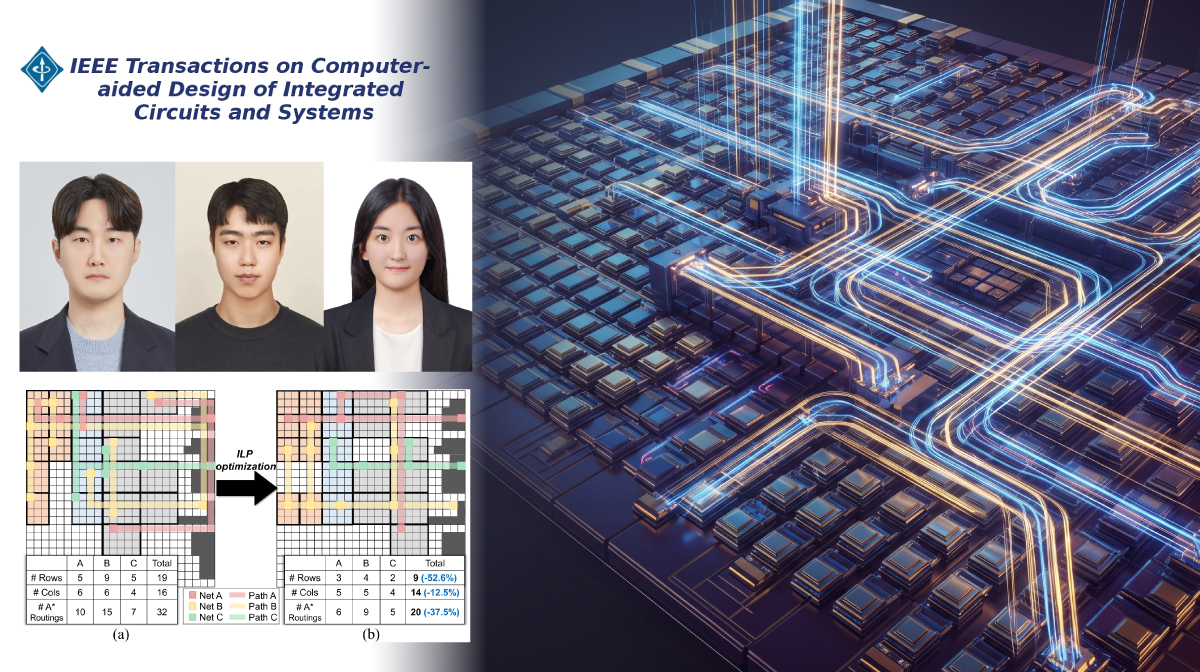
Modern computing is increasingly limited not by processing speed, but by the time and energy required to move data between memory and processors. Researchers at UNIST have developed an automated design framework that addresses this challenge by making logic-in-memory (LiM) chips more efficient.
Led by Professor Heechun Park of the Department of Electrical Engineering, the team designed a framework that automatically optimizes the placement of logic circuits and data pathways in memristor-based LiM architectures. By enabling more operations to run simultaneously while making better use of limited chip area, the approach reduced the number of computation cycles by nearly 20% compared with existing state-of-the-art methods.
Unlike conventional computer chips, LiM architectures perform computation directly where data are stored, reducing costly data movement between memory and processors. This approach helps overcome the memory wall where data transfer limits overall computing performance.
The framework determines where computations are performed within a memristor crossbar array and how intermediate results move to the next operation. Unlike previous approaches, it enables computations to proceed in both the horizontal and vertical directions, allowing more operations to run simultaneously while making better use of the available chip area.
The framework also reorganizes intermediate data during computation, freeing unused memory cells and reducing wasted space. It then identifies efficient routes for transferring intermediate results between computational blocks, preserving parallel execution even under tight area constraints.
In benchmark evaluations, chips designed using the new framework required 19.6% fewer computation cycles than those designed using existing approaches. The framework also successfully mapped every benchmark circuit, including designs that previous methods could not accommodate under the same area constraints, suggesting it can scale to larger LiM systems.
“The performance of LiM computing depends not only on the memory device itself, but also on how computations are organized within the array,” said Professor Park. "By arranging operations to maximize parallel execution, our framework improves efficiency while remaning practical under realistic area constraints."
The research was conducted by Ikkyum Kim and Minhong Kim as first and second authors, respectively, with Professor Heechun Park serving as the corresponding author. The findings were published online in IEEE Transactions on Computer-Aided Design of Integrated Circuits and Systems (IEEE TCAD) on June 2, 2026.
The research was supported by the National Research Foundation of Korea (NRF) and the Institute of Information & Communications Technology Planning & Evaluation (IITP). The EDA tool was supported by the IC Design Education Center (IDEC).
Journal Reference
Ikkyum Kim, Minhong Kim, and Heechun Park, “A Parallelism-Driven, Area-Aware Technology Mapping Framework for Memristive Logic-in-Memory,” IEEE TCAD , (2026).
Related Links





-
Adaptive Wireless Charging for Implantable Medical Devices
-
Solution-Processed Semiconductor Enables High-Performance RF Switches for 6G and Satellite Communications
-
New Wearable Patch Combines Multimodal Sensing with On-Chip AI
-
New Semiconductor Device Brings Communication and AI Computing onto a Single Chip