UNIST site map
- Admissions
-
Academics
- Colleges and Schools
-
Academic Affairs
- Academic Calendar
- Academic Curriculum
- Requirements for Graduation
- Browse Open Courses
- Undergraduate Administration
-
Graduate Academic Affairs
- Tuition Fee Payment
- Academic Leave of Absence/ Academic Return
- Voluntary Withdrawal/ Expulsion
- Change of Major
- Change of Degree Program/ Dropping of Degree Program
- Class Period/ Attendance Period/ Academic Year・Semester
- Course Registration
- Course Drop
- Attendance/ Grade/ Exam
- Credit Transfer/ Credit Carryover
- Academic Forms
- Education Support
-
Research/Industry
- Research Aims
- Research Findings
- Researcher Search
-
Research Organizations
- UNIST Multi-Interdisciplinary Institute
- IBS Research Groups
-
UNIST Labs
- Department of Mechanical Engineering
- School of Energy and Chemical Engineering
- Department of Civil
- Department of Materials Science and Engineering
- Department of Nuclear Engineering
- Department of Industrial Engineering
- Department of Design
- Department of Biomedical Engineering
- Department of Biological Sciences
- Department of Electrical Engineering
- Department of Computer Science and Engineering
- Department of Mathematical Sciences
- Department of Chemistry
- Department of Physics
- School of Business Administration
- Graduate School of Carbon Neutrality
- Graduate School of Artificial Intelligence
- Research Support
- University-Industry Relations
- Campus Life
- News Center
- About UNIST
-
etc
- UNIST Bulletin
- Work-Life Balance Support System
- UNIST Gender Equality Plan
- Faculty Invitation for Tenure Track
- Faculty Invitation for Non-Tenure Track
- Board Meeting Minutes
- University Council Meeting Minutes
- Administrative Service Charter
- Privacy Policy
- Copyright Policy
- Rejection of Unauthorized Email Collection
- Operation and Management Policy for Video Information Processing Devices
- Information Disclosure


Connection Points of Knowledge, Everything About UNIST
Try searching.
Recommended search terms


- portal
- U Academics Innovation Center
- Leadership Center
- Dormitory
- Academic Information Center
- International Students Support
- Browse Open Courses
- Course Registration
- Graduation Requirements for Graduation
- Academic Leave of Absence/ Academic Return
- Military Service
- Certificate Issuance
- Academic Calendar
- Scholarships
- Campus Map
- Campus Life Guidebook
- Health Care Center
- Human Rights Center
- portal
- Job Opening
- Announcement for Bid
- UNIST AI Services
- UNIST Daycare Center
- Sports Center
- UI Downloads
- Announcement
- Recruitment of Professors (Non-tenure)
- Faculty Invitation for Tenure Track
- UNIST Academic Information Center
- Office of Research Facilities and Training
- Office of Research Affairs
- Rule Management System
- Academic Calendar


This is a collection of menus necessary for UNIST students .
students
- portal
- U Academics Innovation Center
- Leadership Center
- Dormitory
- Academic Information Center
- International Students Support
- Browse Open Courses
- Course Registration
- Graduation Requirements for Graduation
- Academic Leave of Absence/ Academic Return
- Military Service
- Certificate Issuance
- Academic Calendar
- Scholarships
- Campus Map
- Campus Life Guidebook
- Health Care Center
- Human Rights Center


This is a collection of menus necessary for prospective UNIST Students .
prospective Students


This is a collection of menus necessary for UNIST Faculty & Staff .
Faculty & Staff
- portal
- Job Opening
- Announcement for Bid
- UNIST AI Services
- UNIST Daycare Center
- Sports Center
- UI Downloads
- Announcement
- Recruitment of Professors (Non-tenure)
- Faculty Invitation for Tenure Track
- UNIST Academic Information Center
- Office of Research Facilities and Training
- Office of Research Affairs
- Rule Management System
- Academic Calendar


NEWS CENTER
Discover not only Research Findings and event news, but also the diverse facets of UNIST presented by reporters and writers.
News Center

UNIST News
A New Way to Harness Hot Electrons
Published in Nat. Commun., the findings reveal a new pathway for using short-lived hot-electron energy in light-driven chemical reactions.
- Research
- JooHyeon Heo
- 2026.08.10
- 1409
Abstract
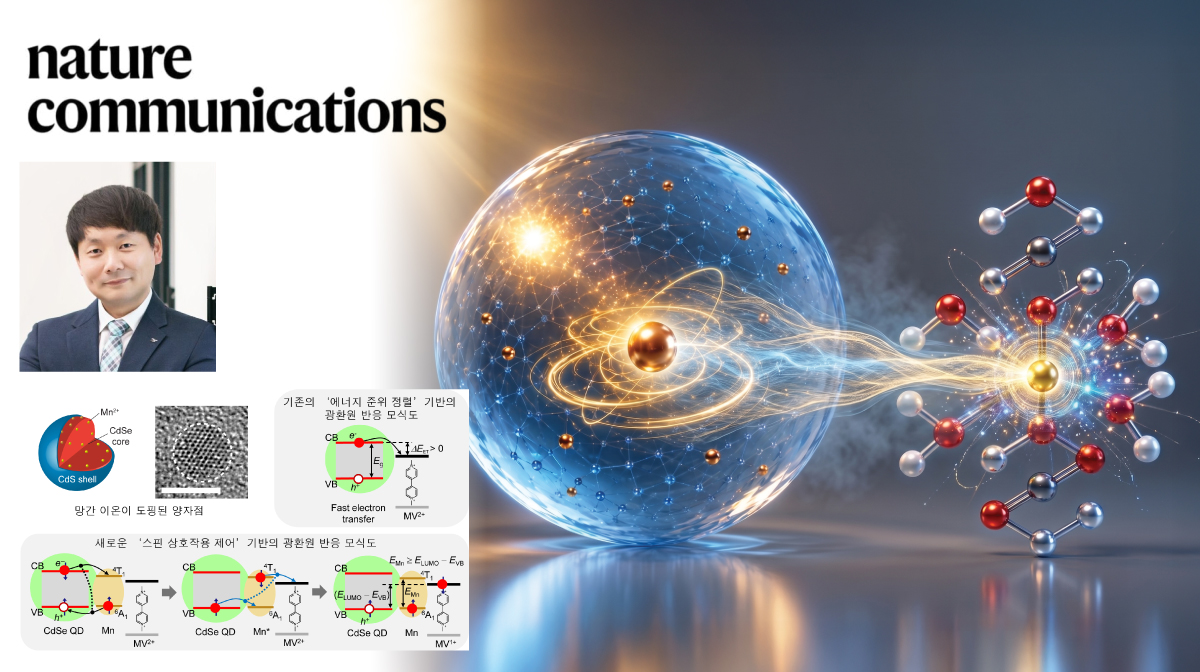
For decades, researchers have understood electron transfer in photocalysis through one guiding principle. Electrons move most readily when the energy levels of a semiconductor and a reacting molecule are well matched. Researchers at UNIST and Los Alamos National Laboratory (LANL) have demonstrated that spin interactions can provide an alternative pathway, allowing electron transfer even when conventional energy-level alignment is unfavorable.
Professor Ho Jin of the Department of Chemistry at UNIST, in collaboration with Dr. Victor I. Klimov of LANL, showed that manganese ions inside semiconductor quantum dots (QDs) create an ultrafast spin-exchange pathway that channels hot-electron energy into photoreduction reactions. The findings offer a new way to design photocatalysts that make better use of sunlight for hydrogen production and carbon dioxide conversion.
QDs readily transfer photoexcited electrons to nearby molecules, making them attractive materials for photocatalysis. Their most energetic electrons, however, lose excess energy almost immediately, leaving little time for useful chemical reactions to occur.
The team addressed this challenge by introducing magnetic manganese ions into cadmium selenide (CdSe) QDs. Before hot electrons could cool, the manganese ions captured their excess energy through ultrafast spin exchange. As the ions returned to their original spin state, that energy drove electrons into nearby molecules, triggering photoreduction reactions that would otherwise be difficult to achieve.
Using femtosecond transient absorption spectroscopy, the researchers followed the electron transfer process in real time. Compared with undoped QDs, manganese-doped particles transferred electrons to methyl viologen more than ten times faster, demonstrating that spin exchange provides an efficient pathway for charge transfer.
The team then asked whether the mechanism truly depended on hot-electron energy. When larger QDs were illuminated with higher-energy light, photoreduction readily occurred. Under lower-energy illumination, the reaction largely disappeared. Together, these experiments showed that manganese captures the excess energy of hot electrons before it is lost as heat.
“We have traditionally thought of energy-level alignment as the deciding factor in electron transfer,” said Professor Jin. “Our results show that spin exchange can provide an alternative pathway, giving us a new way to harness the energy of hot electrons for photocatalysis.”
Professor Ho Jin served as the first author of the study. Their findings were published in Nature Communications on June 26, 2026.
Journal Reference
Ho Jin, Valerio Pinchetti, Connor Orrison, et al., “Ultrafast photoreduction driven by interfacial spin exchange in manganese-doped quantum dots,” Nat. Commun., (2026).
Related Links