UNIST site map
- Admissions
-
Academics
- Colleges and Schools
-
Academic Affairs
- Academic Calendar
- Academic Curriculum
- Requirements for Graduation
- Browse Open Courses
- Undergraduate Administration
-
Graduate Academic Affairs
- Tuition Fee Payment
- Academic Leave of Absence/ Academic Return
- Voluntary Withdrawal/ Expulsion
- Change of Major
- Change of Degree Program/ Dropping of Degree Program
- Class Period/ Attendance Period/ Academic Year・Semester
- Course Registration
- Course Drop
- Attendance/ Grade/ Exam
- Credit Transfer/ Credit Carryover
- Academic Forms
- Education Support
-
Research/Industry
- Research Aims
- Research Findings
- Researcher Search
-
Research Organizations
- UNIST Multi-Interdisciplinary Institute
- IBS Research Groups
-
UNIST Labs
- Department of Mechanical Engineering
- School of Energy and Chemical Engineering
- Department of Civil
- Department of Materials Science and Engineering
- Department of Nuclear Engineering
- Department of Industrial Engineering
- Department of Design
- Department of Biomedical Engineering
- Department of Biological Sciences
- Department of Electrical Engineering
- Department of Computer Science and Engineering
- Department of Mathematical Sciences
- Department of Chemistry
- Department of Physics
- School of Business Administration
- Graduate School of Carbon Neutrality
- Graduate School of Artificial Intelligence
- Research Support
- University-Industry Relations
- Campus Life
- News Center
- About UNIST
-
etc
- UNIST Bulletin
- Work-Life Balance Support System
- UNIST Gender Equality Plan
- Faculty Invitation for Tenure Track
- Faculty Invitation for Non-Tenure Track
- Board Meeting Minutes
- University Council Meeting Minutes
- Administrative Service Charter
- Privacy Policy
- Copyright Policy
- Rejection of Unauthorized Email Collection
- Operation and Management Policy for Video Information Processing Devices
- Information Disclosure


Connection Points of Knowledge, Everything About UNIST
Try searching.
Recommended search terms


- portal
- U Academics Innovation Center
- Leadership Center
- Dormitory
- Academic Information Center
- International Students Support
- Browse Open Courses
- Course Registration
- Graduation Requirements for Graduation
- Academic Leave of Absence/ Academic Return
- Military Service
- Certificate Issuance
- Academic Calendar
- Scholarships
- Campus Map
- Campus Life Guidebook
- Health Care Center
- Human Rights Center
- portal
- Job Opening
- Announcement for Bid
- UNIST AI Services
- UNIST Daycare Center
- Sports Center
- UI Downloads
- Announcement
- Recruitment of Professors (Non-tenure)
- Faculty Invitation for Tenure Track
- UNIST Academic Information Center
- Office of Research Facilities and Training
- Office of Research Affairs
- Rule Management System
- Academic Calendar


This is a collection of menus necessary for UNIST students .
students
- portal
- U Academics Innovation Center
- Leadership Center
- Dormitory
- Academic Information Center
- International Students Support
- Browse Open Courses
- Course Registration
- Graduation Requirements for Graduation
- Academic Leave of Absence/ Academic Return
- Military Service
- Certificate Issuance
- Academic Calendar
- Scholarships
- Campus Map
- Campus Life Guidebook
- Health Care Center
- Human Rights Center


This is a collection of menus necessary for prospective UNIST Students .
prospective Students


This is a collection of menus necessary for UNIST Faculty & Staff .
Faculty & Staff
- portal
- Job Opening
- Announcement for Bid
- UNIST AI Services
- UNIST Daycare Center
- Sports Center
- UI Downloads
- Announcement
- Recruitment of Professors (Non-tenure)
- Faculty Invitation for Tenure Track
- UNIST Academic Information Center
- Office of Research Facilities and Training
- Office of Research Affairs
- Rule Management System
- Academic Calendar


NEWS CENTER
Discover not only Research Findings and event news, but also the diverse facets of UNIST presented by reporters and writers.
News Center

UNIST News
New Organic Photodetector Improves Polarized Near-Infrared Light Detection
Their findings have been published online in Advanced Science on June 28, 2026.
- Research
- JooHyeon Heo
- 2026.08.05
- 4142
Abstract
Near-infrared (NIR) circularly polarized light (CPL) carries information that conventional light cannot, making it valuable for applications ranging from autonomous vehicle sensors and bioimaging to optical security and advanced communications. Detecting this light accurately, however, has remained difficult because the organic semiconductor films used in these devices often lose the molecular order needed to distinguish different polarization states.
A research team, led by Professor BongSoo Kim of the Department of Chemistry at UNIST and Professor Joon Hak Oh of Seoul National University has found a way to overcome that limitation. By controlling how chiral organic semiconductor molecules organize within thin films, the researchers significantly improved the films' ability to distinguish between left- and right-handed CPL. When incorporated into a photodetector, the optimized films delivered what the team reports as the highest performance yet achieved for NIR CPL detection.
Unlike conventional light detectors, CPL can distinguish between two different polarization states of light. This additional information can reveal not only an object's shape but also properties, such as its surface composition or molecular structure, making the technology valuable for sensing and imaging applications.
The researchers achieved the improvement by applying a simple thermal annealing process to thin films made from fluorine-substituted chiral organic semiconductor molecules. Rather than remaining randomly arranged, the molecules reorganized into larger, more ordered crystal domains. This more ordered molecular arrangement strengthened the film's interaction with CPL.
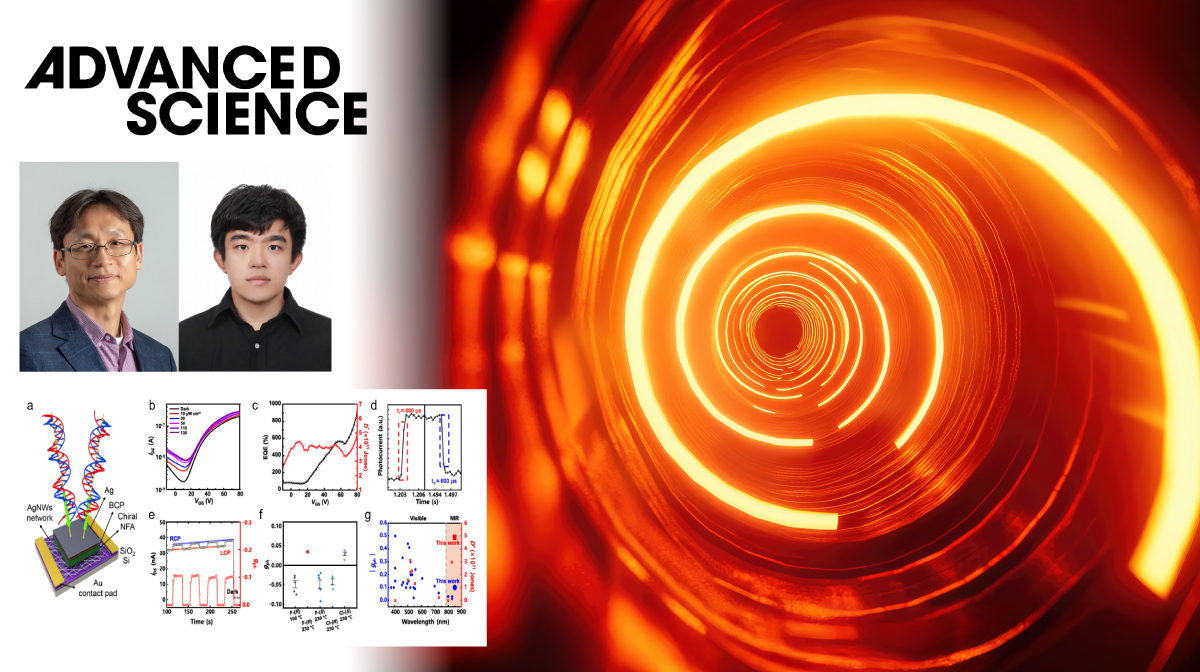
As a result, the film's ability to selectively absorb CPL increased more than threefold after annealing at 250°C, with its absorption dissymmetry factor rising from approximately 0.03 to 0.1. Structural analysis confirmed that the annealed films adopted a highly ordered molecular arrangement closely resembling that of single crystals.
The researchers also discovered an unexpected effect. As the molecular packing reorganized, the film reversed the polarization it preferentially absorbed, demonstrating that heat treatment could control not only the strength but also the handedness of the material's optical response. By comparison, similar films containing chlorine instead of fluorine showed little structural change above 150°C and exhibited lower polarization selectivity after annealing.
To turn these improved optical properties into measurable electrical signals, the team integrated the optimized films into a vertical organic transistor. The device architecture efficiently collected and amplified charges generated by incoming light, allowing the detector to fully capitalize on the improved molecular organization.
The resulting photodetector achieved a photocurrent dissymmetry factor of 0.1 at a wavelength of 850 nanometers, demonstrating excellent discrimination between left- and right-handed CPL. It also recorded a specific detectivity of 4.9 × 10¹¹ Jones, an external quantum efficiency of up to 909%, and a response time of less than 600 microseconds—the highest performance reported to date for NIR CPL detectors.
“We found that simply controlling how the molecules organize within a thin film can dramatically improve how the materials respond to CPL,” the research team said. “We hope this strategy will help advance next-generation optical sensors and imaging technologies that rely on precise light detection.”
Their findings were published online in Advanced Science on June 28, 2026. The research was supported by the National Research Foundation of Korea (NRF) and the Ministry of Science and ICT (MSIT).
Journal Reference
Jaeyong Ahn, Kwangmin Kim, Sangwook Lee, et al ., “Thermally Driven Supramolecular Chirality Evolution in Low-Bandgap Fused-Ring Conjugated Molecules for High-Performance NIR Circularly Polarized Light Detection,” Adv. Sci., (2026).
Related Links