UNIST site map
- Admissions
-
Academics
- Colleges and Schools
-
Academic Affairs
- Academic Calendar
- Academic Curriculum
- Requirements for Graduation
- Browse Open Courses
- Undergraduate Administration
-
Graduate Academic Affairs
- Tuition Fee Payment
- Academic Leave of Absence/ Academic Return
- Voluntary Withdrawal/ Expulsion
- Change of Major
- Change of Degree Program/ Dropping of Degree Program
- Class Period/ Attendance Period/ Academic Year・Semester
- Course Registration
- Course Drop
- Attendance/ Grade/ Exam
- Credit Transfer/ Credit Carryover
- Academic Forms
- Education Support
-
Research/Industry
- Research Aims
- Research Findings
- Researcher Search
-
Research Organizations
- UNIST Multi-Interdisciplinary Institute
- IBS Research Groups
-
UNIST Labs
- Department of Mechanical Engineering
- School of Energy and Chemical Engineering
- Department of Civil
- Department of Materials Science and Engineering
- Department of Nuclear Engineering
- Department of Industrial Engineering
- Department of Design
- Department of Biomedical Engineering
- Department of Biological Sciences
- Department of Electrical Engineering
- Department of Computer Science and Engineering
- Department of Mathematical Sciences
- Department of Chemistry
- Department of Physics
- School of Business Administration
- Graduate School of Carbon Neutrality
- Graduate School of Artificial Intelligence
- Research Support
- University-Industry Relations
- Campus Life
- News Center
- About UNIST
-
etc
- UNIST Bulletin
- Work-Life Balance Support System
- UNIST Gender Equality Plan
- Faculty Invitation for Tenure Track
- Faculty Invitation for Non-Tenure Track
- Board Meeting Minutes
- University Council Meeting Minutes
- Administrative Service Charter
- Privacy Policy
- Copyright Policy
- Rejection of Unauthorized Email Collection
- Operation and Management Policy for Video Information Processing Devices
- Information Disclosure


Connection Points of Knowledge, Everything About UNIST
Try searching.
Recommended search terms


- portal
- U Academics Innovation Center
- Leadership Center
- Dormitory
- Academic Information Center
- International Students Support
- Browse Open Courses
- Course Registration
- Graduation Requirements for Graduation
- Academic Leave of Absence/ Academic Return
- Military Service
- Certificate Issuance
- Academic Calendar
- Scholarships
- Campus Map
- Campus Life Guidebook
- Health Care Center
- Human Rights Center
- portal
- Job Opening
- Announcement for Bid
- UNIST AI Services
- UNIST Daycare Center
- Sports Center
- UI Downloads
- Announcement
- Recruitment of Professors (Non-tenure)
- Faculty Invitation for Tenure Track
- UNIST Academic Information Center
- Office of Research Facilities and Training
- Office of Research Affairs
- Rule Management System
- Academic Calendar


This is a collection of menus necessary for UNIST students .
students
- portal
- U Academics Innovation Center
- Leadership Center
- Dormitory
- Academic Information Center
- International Students Support
- Browse Open Courses
- Course Registration
- Graduation Requirements for Graduation
- Academic Leave of Absence/ Academic Return
- Military Service
- Certificate Issuance
- Academic Calendar
- Scholarships
- Campus Map
- Campus Life Guidebook
- Health Care Center
- Human Rights Center


This is a collection of menus necessary for prospective UNIST Students .
prospective Students


This is a collection of menus necessary for UNIST Faculty & Staff .
Faculty & Staff
- portal
- Job Opening
- Announcement for Bid
- UNIST AI Services
- UNIST Daycare Center
- Sports Center
- UI Downloads
- Announcement
- Recruitment of Professors (Non-tenure)
- Faculty Invitation for Tenure Track
- UNIST Academic Information Center
- Office of Research Facilities and Training
- Office of Research Affairs
- Rule Management System
- Academic Calendar


NEWS CENTER
Discover not only Research Findings and event news, but also the diverse facets of UNIST presented by reporters and writers.
News Center

UNIST News
Understanding What AI Models Have Learned
Accepted to ICML 2026, MVProbe identifies AI models from their learned parameters.
- Research
- JooHyeon Heo
- 2026.07.20
- 621
Abstract
Not every AI model comes with a manual. As open-source model repositories continue to grow, many checkpoints are shared with little information about how they were trained or what data they learned from. As a result, identifying suitable models for reuse—or tracing where they came from—is becoming increasingly difficult.
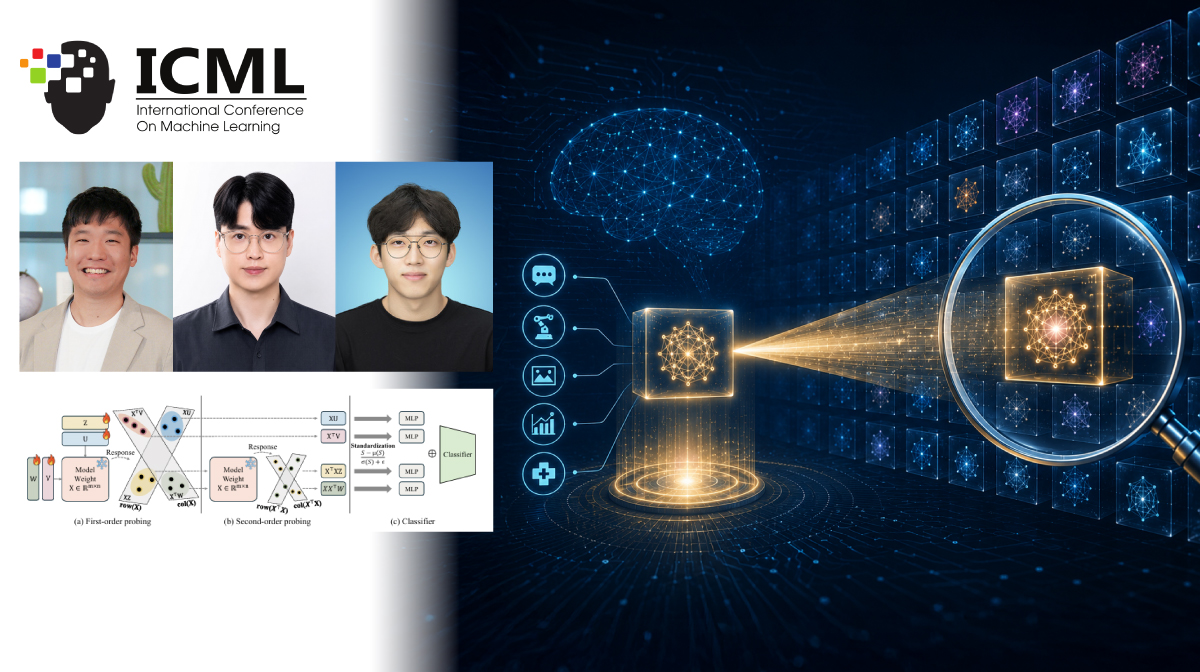
To address this challenge, Professor Jaejun Yoo and his team at the UNIST Graduate School of Artificial Intelligence developed MVProbe (Multi-view Probe), a method that identifies what an AI model has learned by analyzing its internal parameters alone, without relying on metadata or executing the model itself.
Conventional probing methods analyze model weights from only a single perspective, limiting their ability to distinguish between closely related models. MVProbe overcomes this limitation by examining neural network parameters from four complementary perspectives, capturing not only individual parameter values but also the relationships among them to build a more complete representation of a model.
The researchers also showed why existing probing methods struggle to distinguish similar models, demonstrating mathematically that important information embedded in model parameters is overlooked when weights are analyzed from only a single perspective. By integrating multiple complementary views, MVProbe overcomes this limitation while remaining reliable regardless of which neural network layer is analyzed.
The team evaluated MVProbe on the Model Jungle benchmark, a large collection of modern AI models spanning image recognition networks and large generative models. Across all evaluated architectures, the method consistently outperformed the previous state-of-the-art approach, improving identification accuracy by as much as 5.96 percentage points while maintaining stable performance across different network layers.
Beyond making large model repositories easier to search and organize, MVProbe could support a wide range of applications, including model reuse, provenance analysis, copyright verification, and AI security auditing—all without requiring models to be executed.
“As more pretrained AI models become publicly available, the ability to identify and reuse the right one is becoming increasingly important,” said Professor Yoo. "MVProbe makes it possible to search and manage large model repositories by reading the information already encoded in a model's parameters, without running the model itself."
The study was co-first authored by Eunwoo Heo and Kyungguk Seo of the UNIST Graduate School of Artificial Intelligence. It has been accepted for presentation at the International Conference on Machine Learning (ICML) 2026. This work was supported by the Institute for Information & Communications Technology Planning & Evaluation (IITP) and the National Research Foundation of Korea (NRF).
Journal Reference
Eunwoo Heo, Kyeongkook Seo, and Jaejun Yoo, "What Linear Probes Miss: Multi-View Probing for Weight-Space Learning,"
Related Links