UNIST site map
- Admissions
-
Academics
- Colleges and Schools
-
Academic Affairs
- Academic Calendar
- Academic Curriculum
- Requirements for Graduation
- Browse Open Courses
- Undergraduate Administration
-
Graduate Academic Affairs
- Tuition Fee Payment
- Academic Leave of Absence/ Academic Return
- Voluntary Withdrawal/ Expulsion
- Change of Major
- Change of Degree Program/ Dropping of Degree Program
- Class Period/ Attendance Period/ Academic Year・Semester
- Course Registration
- Course Drop
- Attendance/ Grade/ Exam
- Credit Transfer/ Credit Carryover
- Academic Forms
- Education Support
-
Research/Industry
- Research Aims
- Research Findings
- Researcher Search
-
Research Organizations
- UNIST Multi-Interdisciplinary Institute
- IBS Research Groups
-
UNIST Labs
- Department of Mechanical Engineering
- School of Energy and Chemical Engineering
- Department of Civil
- Department of Materials Science and Engineering
- Department of Nuclear Engineering
- Department of Industrial Engineering
- Department of Design
- Department of Biomedical Engineering
- Department of Biological Sciences
- Department of Electrical Engineering
- Department of Computer Science and Engineering
- Department of Mathematical Sciences
- Department of Chemistry
- Department of Physics
- School of Business Administration
- Graduate School of Carbon Neutrality
- Graduate School of Artificial Intelligence
- Research Support
- University-Industry Relations
- Campus Life
- News Center
- About UNIST
-
etc
- UNIST Bulletin
- Work-Life Balance Support System
- UNIST Gender Equality Plan
- Faculty Invitation for Tenure Track
- Faculty Invitation for Non-Tenure Track
- Board Meeting Minutes
- University Council Meeting Minutes
- Administrative Service Charter
- Privacy Policy
- Copyright Policy
- Rejection of Unauthorized Email Collection
- Operation and Management Policy for Video Information Processing Devices
- Information Disclosure


Connection Points of Knowledge, Everything About UNIST
Try searching.
Recommended search terms


- portal
- U Academics Innovation Center
- Leadership Center
- Dormitory
- Academic Information Center
- International Students Support
- Browse Open Courses
- Course Registration
- Graduation Requirements for Graduation
- Academic Leave of Absence/ Academic Return
- Military Service
- Certificate Issuance
- Academic Calendar
- Scholarships
- Campus Map
- Campus Life Guidebook
- Health Care Center
- Human Rights Center
- portal
- Job Opening
- Announcement for Bid
- UNIST AI Services
- UNIST Daycare Center
- Sports Center
- UI Downloads
- Announcement
- Recruitment of Professors (Non-tenure)
- Faculty Invitation for Tenure Track
- UNIST Academic Information Center
- Office of Research Facilities and Training
- Office of Research Affairs
- Rule Management System
- Academic Calendar


This is a collection of menus necessary for UNIST students .
students
- portal
- U Academics Innovation Center
- Leadership Center
- Dormitory
- Academic Information Center
- International Students Support
- Browse Open Courses
- Course Registration
- Graduation Requirements for Graduation
- Academic Leave of Absence/ Academic Return
- Military Service
- Certificate Issuance
- Academic Calendar
- Scholarships
- Campus Map
- Campus Life Guidebook
- Health Care Center
- Human Rights Center


This is a collection of menus necessary for prospective UNIST Students .
prospective Students


This is a collection of menus necessary for UNIST Faculty & Staff .
Faculty & Staff
- portal
- Job Opening
- Announcement for Bid
- UNIST AI Services
- UNIST Daycare Center
- Sports Center
- UI Downloads
- Announcement
- Recruitment of Professors (Non-tenure)
- Faculty Invitation for Tenure Track
- UNIST Academic Information Center
- Office of Research Facilities and Training
- Office of Research Affairs
- Rule Management System
- Academic Calendar


NEWS CENTER
Discover not only Research Findings and event news, but also the diverse facets of UNIST presented by reporters and writers.
News Center

UNIST News
New Wrinkle Architecture Broadens Optical Responses for Advanced Security Films
The findings were published in Advanced Functional Materials on June 25, 2026.
- Research
- JooHyeon Heo
- 2026.07.22
- 555
Abstract
Hidden optical images that appear only when a transparent film is bent could provide a new generation of anti-counterfeiting technologies. Researchers at UNIST have demonstrated a strategy for programming the microscopic wrinkle patterns responsible for structural color, enabling optical films with enhanced viewing-angle sensitivity and unique optical fingerprints.
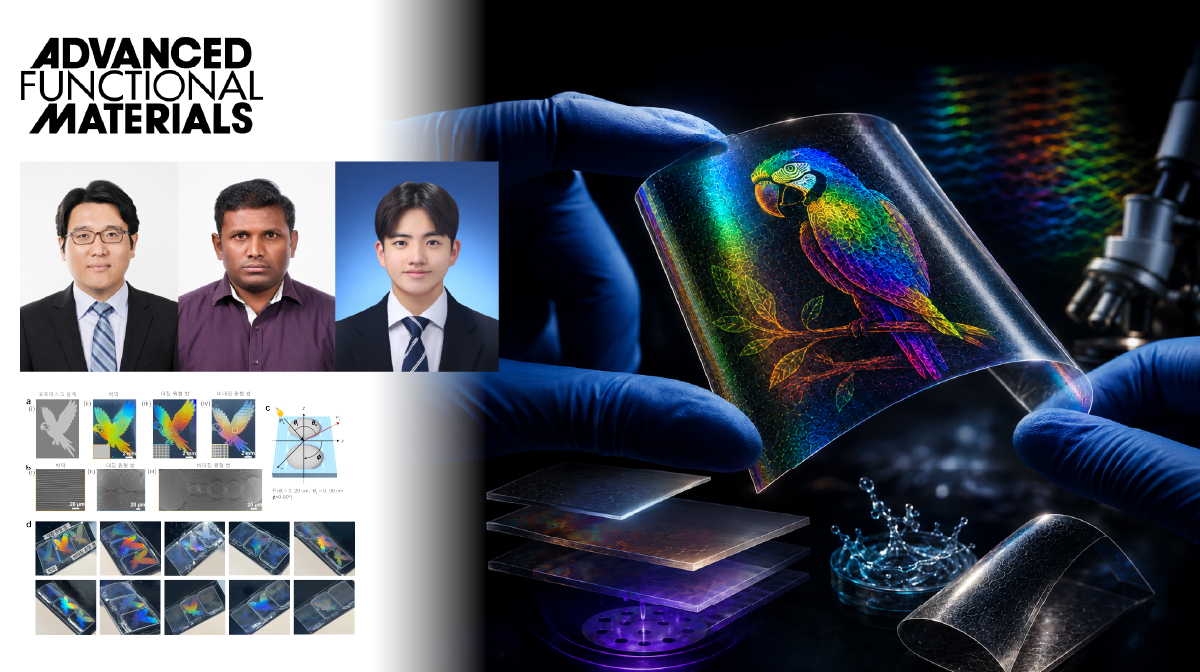
Led by Professor Taesung Kim of the Department of Mechanical Engineering, the researchers discovered that simple geometric patterns can precisely control how microscopic wrinkles form as the film bends. By reshaping local mechanical stresses, the patterned boundaries guide wrinkle growth into both straight and curved domains while preserving the regular spacing responsible for structural color. This independent control over wrinkle orientation expands the film's optical capabilities.
The enhanced wrinkle architecture translated directly into a broader optical response. The engineered films required only seven degrees of viewing-angle change to display the full visible color spectrum, compared with approximately thirty degrees for conventional wrinkle-based films. Distinct color changes also appeared with angular shifts as small as one degree, allowing substantially more optical information to be encoded within the same viewing range.
To demonstrate these capabilities, the team fabricated a transparent security film featuring a hidden macaw image that appeared only when the film was bent. Unlike conventional wrinkle-based security films, which are visible only over a narrow range of viewing angles, the new design maintains clear image visibility and vivid structural colors across viewing angles from 0° to 90°.
Each film also developed subtle variations in wrinkle branching, creating device-specific optical fingerprints that provide an additional layer of authentication beyond the visible security image. The films also showed excellent mechanical durability, maintaining stable wrinkle patterns and optical performance after 500 repeated bending cycles.
“Instead of treating wrinkles as an unavoidable mechanical instability, we showed that they can be programmed through geometric design,” said Professor Kim. “By controlling wrinkle orientation while preserving wrinkle periodicity, we significantly broadened the optical response of wrinkle-based structural color films.”
He added, "The approach could be applied to anti-counterfeiting technologies for banknotes, identification cards, luxury goods, and pharmaceutical packaging, while also providing a versatile platform for optical sensors and flexible display technologies."
The findings were published in Advanced Functional Materials on June 25, 2026. Dr. Kaliannan Thiyagarajan and Sungjoon Ji from UNIST served as co-first authors of the study. The research was supported by the National Research Foundation of Korea (NRF) and UNIST.
Journal Reference
Kaliannan Thiyagarajan, Sungjoon Ji, Jiseok Han, et al ., “Geometrically Programmed Wrinkle Architectonics for High Angle-Dependent Structural Coloration,” Adv. Funct. Mater. , (2026).
Related Links