UNIST site map
- Admissions
-
Academics
- Colleges and Schools
-
Academic Affairs
- Academic Calendar
- Academic Curriculum
- Requirements for Graduation
- Browse Open Courses
- Undergraduate Administration
-
Graduate Academic Affairs
- Tuition Fee Payment
- Academic Leave of Absence/ Academic Return
- Voluntary Withdrawal/ Expulsion
- Change of Major
- Change of Degree Program/ Dropping of Degree Program
- Class Period/ Attendance Period/ Academic Year・Semester
- Course Registration
- Course Drop
- Attendance/ Grade/ Exam
- Credit Transfer/ Credit Carryover
- Academic Forms
- Education Support
-
Research/Industry
- Research Aims
- Research Findings
- Researcher Search
-
Research Organizations
- UNIST Multi-Interdisciplinary Institute
- IBS Research Groups
-
UNIST Labs
- Department of Mechanical Engineering
- School of Energy and Chemical Engineering
- Department of Civil
- Department of Materials Science and Engineering
- Department of Nuclear Engineering
- Department of Industrial Engineering
- Department of Design
- Department of Biomedical Engineering
- Department of Biological Sciences
- Department of Electrical Engineering
- Department of Computer Science and Engineering
- Department of Mathematical Sciences
- Department of Chemistry
- Department of Physics
- School of Business Administration
- Graduate School of Carbon Neutrality
- Graduate School of Artificial Intelligence
- Research Support
- University-Industry Relations
- Campus Life
- News Center
- About UNIST
-
etc
- UNIST Bulletin
- Work-Life Balance Support System
- UNIST Gender Equality Plan
- Faculty Invitation for Tenure Track
- Faculty Invitation for Non-Tenure Track
- Board Meeting Minutes
- University Council Meeting Minutes
- Administrative Service Charter
- Privacy Policy
- Copyright Policy
- Rejection of Unauthorized Email Collection
- Operation and Management Policy for Video Information Processing Devices
- Information Disclosure


Connection Points of Knowledge, Everything About UNIST
Try searching.
Recommended search terms


- portal
- U Academics Innovation Center
- Leadership Center
- Dormitory
- Academic Information Center
- International Students Support
- Browse Open Courses
- Course Registration
- Graduation Requirements for Graduation
- Academic Leave of Absence/ Academic Return
- Military Service
- Certificate Issuance
- Academic Calendar
- Scholarships
- Campus Map
- Campus Life Guidebook
- Health Care Center
- Human Rights Center
- portal
- Job Opening
- Announcement for Bid
- UNIST AI Services
- UNIST Daycare Center
- Sports Center
- UI Downloads
- Announcement
- Recruitment of Professors (Non-tenure)
- Faculty Invitation for Tenure Track
- UNIST Academic Information Center
- Office of Research Facilities and Training
- Office of Research Affairs
- Rule Management System
- Academic Calendar


This is a collection of menus necessary for UNIST students .
students
- portal
- U Academics Innovation Center
- Leadership Center
- Dormitory
- Academic Information Center
- International Students Support
- Browse Open Courses
- Course Registration
- Graduation Requirements for Graduation
- Academic Leave of Absence/ Academic Return
- Military Service
- Certificate Issuance
- Academic Calendar
- Scholarships
- Campus Map
- Campus Life Guidebook
- Health Care Center
- Human Rights Center


This is a collection of menus necessary for prospective UNIST Students .
prospective Students


This is a collection of menus necessary for UNIST Faculty & Staff .
Faculty & Staff
- portal
- Job Opening
- Announcement for Bid
- UNIST AI Services
- UNIST Daycare Center
- Sports Center
- UI Downloads
- Announcement
- Recruitment of Professors (Non-tenure)
- Faculty Invitation for Tenure Track
- UNIST Academic Information Center
- Office of Research Facilities and Training
- Office of Research Affairs
- Rule Management System
- Academic Calendar


NEWS CENTER
Discover not only Research Findings and event news, but also the diverse facets of UNIST presented by reporters and writers.
News Center

UNIST News
Quantum Algorithm Cuts the Cost of Training Robust AI by 80%
Accepted to ICML 2026, the method accelerates one of the most computationally demanding steps in robust reinforcement learning.
- Research
- JooHyeon Heo
- 2026.07.21
- 650
Abstract
Artificial intelligence systems deployed in the real world must continue to make reliable decisions even when conditions differ from those encountered during training. Robust reinforcement learning (RRL) addresses this challenge by preparing AI agents for the worst-case scenarios they may face. However, identifying those worst-case conditions requires searching a large uncertainty space, making training increasingly expensive as the number of possible environmental variations grows.
To this bottleneck, Professor Sung Whan Yoon of the Graduate School of Artificial Intelligence at UNIST, in collaboration with Professor Joongheon Kim of Korea University, developed Quantum Robust Inner Minimization (QRIM), a method that replaces only the inner optimization responsible for identifying worst-case environments, while leaving the overall reinforcement learning pipeline unchanged.
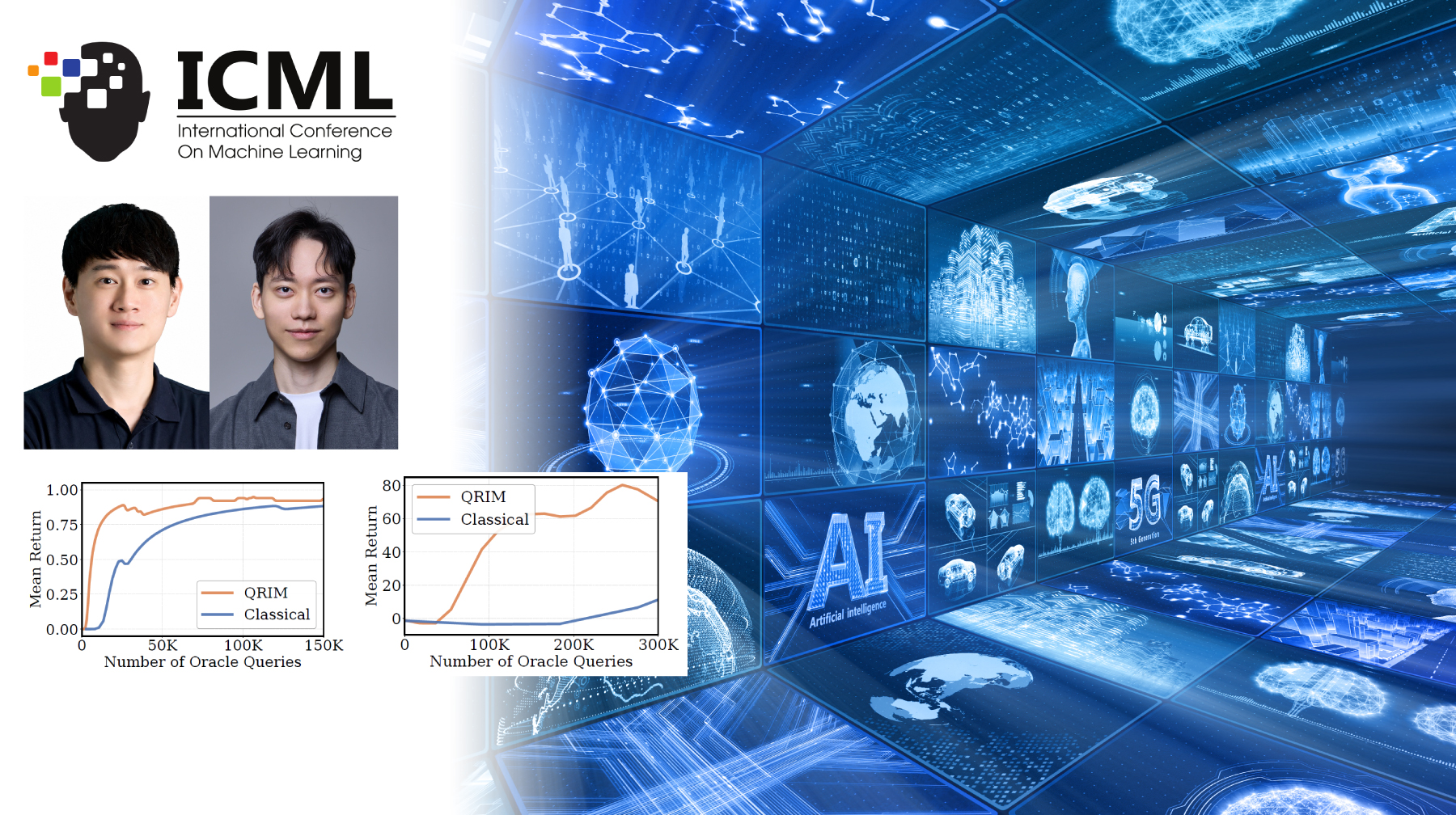
QRIM exploits quantum superposition to evaluate many possible environmental conditions simultaneously rather than examining each one individually. By amplifying the worst-case scenarios through a quantum search routine, the method reduces the number of required environment queries from N to √N—a quadratic improvement in query complexity—without modifying the surrounding reinforcement learning procedure.
Across a series of experiments, QRIM learned more robust policies while requiring only 20–30% of the computation used by conventional methods. The researchers validated the algorithm through both classical simulations and experiments on IBM's 127-qubit quantum processor, demonstrating that the quadratic speed-up remained effective even in the presence of hardware noise.
“QRIM redesigns the most computationally demanding component of RRL—the search for worst-case environments—using a quantum algorithm,” said first author Hyun Kyu Lee. "Because only the inner optimization is replaced, existing reinforcement learning algorithms can be readily incorporate the quantum module, making the approach broadly applicable across robust reinforcement learning."
“This study demonstrates how quantum computing can complement artificial intelligence by addressing a well-defined computational bottleneck,” said Professor Yoon. "As quantum hardware continues to advance, approaches like QRIM could help make RRL practical for applications that require reliable decision-making under uncertainty, including robotics and autonomous driving."
The findings have been accepted for presentation at the International Conference on Machine Learning (ICML) 2026, one of the world's leading conferences on machine learning. Among the quantum AI papers accepted to ICML 2026, QRIM is the only study led by a Korean research institution. The research was supported by the National Research Foundation of Korea (NRF) and the Institute for Information & Communications Technology Planning & Evaluation (IITP) through programs funded by the Ministry of Science and ICT (MSIT).
Journal Reference
Hyun Kyu Lee, Joongheon Kim, and Sung Whan Yoon, “Quantum Robust Inner Minimization for Reinforcement Learning with Quadratic Speed-Up in Query Complexity,” ICML, (2026) .
Related Links