UNIST site map
- Admissions
-
Academics
- Colleges and Schools
-
Academic Affairs
- Academic Calendar
- Academic Curriculum
- Requirements for Graduation
- Browse Open Courses
- Undergraduate Administration
-
Graduate Academic Affairs
- Tuition Fee Payment
- Academic Leave of Absence/ Academic Return
- Voluntary Withdrawal/ Expulsion
- Change of Major
- Change of Degree Program/ Dropping of Degree Program
- Class Period/ Attendance Period/ Academic Year・Semester
- Course Registration
- Course Drop
- Attendance/ Grade/ Exam
- Credit Transfer/ Credit Carryover
- Academic Forms
- Education Support
-
Research/Industry
- Research Aims
- Research Findings
- Researcher Search
-
Research Organizations
- UNIST Multi-Interdisciplinary Institute
- IBS Research Groups
-
UNIST Labs
- Department of Mechanical Engineering
- School of Energy and Chemical Engineering
- Department of Civil
- Department of Materials Science and Engineering
- Department of Nuclear Engineering
- Department of Industrial Engineering
- Department of Design
- Department of Biomedical Engineering
- Department of Biological Sciences
- Department of Electrical Engineering
- Department of Computer Science and Engineering
- Department of Mathematical Sciences
- Department of Chemistry
- Department of Physics
- School of Business Administration
- Graduate School of Carbon Neutrality
- Graduate School of Artificial Intelligence
- Research Support
- University-Industry Relations
- Campus Life
- News Center
- About UNIST
-
etc
- UNIST Bulletin
- Work-Life Balance Support System
- UNIST Gender Equality Plan
- Faculty Invitation for Tenure Track
- Faculty Invitation for Non-Tenure Track
- Board Meeting Minutes
- University Council Meeting Minutes
- Administrative Service Charter
- Privacy Policy
- Copyright Policy
- Rejection of Unauthorized Email Collection
- Operation and Management Policy for Video Information Processing Devices
- Information Disclosure


Connection Points of Knowledge, Everything About UNIST
Try searching.
Recommended search terms


- portal
- U Academics Innovation Center
- Leadership Center
- Dormitory
- Academic Information Center
- International Students Support
- Browse Open Courses
- Course Registration
- Graduation Requirements for Graduation
- Academic Leave of Absence/ Academic Return
- Military Service
- Certificate Issuance
- Academic Calendar
- Scholarships
- Campus Map
- Campus Life Guidebook
- Health Care Center
- Human Rights Center
- portal
- Job Opening
- Announcement for Bid
- UNIST AI Services
- UNIST Daycare Center
- Sports Center
- UI Downloads
- Announcement
- Recruitment of Professors (Non-tenure)
- Faculty Invitation for Tenure Track
- UNIST Academic Information Center
- Office of Research Facilities and Training
- Office of Research Affairs
- Rule Management System
- Academic Calendar


This is a collection of menus necessary for UNIST students .
students
- portal
- U Academics Innovation Center
- Leadership Center
- Dormitory
- Academic Information Center
- International Students Support
- Browse Open Courses
- Course Registration
- Graduation Requirements for Graduation
- Academic Leave of Absence/ Academic Return
- Military Service
- Certificate Issuance
- Academic Calendar
- Scholarships
- Campus Map
- Campus Life Guidebook
- Health Care Center
- Human Rights Center


This is a collection of menus necessary for prospective UNIST Students .
prospective Students


This is a collection of menus necessary for UNIST Faculty & Staff .
Faculty & Staff
- portal
- Job Opening
- Announcement for Bid
- UNIST AI Services
- UNIST Daycare Center
- Sports Center
- UI Downloads
- Announcement
- Recruitment of Professors (Non-tenure)
- Faculty Invitation for Tenure Track
- UNIST Academic Information Center
- Office of Research Facilities and Training
- Office of Research Affairs
- Rule Management System
- Academic Calendar


NEWS CENTER
Discover not only Research Findings and event news, but also the diverse facets of UNIST presented by reporters and writers.
News Center

UNIST News
Game-Changing Interface Coating Enables Scalable, High-Efficiency Perovskite/Silicon Solar Cells
Their findings have been published in Nature Photonics on June 1, 2026.
- Research
- JooHyeon Heo
- 2026.06.18
- 1994

Abstract
UNIST, in collaboration with King Abdullah University of Science and Technology (KAUST), has developed a groundbreaking coating that unlocks large-scale, ambient-condition production of high-performance perovskite/silicon tandem solar cells.
Led by Distinguished Professor Sang Il Seok of the School of Energy and Chemical Engineering and Professor Kyoung Jin Choi of the Department of Materials Science and Engineering, the team engineered a three-component interface layer that ensures uniform coverage and reduces defects during fabrication. This innovation allows the production of tandem cells outside of costly, sealed environments—an essential step toward commercialization.
The resulting devices achieved a certified efficiency of 31.36%, with peak performance reaching 31.72%. Remarkably, they maintained over 92% of their initial efficiency after 600 hours in oxygen-rich, high-temperature conditions, and over 90% after 1,000 hours under continuous illumination—all without encapsulation.
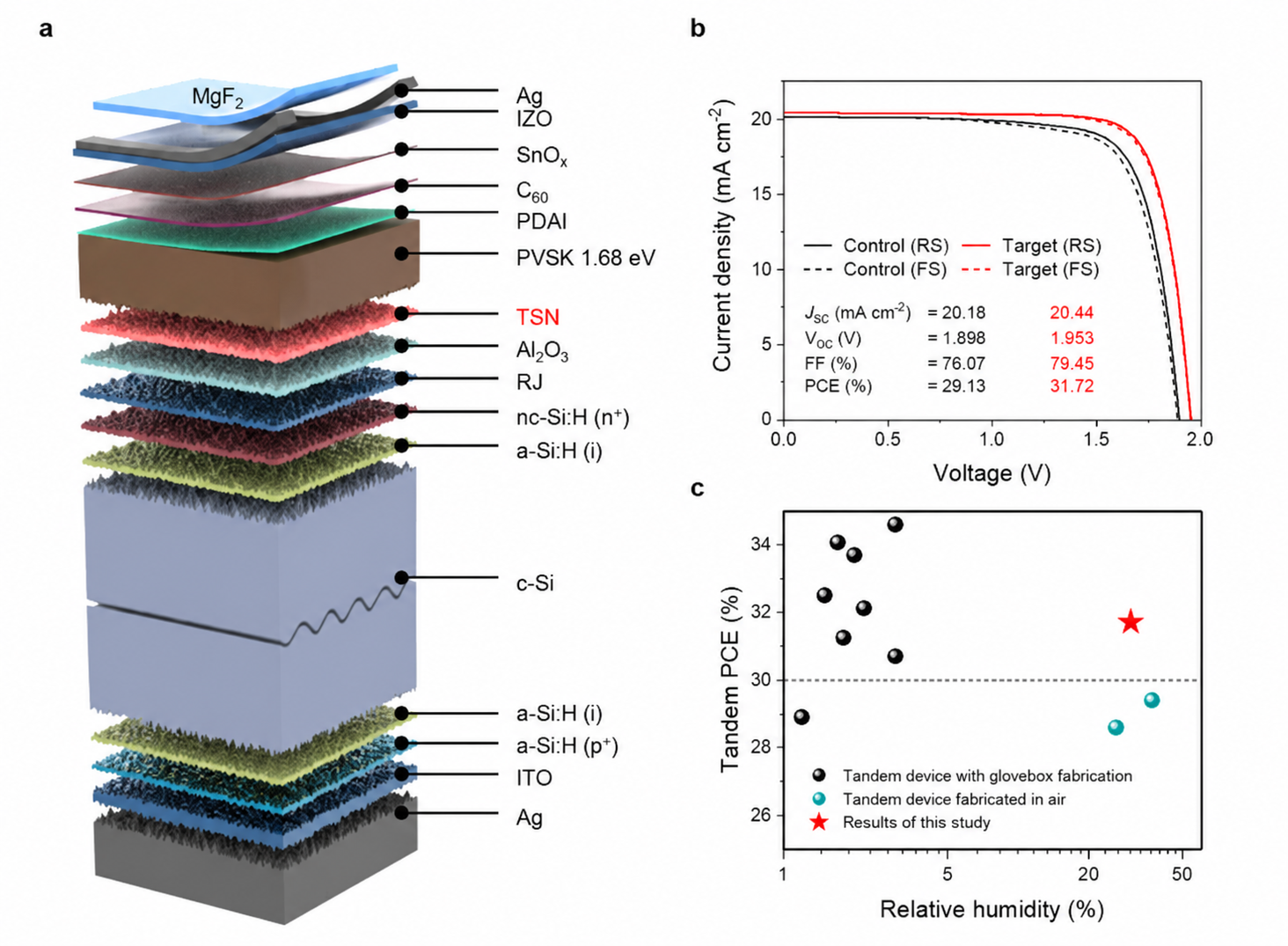
This technology not only delivers record efficiencies but also simplifies manufacturing, drastically reducing costs and enabling large-area production in standard environments. It paves the way for affordable, high-efficiency solar solutions that can be deployed at scale.
The research team includes Gwisu Kim and Young Im Noh from UNIST, and Adi Prasetio from KAUST as first co-authors. The corresponding authors are Professors Sang Il Seok and Kyoung Jin Choi from UNIST, and Professor Stefaan De Wolf from KAUST. Contributions also came from researchers from the Chinese University of Hong Kong, Shenzhen (CUHKSZ) and Forschungszentrum Jülich GmbH (FZJ) in Germany.
Professor Choi states, “Our findings align with the K-Moonshot Project, a national initiative focused on developing ultra-high-efficiency multi-junction solar cells, which brings us closer to realizing practical and affordable solar energy.” Professor Seok adds, “Demonstrating stability and high efficiency in open air indicates that the technology is ready for industrial-scale production.”
Published in Nature Photonics on June 1, this breakthrough was supported by Hyundai Motor Company, the National Research Foundation of Korea (NRF), the Ministry of Science, and ICT (MSIT), the Korea Energy Technology Evaluation and Planning Agency (KETEP), and the Ministry of Trade, Industry and Energy (MOTIE).
Journal Reference
Gwisu Kim, Adi Prasetio, Young Im Noh, et al., “Ternary self-assembled molecular contact for ambient-processed perovskite/silicon tandem solar cells,” Nat. Photon. , (2026).
Related Links
Related Photo



-
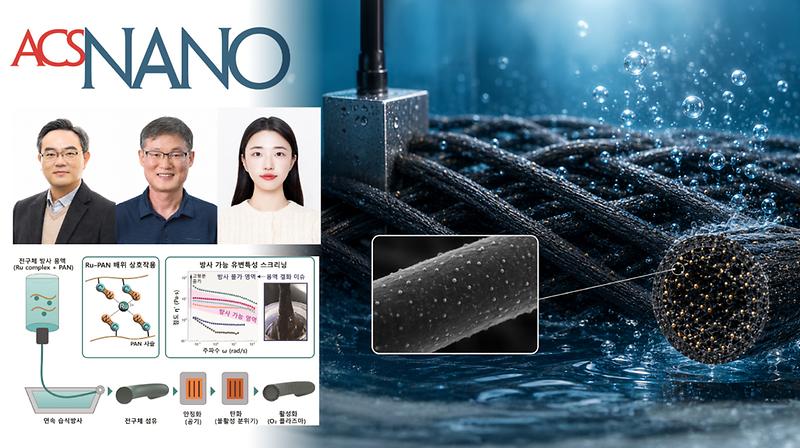
Roll-to-Roll Manufacturing of Ruthenium-Loaded Carbon Fiber Electrodes for Efficient Hydrogen Production
-
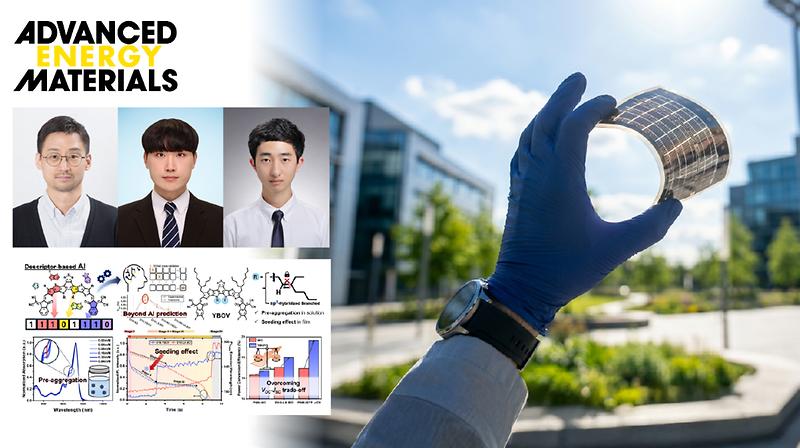
New Research Reveals High-Performance Organic Solar Cells Surpassing AI Predictions
-
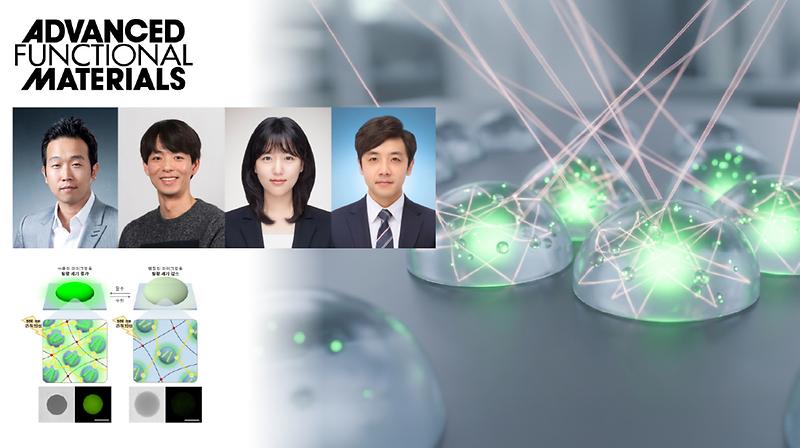
New Study Unveils Water-Responsive Luminescent Material
-
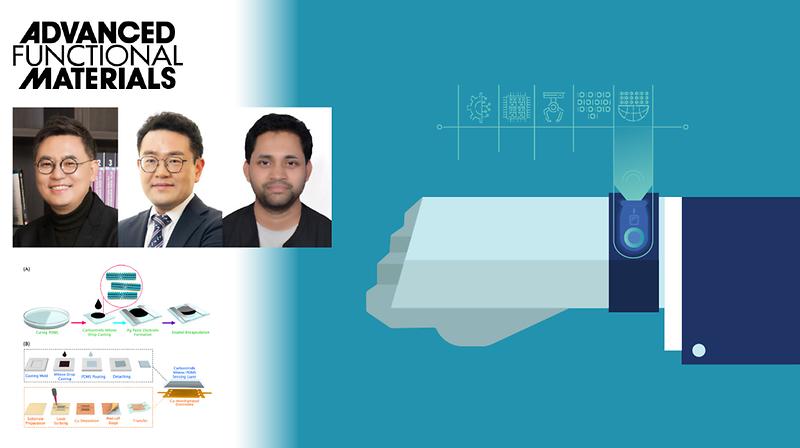
Ultra-Sensitive Wearable MXene Sensor for Real-Time Human-Machine Interfaces