UNIST site map
- Admissions
-
Academics
- Colleges and Schools
-
Academic Affairs
- Academic Calendar
- Academic Curriculum
- Requirements for Graduation
- Browse Open Courses
- Undergraduate Administration
-
Graduate Academic Affairs
- Tuition Fee Payment
- Academic Leave of Absence/ Academic Return
- Voluntary Withdrawal/ Expulsion
- Change of Major
- Change of Degree Program/ Dropping of Degree Program
- Class Period/ Attendance Period/ Academic Year・Semester
- Course Registration
- Course Drop
- Attendance/ Grade/ Exam
- Credit Transfer/ Credit Carryover
- Academic Forms
- Education Support
-
Research/Industry
- Research Aims
- Research Findings
- Researcher Search
-
Research Organizations
- UNIST Multi-Interdisciplinary Institute
- IBS Research Groups
-
UNIST Labs
- Department of Mechanical Engineering
- School of Energy and Chemical Engineering
- Department of Civil
- Department of Materials Science and Engineering
- Department of Nuclear Engineering
- Department of Industrial Engineering
- Department of Design
- Department of Biomedical Engineering
- Department of Biological Sciences
- Department of Electrical Engineering
- Department of Computer Science and Engineering
- Department of Mathematical Sciences
- Department of Chemistry
- Department of Physics
- School of Business Administration
- Graduate School of Carbon Neutrality
- Graduate School of Artificial Intelligence
- Research Support
- University-Industry Relations
- Campus Life
- News Center
- About UNIST
-
etc
- UNIST Bulletin
- Work-Life Balance Support System
- UNIST Gender Equality Plan
- Faculty Invitation for Tenure Track
- Faculty Invitation for Non-Tenure Track
- Board Meeting Minutes
- University Council Meeting Minutes
- Administrative Service Charter
- Privacy Policy
- Copyright Policy
- Rejection of Unauthorized Email Collection
- Operation and Management Policy for Video Information Processing Devices
- Information Disclosure


Connection Points of Knowledge, Everything About UNIST
Try searching.
Recommended search terms


- portal
- U Academics Innovation Center
- Leadership Center
- Dormitory
- Academic Information Center
- International Students Support
- Browse Open Courses
- Course Registration
- Graduation Requirements for Graduation
- Academic Leave of Absence/ Academic Return
- Military Service
- Certificate Issuance
- Academic Calendar
- Scholarships
- Campus Map
- Campus Life Guidebook
- Health Care Center
- Human Rights Center
- portal
- Job Opening
- Announcement for Bid
- UNIST AI Services
- UNIST Daycare Center
- Sports Center
- UI Downloads
- Announcement
- Recruitment of Professors (Non-tenure)
- Faculty Invitation for Tenure Track
- UNIST Academic Information Center
- Office of Research Facilities and Training
- Office of Research Affairs
- Rule Management System
- Academic Calendar


This is a collection of menus necessary for UNIST students .
students
- portal
- U Academics Innovation Center
- Leadership Center
- Dormitory
- Academic Information Center
- International Students Support
- Browse Open Courses
- Course Registration
- Graduation Requirements for Graduation
- Academic Leave of Absence/ Academic Return
- Military Service
- Certificate Issuance
- Academic Calendar
- Scholarships
- Campus Map
- Campus Life Guidebook
- Health Care Center
- Human Rights Center


This is a collection of menus necessary for prospective UNIST Students .
prospective Students


This is a collection of menus necessary for UNIST Faculty & Staff .
Faculty & Staff
- portal
- Job Opening
- Announcement for Bid
- UNIST AI Services
- UNIST Daycare Center
- Sports Center
- UI Downloads
- Announcement
- Recruitment of Professors (Non-tenure)
- Faculty Invitation for Tenure Track
- UNIST Academic Information Center
- Office of Research Facilities and Training
- Office of Research Affairs
- Rule Management System
- Academic Calendar


NEWS CENTER
Discover not only Research Findings and event news, but also the diverse facets of UNIST presented by reporters and writers.
News Center

UNIST News
Novel Network Analysis Algorithm for Targeted Community Detection Without Full Data Access
Accepted at SIGMOD 2026, this work offers precise group detection around individuals, with key applications in marketing, fraud detection, and biological research.
- Research
- JooHyeon Heo
- 2026.06.05
- 207
Abstract
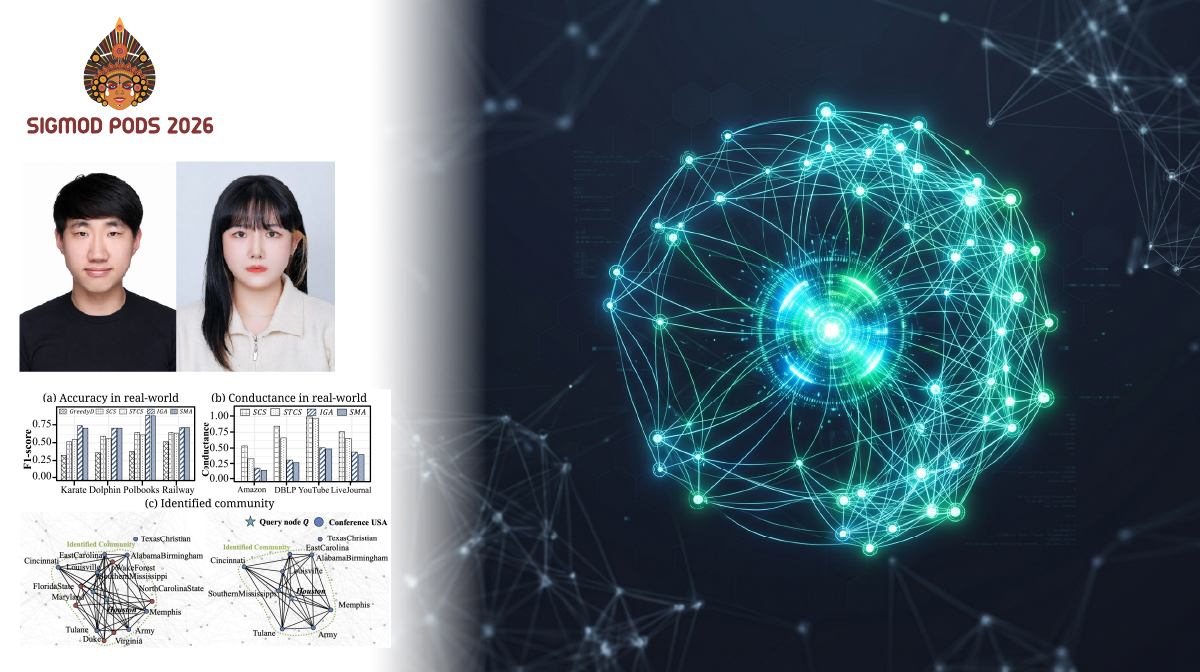
A research team led by Professor JungHoon Kim from the Department of Computer Science and Engineering at UNIST has introduced an innovative network analysis algorithm capable of identifying relevant communities around a target node without requiring access to the entire network. This advancement has the potential to enhance targeted marketing, improve fraud detection, and generate new insights in biological network research.
Traditional community detection tools often struggle with large-scale data or are limited by privacy restrictions that prevent access to full network information. They tend to include unrelated nodes or overlook tightly connected groups around a specific target. The new method addresses these challenges by focusing solely on the neighborhood of a designated node, expanding the community incrementally while adhering to a predefined size.
Starting from the target node—such as a potential customer, a suspicious account, or a biological molecule—the algorithm examines neighboring candidates and assesses whether adding each one improves the overall coherence of the group. It balances internal connectivity with external separation, preventing the community from becoming excessively large. To capture subtle relationships, it also considers small, tightly linked subgroups that might otherwise be missed.
Testing on real-world networks shows this approach significantly outperforms existing methods, with F1 scores up to 1.39 times higher and ARI scores up to 5.95 times higher. These results demonstrate more accurate detection of relevant communities while reducing false positives.
“In many real-world situations, obtaining full network data isn't feasible, and the target community size is often fixed,” said Professor Kim. “Our method quickly identifies meaningful groups around a specific node, making it applicable to areas like customer segmentation, fraud prevention, and biological research.”
Supported by the National Research Foundation of Korea (NRF), the study was led by first author Dahee Kim. Their work has been accepted for presentation at the ACM Special Interest Group on Management of Data (SIGMOD) 2026, scheduled to take place in Bengaluru, India, from May 31 to June 5, 2026. As one of the most respected conferences in data management, SIGMOD offers a platform for pioneering research in the field.
Journal Reference
Dahee Kim, Taejoon Han, Kaiyu Feng, et al., "LMSC: Local Sketch Modularity Optimization for Size-Constrained Community Search in Networks,"'26 SIGMOD, (2026).
Related Links