UNIST site map
- Admissions
-
Academics
- Colleges and Schools
-
Academic Affairs
- Academic Calendar
- Academic Curriculum
- Requirements for Graduation
- Browse Open Courses
- Undergraduate Administration
-
Graduate Academic Affairs
- Tuition Fee Payment
- Academic Leave of Absence/ Academic Return
- Voluntary Withdrawal/ Expulsion
- Change of Major
- Change of Degree Program/ Dropping of Degree Program
- Class Period/ Attendance Period/ Academic Year・Semester
- Course Registration
- Course Drop
- Attendance/ Grade/ Exam
- Credit Transfer/ Credit Carryover
- Academic Forms
- Education Support
-
Research/Industry
- Research Aims
- Research Findings
- Researcher Search
-
Research Organizations
- UNIST Multi-Interdisciplinary Institute
- IBS Research Groups
-
UNIST Labs
- Department of Mechanical Engineering
- School of Energy and Chemical Engineering
- Department of Civil
- Department of Materials Science and Engineering
- Department of Nuclear Engineering
- Department of Industrial Engineering
- Department of Design
- Department of Biomedical Engineering
- Department of Biological Sciences
- Department of Electrical Engineering
- Department of Computer Science and Engineering
- Department of Mathematical Sciences
- Department of Chemistry
- Department of Physics
- School of Business Administration
- Graduate School of Carbon Neutrality
- Graduate School of Artificial Intelligence
- Research Support
- University-Industry Relations
- Campus Life
- News Center
- About UNIST
-
etc
- UNIST Bulletin
- Work-Life Balance Support System
- UNIST Gender Equality Plan
- Faculty Invitation for Tenure Track
- Faculty Invitation for Non-Tenure Track
- Board Meeting Minutes
- University Council Meeting Minutes
- Administrative Service Charter
- Privacy Policy
- Copyright Policy
- Rejection of Unauthorized Email Collection
- Operation and Management Policy for Video Information Processing Devices
- Information Disclosure


Connection Points of Knowledge, Everything About UNIST
Try searching.
Recommended search terms


- portal
- U Academics Innovation Center
- Leadership Center
- Dormitory
- Academic Information Center
- International Students Support
- Browse Open Courses
- Course Registration
- Graduation Requirements for Graduation
- Academic Leave of Absence/ Academic Return
- Military Service
- Certificate Issuance
- Academic Calendar
- Scholarships
- Campus Map
- Campus Life Guidebook
- Health Care Center
- Human Rights Center
- portal
- Job Opening
- Announcement for Bid
- UNIST AI Services
- UNIST Daycare Center
- Sports Center
- UI Downloads
- Announcement
- Recruitment of Professors (Non-tenure)
- Faculty Invitation for Tenure Track
- UNIST Academic Information Center
- Office of Research Facilities and Training
- Office of Research Affairs
- Rule Management System
- Academic Calendar


This is a collection of menus necessary for UNIST students .
students
- portal
- U Academics Innovation Center
- Leadership Center
- Dormitory
- Academic Information Center
- International Students Support
- Browse Open Courses
- Course Registration
- Graduation Requirements for Graduation
- Academic Leave of Absence/ Academic Return
- Military Service
- Certificate Issuance
- Academic Calendar
- Scholarships
- Campus Map
- Campus Life Guidebook
- Health Care Center
- Human Rights Center


This is a collection of menus necessary for prospective UNIST Students .
prospective Students


This is a collection of menus necessary for UNIST Faculty & Staff .
Faculty & Staff
- portal
- Job Opening
- Announcement for Bid
- UNIST AI Services
- UNIST Daycare Center
- Sports Center
- UI Downloads
- Announcement
- Recruitment of Professors (Non-tenure)
- Faculty Invitation for Tenure Track
- UNIST Academic Information Center
- Office of Research Facilities and Training
- Office of Research Affairs
- Rule Management System
- Academic Calendar


NEWS CENTER
Discover not only Research Findings and event news, but also the diverse facets of UNIST presented by reporters and writers.
News Center

UNIST News
AI-Driven Satellite Detects Methane—84 Times More Potent Than CO2—Faster and More Precise
Their findings were published in npj Climate and Atmospheric Science on March 25, 2026.
- Research
- JooHyeon Heo
- 2026.06.01
- 166
Abstract
Methane (CH4) is a powerful greenhouse gas—84 times more potent than carbon dioxide over 20 years. Quickly identifying leaks is crucial, but current methods rely on slow, manual analysis of satellite images. Researchers at UNIST have created an AI-based system that automates methane plume detection, making monitoring faster and more precise.
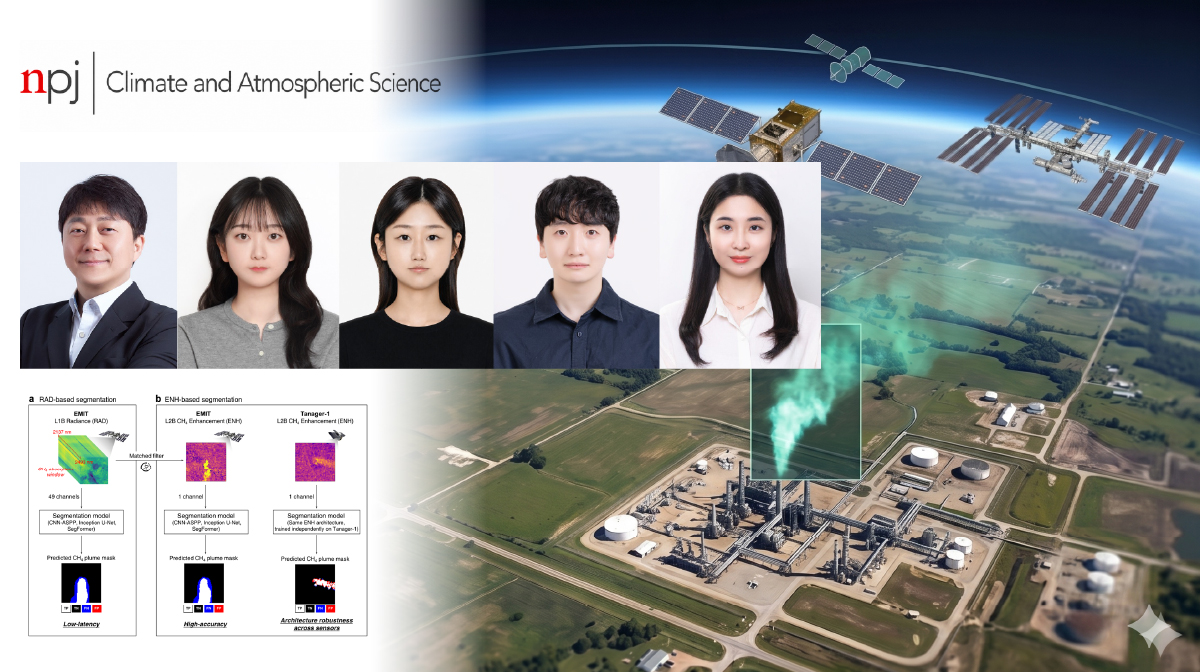
Led by Professor Jungho Im from the Department of Civil, Urban, Earth, and Environmental Engineering, the team built a deep learning model to identify methane leaks in satellite imagery. They tested different data types and modeling techniques to determine the most effective approach for global deployment.
Hyperspectral satellites capture reflected sunlight across hundreds of narrow wavelengths, revealing detailed surface information. The team trained their models on data from NASA's EMIT satellite, which orbits the International Space Station. The models detect methane by recognizing specific infrared wavelengths absorbed by the gas—clear indicators of leaks.
The system successfully identified methane emissions from diverse sources, including oil and gas facilities, waste sites, and coal mines across regions such as Turkmenistan, Algeria, and the US The analysis revealed that the AI system does not merely recognize visual patterns; It interprets physical signals such as absorption features and plume shapes consistent with real-world physics.
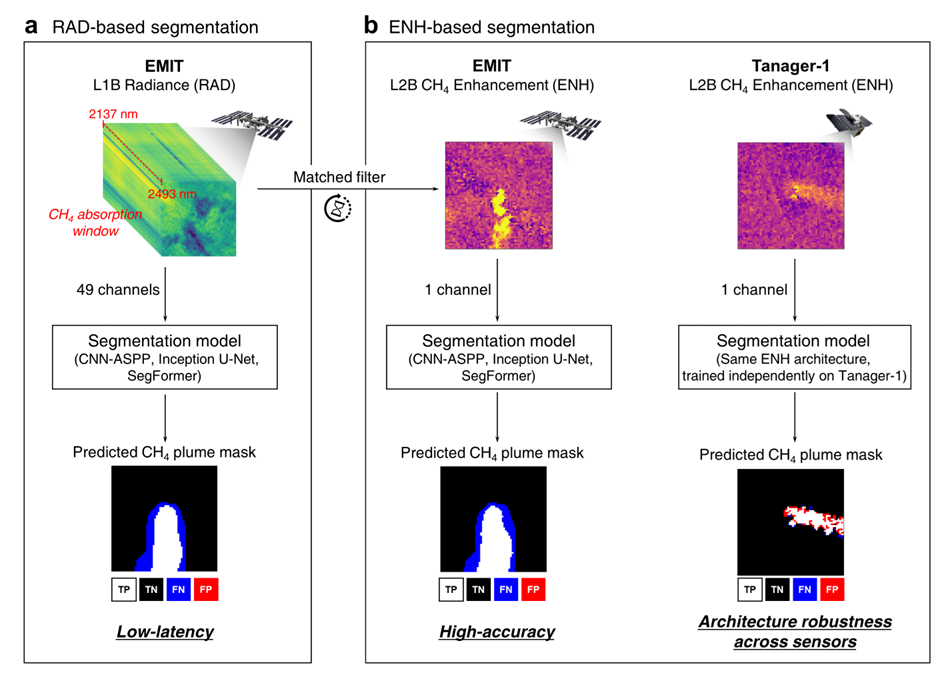
They tested three deep learning architectures—CNN-ASPP, Inception U-Net, and SegFormer—using two data types: raw radiance and processed data that highlights methane concentration. Models trained on the enhanced data performed better overall. But models trained on raw data responded faster, making them useful for quick scans.
Applying these models to Tanager-1 satellite data—commercial hyperspectral imagery—yield similar results, demonstrating the approach's versatility across different sensors.
First authors Seyoung Yang and Yejin Kim played key roles in this work. The models work across various resolutions and conditions, relying on physical principles to quickly flag large leaks for further investigation.
Professor Im emphasized the importance, “Fast leak detection is essential for reducing methane emissions. Traditional methods are slow and require experts. By combining hyperspectral data with AI, we can identify potential trouble spots in real time and strengthen global monitoring efforts.”
Supported by the Ministry of Environment and the Ministry of Education, this research was published in npj Climate and Atmospheric Science on March 25, 2026.
Journal Reference
Seyoung Yang, Yejin Kim, Minki Choo, et al ., “Beyond localized methane plume detection: a dual-path deep learning framework for sensor-agnostic global hyperspectral methane plume monitoring,” npj Clim. Atmos. Sci., (2026).
Related Links
Related Photo
![[연구그림] 메탄 기둥을 탐지하는 기술 비교.png](/app/board/attach/image/579963_1780277837000.do)



-
New Study Uncovers Shift in Climate Drivers Intensifying Wildfires in Australia
-
UNIST Unveils AI-Driven Framework for Real-Time Multi-Pollutant Air Quality Monitoring
-
Sea Surface Temperature Shifts in the Pacific Improve Year-Ahead Winter Climate Predictions
-
Decoding Black Box AI with Human-Readable Data Descriptions and Influence