UNIST site map
- Admissions
-
Academics
- Colleges and Schools
-
Academic Affairs
- Academic Calendar
- Academic Curriculum
- Requirements for Graduation
- Browse Open Courses
- Undergraduate Administration
-
Graduate Academic Affairs
- Tuition Fee Payment
- Academic Leave of Absence/ Academic Return
- Voluntary Withdrawal/ Expulsion
- Change of Major
- Change of Degree Program/ Dropping of Degree Program
- Class Period/ Attendance Period/ Academic Year・Semester
- Course Registration
- Course Drop
- Attendance/ Grade/ Exam
- Credit Transfer/ Credit Carryover
- Academic Forms
- Education Support
-
Research/Industry
- Research Aims
- Research Findings
- Researcher Search
-
Research Organizations
- UNIST Multi-Interdisciplinary Institute
- IBS Research Groups
-
UNIST Labs
- Department of Mechanical Engineering
- School of Energy and Chemical Engineering
- Department of Civil
- Department of Materials Science and Engineering
- Department of Nuclear Engineering
- Department of Industrial Engineering
- Department of Design
- Department of Biomedical Engineering
- Department of Biological Sciences
- Department of Electrical Engineering
- Department of Computer Science and Engineering
- Department of Mathematical Sciences
- Department of Chemistry
- Department of Physics
- School of Business Administration
- Graduate School of Carbon Neutrality
- Graduate School of Artificial Intelligence
- Research Support
- University-Industry Relations
- Campus Life
- News Center
- About UNIST
-
etc
- UNIST Bulletin
- Work-Life Balance Support System
- UNIST Gender Equality Plan
- Faculty Invitation for Tenure Track
- Faculty Invitation for Non-Tenure Track
- Board Meeting Minutes
- University Council Meeting Minutes
- Administrative Service Charter
- Privacy Policy
- Copyright Policy
- Rejection of Unauthorized Email Collection
- Operation and Management Policy for Video Information Processing Devices
- Information Disclosure


Connection Points of Knowledge, Everything About UNIST
Try searching.
Recommended search terms


- portal
- U Academics Innovation Center
- Leadership Center
- Dormitory
- Academic Information Center
- International Students Support
- Browse Open Courses
- Course Registration
- Graduation Requirements for Graduation
- Academic Leave of Absence/ Academic Return
- Military Service
- Certificate Issuance
- Academic Calendar
- Scholarships
- Campus Map
- Campus Life Guidebook
- Health Care Center
- Human Rights Center
- portal
- Job Opening
- Announcement for Bid
- UNIST AI Services
- UNIST Daycare Center
- Sports Center
- UI Downloads
- Announcement
- Recruitment of Professors (Non-tenure)
- Faculty Invitation for Tenure Track
- UNIST Academic Information Center
- Office of Research Facilities and Training
- Office of Research Affairs
- Rule Management System
- Academic Calendar


This is a collection of menus necessary for UNIST students .
students
- portal
- U Academics Innovation Center
- Leadership Center
- Dormitory
- Academic Information Center
- International Students Support
- Browse Open Courses
- Course Registration
- Graduation Requirements for Graduation
- Academic Leave of Absence/ Academic Return
- Military Service
- Certificate Issuance
- Academic Calendar
- Scholarships
- Campus Map
- Campus Life Guidebook
- Health Care Center
- Human Rights Center


This is a collection of menus necessary for prospective UNIST Students .
prospective Students


This is a collection of menus necessary for UNIST Faculty & Staff .
Faculty & Staff
- portal
- Job Opening
- Announcement for Bid
- UNIST AI Services
- UNIST Daycare Center
- Sports Center
- UI Downloads
- Announcement
- Recruitment of Professors (Non-tenure)
- Faculty Invitation for Tenure Track
- UNIST Academic Information Center
- Office of Research Facilities and Training
- Office of Research Affairs
- Rule Management System
- Academic Calendar


NEWS CENTER
Discover not only Research Findings and event news, but also the diverse facets of UNIST presented by reporters and writers.
News Center

UNIST News
New Study Unveils High-Performance Dye-Sensitized Electrode for Artificial Photosynthesis
The findings of this research have been published in Advanced Functional Materials on April 13, 2026.
- Research
- JooHyeon Heo
- 2026.05.15
- 102
Abstract
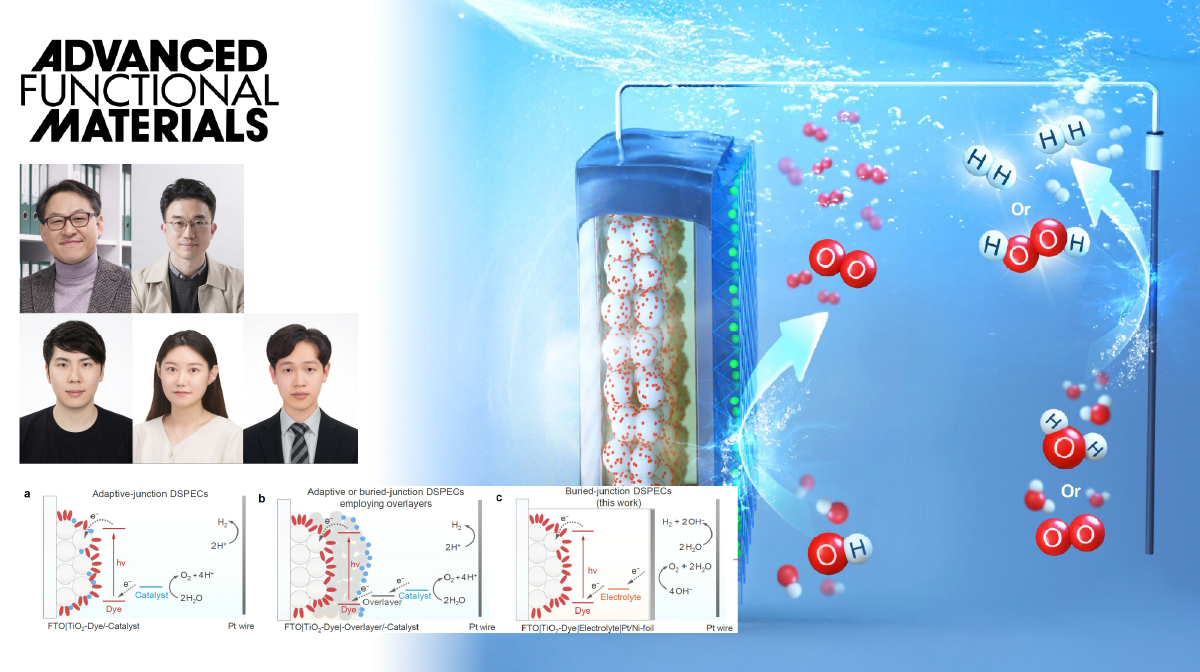
A research team at UNIST has introduced an innovative dye-sensitized electrode that marks a significant leap in artificial photosynthesis technology. Demonstrating exceptional efficiency and durability, the system can produce hydrogen peroxide solely using sunlight—bringing us closer to sustainable chemical manufacturing.
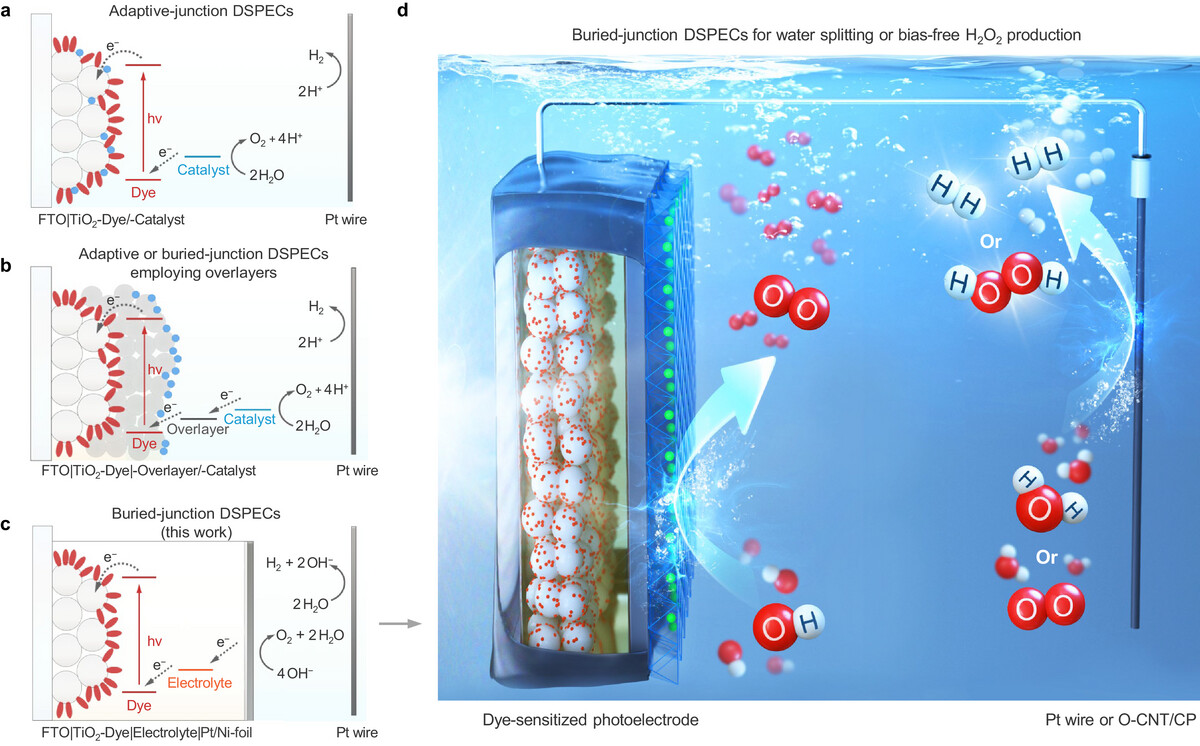
Led by Professor Tae-Hyuk Kwon from the Department of Chemistry and Professor Ji-Wook Jang from the School of Energy and Chemical Engineering, the team developed an electrode that mimics natural electron-transfer processes in plants. The device features an organic dye layer combined with a redox mediator, encapsulated within a nickel foil structure. This configuration facilitates a cascade-like, stepwise electron transfer—from the dye to the mediator, then to the nickel substrate, and ultimately to the catalyst—minimizing charge loss and enhancing stability.
Unlike conventional designs with dyes exposed directly to electrolytes, this architecture prevents degradation and significantly prolongs operational lifespan. The electrode achieved a Faradaic efficiency of 98% in water splitting and demonstrated stable performance over 150 hours. When used for sunlight-driven hydrogen peroxide production, it attained a solar-to-fuel efficiency of 4.15%, setting a new global record without requiring external voltage.

“By optimizing the electrode interface, we were able to enhance efficiency and durability simultaneously,” explained Professor Kwon. “This environmentally friendly system paves the way for sustainable production of valuable chemicals using solar energy.”
According to the research team, this breakthrough addresses core challenges in artificial photosynthesis—namely, efficiency, stability, and environmental safety—paving the path toward scalable, renewable fuel and chemical production. Its simplicity and eco-friendly design hold great promise for future applications in green chemistry and renewable energy.
This research was participated by researchers Jun-Hyeok Park, Kyounglim Kim, and Jinyoung Lee as the first co-authors. The findings of this research have been published in Advanced Functional Materials on April 13, 2026.
Journal Reference
Jun-Hyeok Park, Kyounglim Kim, Jinyoung Lee, et al., "Bias-Free Highly Efficient and Stable Dye-Sensitized Photoelectrochemical Cells via Cascade Charge Transfer," Adv. Funct. Mater., (2026).
Related Links
Related Photo



-
New Electrode Converts CO2 into Chemicals While Generating Electricity
-
Ultrafast 3D Microfabrication Technology Produces Complex Structures in Just 60 Seconds
-
Breakthrough QD Display Technology Achieves 4,000 PPI Resolution — Ideal for XR Glasses
-
UNIST Unveils Smart Contact Lens with Meniscus Pixel Printing for Vision-Based Robotic Control