UNIST site map
- Admissions
-
Academics
- Colleges and Schools
-
Academic Affairs
- Academic Calendar
- Academic Curriculum
- Requirements for Graduation
- Browse Open Courses
- Undergraduate Administration
-
Graduate Academic Affairs
- Tuition Fee Payment
- Academic Leave of Absence/ Academic Return
- Voluntary Withdrawal/ Expulsion
- Change of Major
- Change of Degree Program/ Dropping of Degree Program
- Class Period/ Attendance Period/ Academic Year・Semester
- Course Registration
- Course Drop
- Attendance/ Grade/ Exam
- Credit Transfer/ Credit Carryover
- Academic Forms
- Education Support
-
Research/Industry
- Research Aims
- Research Findings
- Researcher Search
-
Research Organizations
- UNIST Multi-Interdisciplinary Institute
- IBS Research Groups
-
UNIST Labs
- Department of Mechanical Engineering
- School of Energy and Chemical Engineering
- Department of Civil
- Department of Materials Science and Engineering
- Department of Nuclear Engineering
- Department of Industrial Engineering
- Department of Design
- Department of Biomedical Engineering
- Department of Biological Sciences
- Department of Electrical Engineering
- Department of Computer Science and Engineering
- Department of Mathematical Sciences
- Department of Chemistry
- Department of Physics
- School of Business Administration
- Graduate School of Carbon Neutrality
- Graduate School of Artificial Intelligence
- Research Support
- University-Industry Relations
- Campus Life
- News Center
- About UNIST
-
etc
- UNIST Bulletin
- Work-Life Balance Support System
- UNIST Gender Equality Plan
- Faculty Invitation for Tenure Track
- Faculty Invitation for Non-Tenure Track
- Board Meeting Minutes
- University Council Meeting Minutes
- Administrative Service Charter
- Privacy Policy
- Copyright Policy
- Rejection of Unauthorized Email Collection
- Operation and Management Policy for Video Information Processing Devices
- Information Disclosure


Connection Points of Knowledge, Everything About UNIST
Try searching.
Recommended search terms


- portal
- U Academics Innovation Center
- Leadership Center
- Dormitory
- Academic Information Center
- International Students Support
- Browse Open Courses
- Course Registration
- Graduation Requirements for Graduation
- Academic Leave of Absence/ Academic Return
- Military Service
- Certificate Issuance
- Academic Calendar
- Scholarships
- Campus Map
- Campus Life Guidebook
- Health Care Center
- Human Rights Center
- portal
- Job Opening
- Announcement for Bid
- UNIST AI Services
- UNIST Daycare Center
- Sports Center
- UI Downloads
- Announcement
- Recruitment of Professors (Non-tenure)
- Faculty Invitation for Tenure Track
- UNIST Academic Information Center
- Office of Research Facilities and Training
- Office of Research Affairs
- Rule Management System
- Academic Calendar


This is a collection of menus necessary for UNIST students .
students
- portal
- U Academics Innovation Center
- Leadership Center
- Dormitory
- Academic Information Center
- International Students Support
- Browse Open Courses
- Course Registration
- Graduation Requirements for Graduation
- Academic Leave of Absence/ Academic Return
- Military Service
- Certificate Issuance
- Academic Calendar
- Scholarships
- Campus Map
- Campus Life Guidebook
- Health Care Center
- Human Rights Center


This is a collection of menus necessary for prospective UNIST Students .
prospective Students


This is a collection of menus necessary for UNIST Faculty & Staff .
Faculty & Staff
- portal
- Job Opening
- Announcement for Bid
- UNIST AI Services
- UNIST Daycare Center
- Sports Center
- UI Downloads
- Announcement
- Recruitment of Professors (Non-tenure)
- Faculty Invitation for Tenure Track
- UNIST Academic Information Center
- Office of Research Facilities and Training
- Office of Research Affairs
- Rule Management System
- Academic Calendar


NEWS CENTER
Discover not only Research Findings and event news, but also the diverse facets of UNIST presented by reporters and writers.
News Center

UNIST News
Breakthrough QD Display Technology Achieves 4,000 PPI Resolution — Ideal for XR Glasses
The findings of this research have been published in Nature Communications on March 19, 2026.
- Research
- JooHyeon Heo
- 2026.04.27
- 297
Abstract
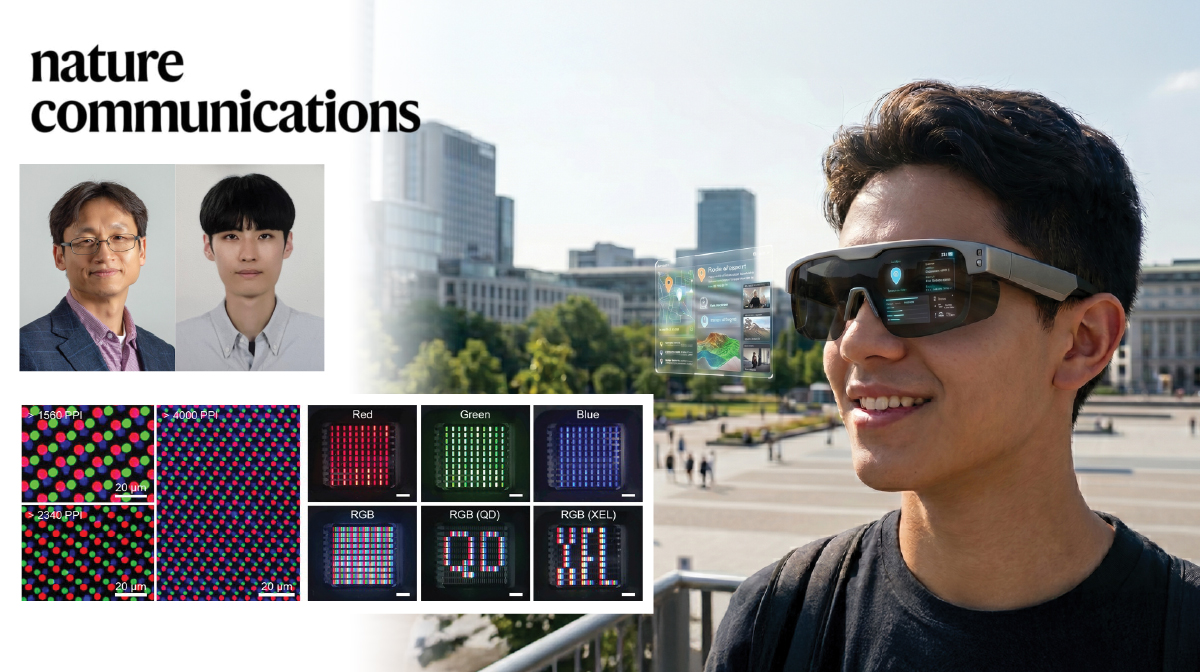
Researchers, affiliated with UNIST have announced a significant advancement in quantum dot (QD) display technology, enabling ultra-fine, high-resolution patterning of QDs suitable for next-generation XR glasses. This innovation promises brighter, more vivid images even in outdoor environments.
Professor BongSoo Kim from the Department of Chemistry at UNIST, in collaboration with Professor Moon Sung Kang of Sogang University and Dr. Chan-mo Kang at Electronics and Telecommunications Research Institute (ETRI), have developed a novel photopatterning technique that maintains the integrity of quantum dots while achieving micron-scale precision.
To meet the demanding resolution required for XR displays—exceeding 3,000 pixels per inch (PPI)—the team’s method patterns quantum dots into 2-micrometer (μm) pixels. This enables over 4,000 PPI, meaning more than 10 million pixels can be packed into a space about the size of a coin, ensuring sharp, immersive visuals.
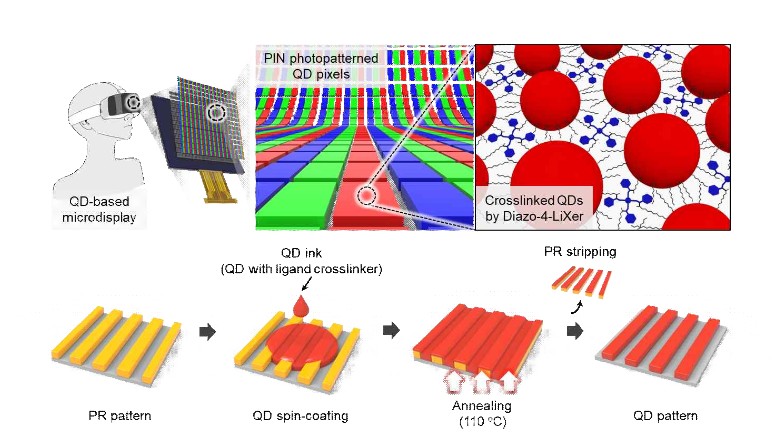
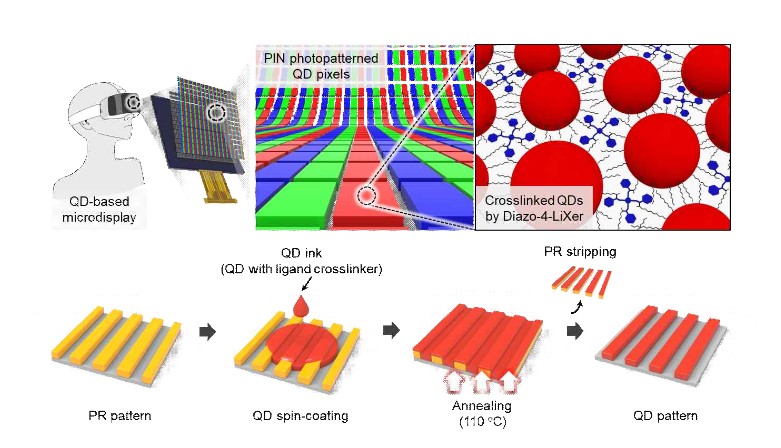
The process employs a custom-developed additive, Diazo-4-LiXer, which facilitates thermocrosslinking at low temperatures (110–120°C) via carbene chemistry, preserving the quantum dots’ luminescent properties. It involves creating a sacrificial photoresist (PR) template, depositing a crosslinked quantum dot film, then removing the PR to leave behind precisely patterned quantum dots—without damage or shape distortion.
This technique not only achieves high fidelity and density but also enables the fabrication of full-color RGB quantum dot LED arrays, demonstrating its potential for commercial application.
Professor Kim commented, “Our method allows for ultra-high resolution patterning of quantum dots while maintaining their exceptional optical properties. It opens new avenues for advanced XR glasses and microdisplays, where brightness, color purity, and resolution are crucial.”
The findings of this research have been published in Nature Communications on March 19, 2026. The study has been supported by the Samsung Research Funding & Incubation Center of Samsung Electronics, the National Research Foundation of Korea (NRF), and the Ministry of Science and ICT (MSIT).
Journal Reference
Hyeokjun Kim, Hyobin Ham, Chang Hyeok Lim, et al., "Photoresist-guided indirect photopatterning of quantum dots via carbene-mediated ligand thermocrosslinking," Nat. Commun., (2026).
Related Links
Related Photo




-
New Study Unveils Region-Specific Dopamine Regulation in the Basal Ganglia
-
Bright Quantum Light Emission Achieved at Room Temperature in 2D Semiconductors
-
Breakthrough Observation of Transient Intermediate in Nitrite-to-Nitric Oxide Conversion
-
Targeted Nanoparticles Eliminate Aging Retinal Cells to Reverse Vision Decline