UNIST site map
- Admissions
-
Academics
- Colleges and Schools
-
Academic Affairs
- Academic Calendar
- Academic Curriculum
- Requirements for Graduation
- Browse Open Courses
- Undergraduate Administration
-
Graduate Academic Affairs
- Tuition Fee Payment
- Academic Leave of Absence/ Academic Return
- Voluntary Withdrawal/ Expulsion
- Change of Major
- Change of Degree Program/ Dropping of Degree Program
- Class Period/ Attendance Period/ Academic Year・Semester
- Course Registration
- Course Drop
- Attendance/ Grade/ Exam
- Credit Transfer/ Credit Carryover
- Academic Forms
- Education Support
-
Research/Industry
- Research Aims
- Research Findings
- Researcher Search
-
Research Organizations
- UNIST Multi-Interdisciplinary Institute
- IBS Research Groups
-
UNIST Labs
- Department of Mechanical Engineering
- School of Energy and Chemical Engineering
- Department of Civil
- Department of Materials Science and Engineering
- Department of Nuclear Engineering
- Department of Industrial Engineering
- Department of Design
- Department of Biomedical Engineering
- Department of Biological Sciences
- Department of Electrical Engineering
- Department of Computer Science and Engineering
- Department of Mathematical Sciences
- Department of Chemistry
- Department of Physics
- School of Business Administration
- Graduate School of Carbon Neutrality
- Graduate School of Artificial Intelligence
- Research Support
- University-Industry Relations
- Campus Life
- News Center
- About UNIST
-
etc
- UNIST Bulletin
- Work-Life Balance Support System
- UNIST Gender Equality Plan
- Faculty Invitation for Tenure Track
- Faculty Invitation for Non-Tenure Track
- Board Meeting Minutes
- University Council Meeting Minutes
- Administrative Service Charter
- Privacy Policy
- Copyright Policy
- Rejection of Unauthorized Email Collection
- Operation and Management Policy for Video Information Processing Devices
- Information Disclosure


Connection Points of Knowledge, Everything About UNIST
Try searching.
Recommended search terms


- portal
- U Academics Innovation Center
- Leadership Center
- Dormitory
- Academic Information Center
- International Students Support
- Browse Open Courses
- Course Registration
- Graduation Requirements for Graduation
- Academic Leave of Absence/ Academic Return
- Military Service
- Certificate Issuance
- Academic Calendar
- Scholarships
- Campus Map
- Campus Life Guidebook
- Health Care Center
- Human Rights Center
- portal
- Job Opening
- Announcement for Bid
- UNIST AI Services
- UNIST Daycare Center
- Sports Center
- UI Downloads
- Announcement
- Recruitment of Professors (Non-tenure)
- Faculty Invitation for Tenure Track
- UNIST Academic Information Center
- Office of Research Facilities and Training
- Office of Research Affairs
- Rule Management System
- Academic Calendar


This is a collection of menus necessary for UNIST students .
students
- portal
- U Academics Innovation Center
- Leadership Center
- Dormitory
- Academic Information Center
- International Students Support
- Browse Open Courses
- Course Registration
- Graduation Requirements for Graduation
- Academic Leave of Absence/ Academic Return
- Military Service
- Certificate Issuance
- Academic Calendar
- Scholarships
- Campus Map
- Campus Life Guidebook
- Health Care Center
- Human Rights Center


This is a collection of menus necessary for prospective UNIST Students .
prospective Students


This is a collection of menus necessary for UNIST Faculty & Staff .
Faculty & Staff
- portal
- Job Opening
- Announcement for Bid
- UNIST AI Services
- UNIST Daycare Center
- Sports Center
- UI Downloads
- Announcement
- Recruitment of Professors (Non-tenure)
- Faculty Invitation for Tenure Track
- UNIST Academic Information Center
- Office of Research Facilities and Training
- Office of Research Affairs
- Rule Management System
- Academic Calendar


NEWS CENTER
Discover not only Research Findings and event news, but also the diverse facets of UNIST presented by reporters and writers.
News Center

UNIST News
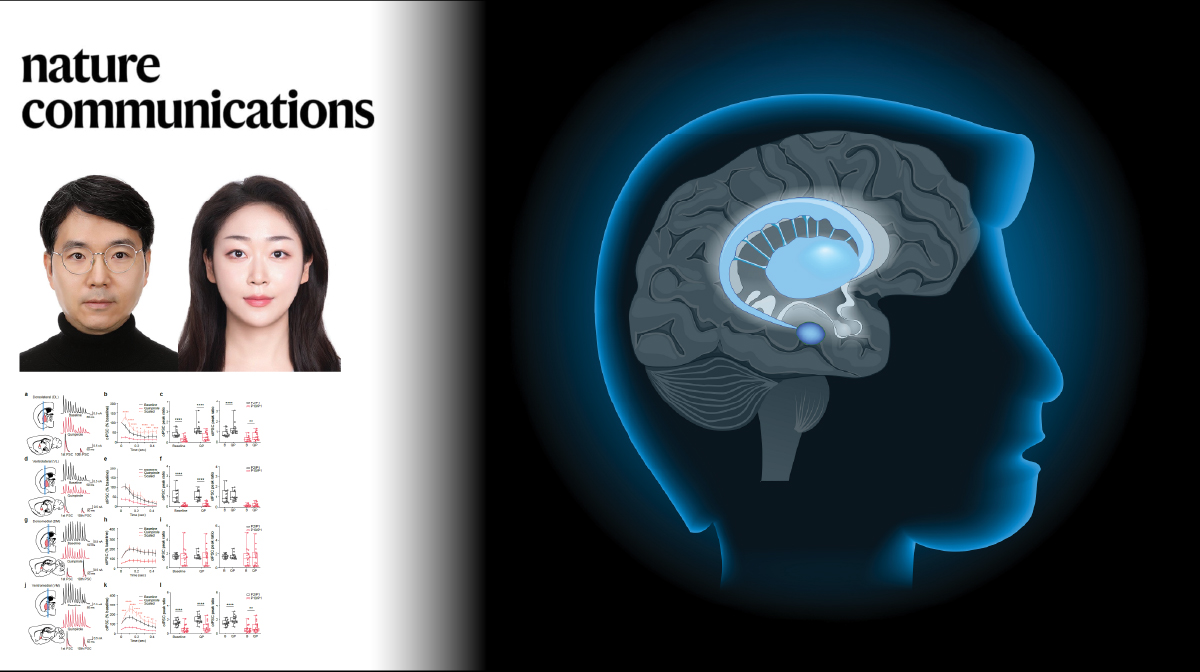
New Study Unveils Region-Specific Dopamine Regulation in the Basal Ganglia
The findings of this research have been published in Nature Communications on April 3, 2026.
- Research
- JooHyeon Heo
- 2026.04.27
- 361
Abstract
Researchers at UNIST have identified a novel spatial rule, governing how dopamine modulates inhibitory signals in the brain’s basal ganglia, deepening our understanding of motor control and opening new avenues for targeted therapies in neurodegenerative diseases, such as Parkinson’s.
The study, led by Professor Jae-Ick Kim of the Department of Biological Sciences, reveals that dopamine’s influence on synapses within the indirect pathway of the basal ganglia varies depending on the specific subregion. Using advanced techniques—including optogenetics, electrophysiology, and computational modeling—the team demonstrated that dopamine differentially regulates GABAergic inhibitory signals through distinct receptor types in different parts of the external globus pallidus (GPe).
Specifically, dopamine reduces inhibitory GABA release via D2 receptors in the dorsolateral and ventromedial GPe regions, weakening inhibition. Conversely, in the dorsomedial and ventrolateral regions, dopamine acts through D4 receptors to suppress postsynaptic activity, also diminishing overall inhibition. This regional specificity suggests that dopamine fine-tunes motor signals in a highly localized manner.
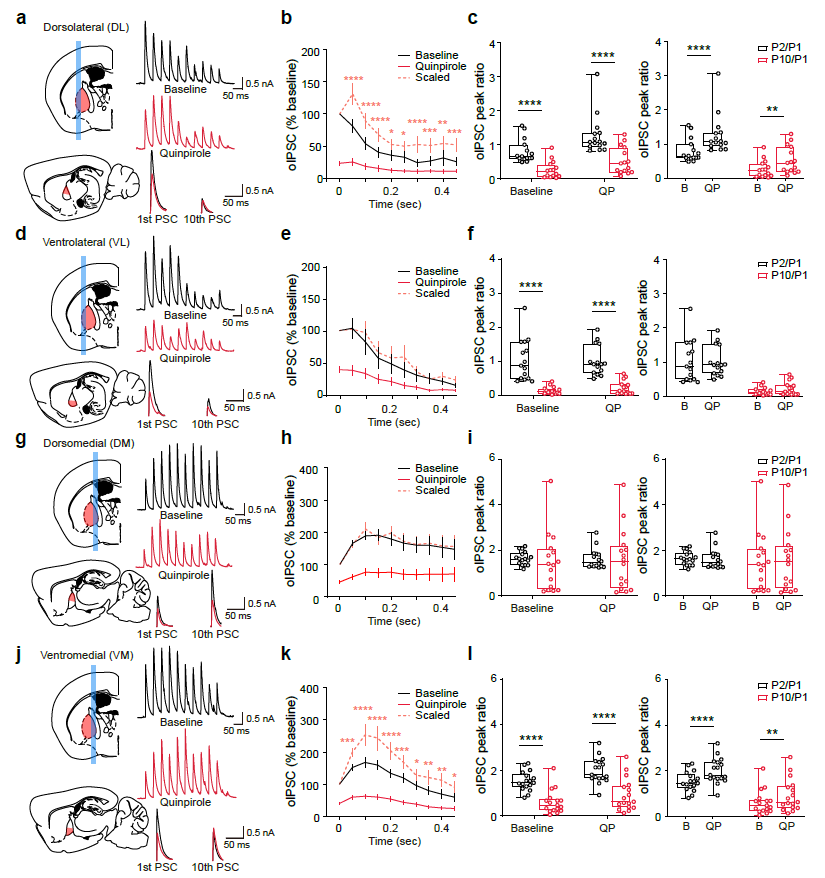
Remarkably, in a Parkinson’s model characterized by dopamine depletion, these region-specific modulation patterns are reversed, indicating that the spatial regulation of dopamine is critical for normal motor function. Such insights could inform the development of more precise interventions targeting specific brain regions and receptor subtypes.
Professor Lee commented on the findings, "Understanding how dopamine differently modulates circuits based on region and receptor type provides a foundation for developing targeted therapies for movement disorders."
Youngeun Lee, the lead researcher, added, "Our study highlights the importance of regional and receptor-specific modulation within the brain's motor circuits, which could lead to more effective treatment strategies."
Published in Nature Communications on April 3, this research offers vital neurophysiological insights for designing treatments for movement disorders. This study has been supported by the Mid-Career Researcher Program and the Bio & Medical Technology Development Program of the National Research Foundation of Korea (NRF), funded by the Ministry of Science and ICT (MSIT).
Journal Reference
Youngeun Lina Lee, Maria Reva, Ki Jung Kim, et al ., “Distinct modes of dopamine modulation on striatopallidal synaptic transmission,” Nat. Commun ., (2026).
Related Links
Related Photo
![[연구그림] 도파민은 억제성 시냅스 전달을 감소하는 동일한 역할을 하지만 세부 구역에 따라서 조절 방식이 다름을 보여주는 실험 결과.png](/app/board/attach/image/574803_1777257139000.do)





-
Breakthrough QD Display Technology Achieves 4,000 PPI Resolution — Ideal for XR Glasses
-
Breakthrough Unveils How Alcohol Amplifies Liver Damage During Illness
-
Targeted Nanoparticles Eliminate Aging Retinal Cells to Reverse Vision Decline
-
Targeting COL6A3-C5 with Nigericin to Reduce Endotrophin and Enhance Metabolic Health in Obesity