UNIST site map
- Admissions
-
Academics
- Colleges and Schools
-
Academic Affairs
- Academic Calendar
- Academic Curriculum
- Requirements for Graduation
- Browse Open Courses
- Undergraduate Administration
-
Graduate Academic Affairs
- Tuition Fee Payment
- Academic Leave of Absence/ Academic Return
- Voluntary Withdrawal/ Expulsion
- Change of Major
- Change of Degree Program/ Dropping of Degree Program
- Class Period/ Attendance Period/ Academic Year・Semester
- Course Registration
- Course Drop
- Attendance/ Grade/ Exam
- Credit Transfer/ Credit Carryover
- Academic Forms
- Education Support
-
Research/Industry
- Research Aims
- Research Findings
- Researcher Search
-
Research Organizations
- UNIST Multi-Interdisciplinary Institute
- IBS Research Groups
-
UNIST Labs
- Department of Mechanical Engineering
- School of Energy and Chemical Engineering
- Department of Civil
- Department of Materials Science and Engineering
- Department of Nuclear Engineering
- Department of Industrial Engineering
- Department of Design
- Department of Biomedical Engineering
- Department of Biological Sciences
- Department of Electrical Engineering
- Department of Computer Science and Engineering
- Department of Mathematical Sciences
- Department of Chemistry
- Department of Physics
- School of Business Administration
- Graduate School of Carbon Neutrality
- Graduate School of Artificial Intelligence
- Research Support
- University-Industry Relations
- Campus Life
- News Center
- About UNIST
-
etc
- UNIST Bulletin
- Work-Life Balance Support System
- UNIST Gender Equality Plan
- Faculty Invitation for Tenure Track
- Faculty Invitation for Non-Tenure Track
- Board Meeting Minutes
- University Council Meeting Minutes
- Administrative Service Charter
- Privacy Policy
- Copyright Policy
- Rejection of Unauthorized Email Collection
- Operation and Management Policy for Video Information Processing Devices
- Information Disclosure


Connection Points of Knowledge, Everything About UNIST
Try searching.
Recommended search terms


- portal
- U Academics Innovation Center
- Leadership Center
- Dormitory
- Academic Information Center
- International Students Support
- Browse Open Courses
- Course Registration
- Graduation Requirements for Graduation
- Academic Leave of Absence/ Academic Return
- Military Service
- Certificate Issuance
- Academic Calendar
- Scholarships
- Campus Map
- Campus Life Guidebook
- Health Care Center
- Human Rights Center
- portal
- Job Opening
- Announcement for Bid
- UNIST AI Services
- UNIST Daycare Center
- Sports Center
- UI Downloads
- Announcement
- Recruitment of Professors (Non-tenure)
- Faculty Invitation for Tenure Track
- UNIST Academic Information Center
- Office of Research Facilities and Training
- Office of Research Affairs
- Rule Management System
- Academic Calendar


This is a collection of menus necessary for UNIST students .
students
- portal
- U Academics Innovation Center
- Leadership Center
- Dormitory
- Academic Information Center
- International Students Support
- Browse Open Courses
- Course Registration
- Graduation Requirements for Graduation
- Academic Leave of Absence/ Academic Return
- Military Service
- Certificate Issuance
- Academic Calendar
- Scholarships
- Campus Map
- Campus Life Guidebook
- Health Care Center
- Human Rights Center


This is a collection of menus necessary for prospective UNIST Students .
prospective Students


This is a collection of menus necessary for UNIST Faculty & Staff .
Faculty & Staff
- portal
- Job Opening
- Announcement for Bid
- UNIST AI Services
- UNIST Daycare Center
- Sports Center
- UI Downloads
- Announcement
- Recruitment of Professors (Non-tenure)
- Faculty Invitation for Tenure Track
- UNIST Academic Information Center
- Office of Research Facilities and Training
- Office of Research Affairs
- Rule Management System
- Academic Calendar


NEWS CENTER
Discover not only Research Findings and event news, but also the diverse facets of UNIST presented by reporters and writers.
News Center

UNIST News
Innovative Scalable Electrochemical Approach for Transforming Waste Glycerol into Hydrogen and High-Value Chemicals
The findings of this research were published online in Joule (IF: 35.4) on March 18, 2026.
- Research
- JooHyeon Heo
- 2026.04.23
- 100
Abstract
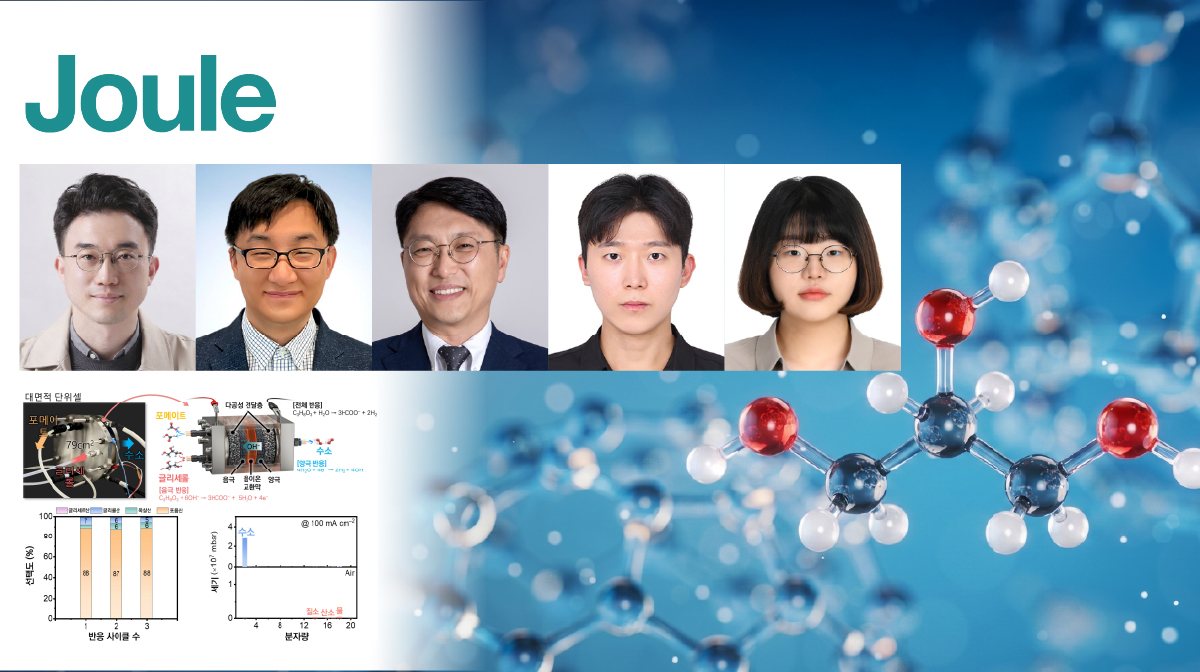
A joint research team, led by Professors Ji-Wook Jang, Hankwon Lim, and Hosik Lee from the School of Energy and Chemical Engineering at UNIST, in collaboration with Dr. Juchan Yang from the Energy & Environment Materials Research Division at Korea Institute of Materials Science (KIMS), has announced the development of a high-performance, scalable electrochemical system that transforms waste glycerol—an industrial byproduct of biodiesel production—into hydrogen and value-added chemicals, such as formate.
This innovative system replaces the conventional oxygen evolution reaction (OER) in water electrolysis with glycerol oxidation, resulting in reduced energy consumption and enhanced efficiency. Using a copper-cobalt oxide catalyst, the system a current density of 110 mA/cm² at just 1.31 V, with 96% selectivity for formate. The technology was successfully scaled to a 79 cm² electrode, demonstrating its potential for industrial applications.
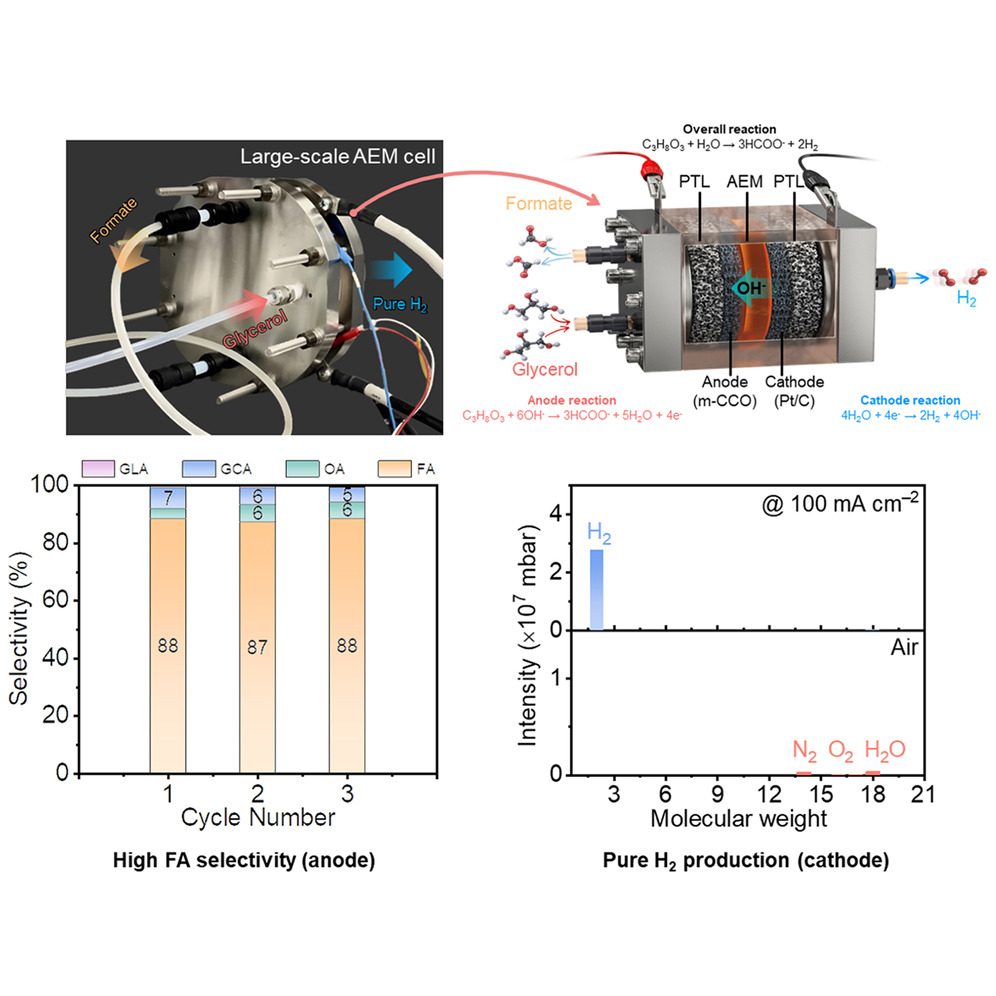
This advancement provides a sustainable, cost-effective pathway for large-scale hydrogen production through glycerol valorization. By simultaneously generating hydrogen and valuable chemicals from waste biomass, the approach promises significant reductions in green hydrogen costs and improved resource efficiency. Additionally, integrating energy and chemical manufacturing processes supports global efforts toward carbon neutrality and a sustainable hydrogen economy. Moreover, its scalability and compatibility with continuous operation suggest promising prospects for industrial deployment and further scale-up to megawatt-level systems.
Juchan Yang, Principal Researcher at KIMS, emphasizes, “This study demonstrates the large-scale synthesis of low-cost, non-precious catalysts and their successful integration into a practical electrolyzer system, marking a significant step toward commercial viability.”
Professor Ji-Wook Jang of UNIST adds, “Transforming biomass waste like glycerol into high-value chemicals and hydrogen not only accelerates carbon neutrality but also offers strategic advantages in building a sustainable hydrogen economy.”
The findings of this research were published online in Joule (IF: 35.4) on March 18, 2026. The study was supported by the National Research Council of Science & Technology (NST), the Korea Institute of Energy Technology Evaluation and Planning (KETEP), the National Research Foundation of Korea (NRF), and the Korea Institute of Industrial Technology (KEIT). Core analyzes and computational modeling were conducted using supercomputing resources provided by the Korea Institute of Science and Technology Information (KISTI), with technical support, as well as the synchrotron radiation source at the 6D beamline of the Pohang Accelerator Laboratory.
Journal Reference
Ki-Yong Yoon, Seon Woo Hwang, Hee Yoon Roh et al. , “Commercial-scale glycerol valorization using surface-modified copper cobalt oxide catalyst in high-capacity anion exchange membrane electrolyzer,” Joule , (2026).
Related Links
Related Photo



-
Turning Solar Panel Waste into Hydrogen and High-Value Silica
-
New Study Unveils Mussel-Inspired Coating for Rapid Radioactive Surface Decontamination
-
Advanced Interface Engineering for High-Performance Solar Cells and Green Hydrogen
-
New Study Unveils Atomic Disorder Strategy to Enhance Stability and Efficiency of High-Capacity Batteries