UNIST site map
- Admissions
-
Academics
- Colleges and Schools
-
Academic Affairs
- Academic Calendar
- Academic Curriculum
- Requirements for Graduation
- Browse Open Courses
- Undergraduate Administration
-
Graduate Academic Affairs
- Tuition Fee Payment
- Academic Leave of Absence/ Academic Return
- Voluntary Withdrawal/ Expulsion
- Change of Major
- Change of Degree Program/ Dropping of Degree Program
- Class Period/ Attendance Period/ Academic Year・Semester
- Course Registration
- Course Drop
- Attendance/ Grade/ Exam
- Credit Transfer/ Credit Carryover
- Academic Forms
- Education Support
-
Research/Industry
- Research Aims
- Research Findings
- Researcher Search
-
Research Organizations
- UNIST Multi-Interdisciplinary Institute
- IBS Research Groups
-
UNIST Labs
- Department of Mechanical Engineering
- School of Energy and Chemical Engineering
- Department of Civil
- Department of Materials Science and Engineering
- Department of Nuclear Engineering
- Department of Industrial Engineering
- Department of Design
- Department of Biomedical Engineering
- Department of Biological Sciences
- Department of Electrical Engineering
- Department of Computer Science and Engineering
- Department of Mathematical Sciences
- Department of Chemistry
- Department of Physics
- School of Business Administration
- Graduate School of Carbon Neutrality
- Graduate School of Artificial Intelligence
- Research Support
- University-Industry Relations
- Campus Life
- News Center
- About UNIST
-
etc
- UNIST Bulletin
- Work-Life Balance Support System
- UNIST Gender Equality Plan
- Faculty Invitation for Tenure Track
- Faculty Invitation for Non-Tenure Track
- Board Meeting Minutes
- University Council Meeting Minutes
- Administrative Service Charter
- Privacy Policy
- Copyright Policy
- Rejection of Unauthorized Email Collection
- Operation and Management Policy for Video Information Processing Devices
- Information Disclosure


Connection Points of Knowledge, Everything About UNIST
Try searching.
Recommended search terms


- portal
- U Academics Innovation Center
- Leadership Center
- Dormitory
- Academic Information Center
- International Students Support
- Browse Open Courses
- Course Registration
- Graduation Requirements for Graduation
- Academic Leave of Absence/ Academic Return
- Military Service
- Certificate Issuance
- Academic Calendar
- Scholarships
- Campus Map
- Campus Life Guidebook
- Health Care Center
- Human Rights Center
- portal
- Job Opening
- Announcement for Bid
- UNIST AI Services
- UNIST Daycare Center
- Sports Center
- UI Downloads
- Announcement
- Recruitment of Professors (Non-tenure)
- Faculty Invitation for Tenure Track
- UNIST Academic Information Center
- Office of Research Facilities and Training
- Office of Research Affairs
- Rule Management System
- Academic Calendar


This is a collection of menus necessary for UNIST students .
students
- portal
- U Academics Innovation Center
- Leadership Center
- Dormitory
- Academic Information Center
- International Students Support
- Browse Open Courses
- Course Registration
- Graduation Requirements for Graduation
- Academic Leave of Absence/ Academic Return
- Military Service
- Certificate Issuance
- Academic Calendar
- Scholarships
- Campus Map
- Campus Life Guidebook
- Health Care Center
- Human Rights Center


This is a collection of menus necessary for prospective UNIST Students .
prospective Students


This is a collection of menus necessary for UNIST Faculty & Staff .
Faculty & Staff
- portal
- Job Opening
- Announcement for Bid
- UNIST AI Services
- UNIST Daycare Center
- Sports Center
- UI Downloads
- Announcement
- Recruitment of Professors (Non-tenure)
- Faculty Invitation for Tenure Track
- UNIST Academic Information Center
- Office of Research Facilities and Training
- Office of Research Affairs
- Rule Management System
- Academic Calendar


NEWS CENTER
Discover not only Research Findings and event news, but also the diverse facets of UNIST presented by reporters and writers.
News Center

UNIST News
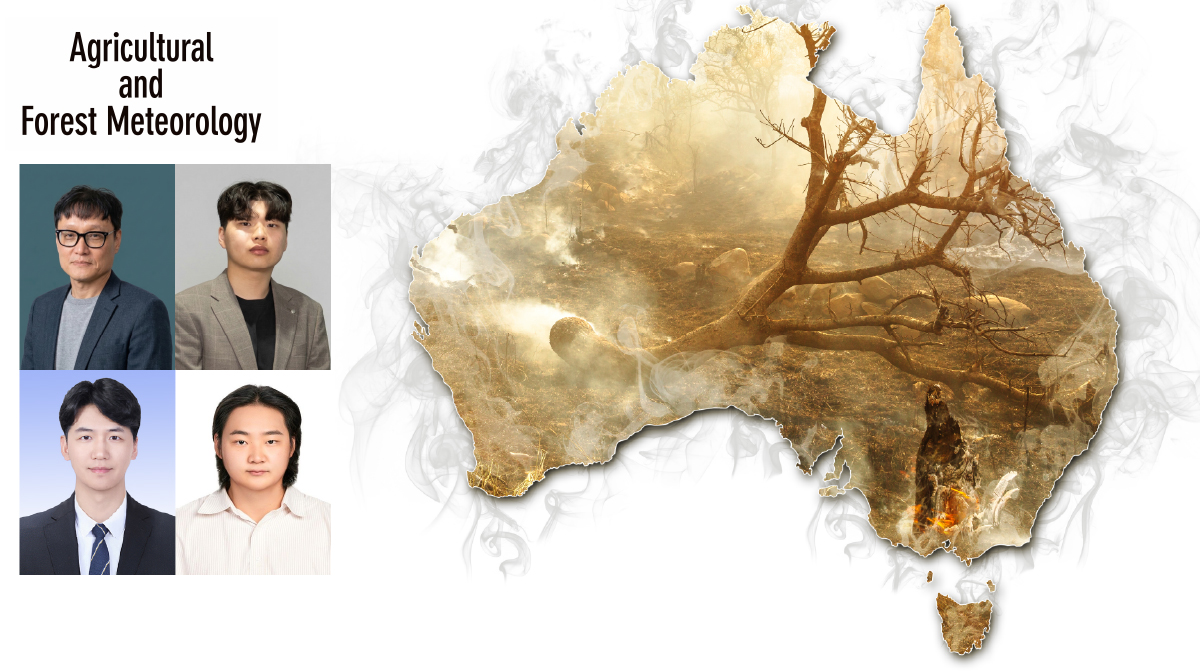
New Study Uncovers Shift in Climate Drivers Intensifying Wildfires in Australia
The findings of this research were published in Agricultural and Forest Meteorology on April 11, 2026.
- Research
- JooHyeon Heo
- 2026.04.22
- 107
Abstract
An international team of researchers, affiliated with UNIST, has identified a dramatic transformation in wildfire patterns across Southeastern Australia (SEA). Analyzing data from 1981 to 2022, the research shows that since the early 2000s, the region has experienced a fivefold increase in extreme fire weather days, driven increasingly by the Southern Annular Mode (SAM) rather than the traditionally dominant El Niño–Southern Oscillation (ENSO). This shift highlights new challenges in predicting and managing wildfires under a changing climate.
Led by Professor Myong-In Lee from the Department of Civil, Urban, Earth and Environmental Engineering at UNIST, this study was conducted in collaboration with experts from the University of Hawaii and POSTECH.
In this study, the team identified a regime shift beginning in the early 2000s, characterized by emphasized interannual variability and a sharp rise in extreme fire weather days. Over the past two decades, wildfire risk volatility has more than doubled. This change is primarily attributed to the strengthening of land-atmosphere coupling, where drought conditions intensify surface heating, creating a feedback loop that fuels more frequent and severe wildfires.
beginning in the early 2000s, marked by heightened interannual variability and a sharp rise in extreme fire weather days. Over the past two decades, wildfire risk volatility has more than doubled. This change is primarily driven by strengthened land–atmosphere coupling: drought conditions dry out surface soils, creating a feedback loop that amplifies surface heating and fosters more frequent and severe wildfires.
While ENSO has traditionally been the main climate driver influencing Australian wildfires, recent evidence indicates that the SAM’s influence has grown, now serving as the dominant factor regulating wildfire variability.
Kiwook Kim, the main author of the study, comments, “Our findings emphasize the need for enhanced monitoring of atmospheric circulation patterns and soil moisture levels. This knowledge is vital for improving fire risk predictions and informing climate adaptation strategies to safeguard communities and ecosystems.”
“Understanding how climate factors influence wildfires is more critical than ever,” says Professor Lee. “Recognizing the increasing role of the Southern Annular Mode and the complex land-atmosphere interactions enables us to develop more accurate prediction models and better prepare for future wildfire seasons.”
The findings of this research were published in Agricultural and Forest Meteorology on April 11, 2026. This research was supported by the Korea Environment Industry & Technology Institute (KEITI) under the Climate Change R&D Project for New Climate Regime project, funded by the Ministry of Environment (MOE) of Korea.
Journal Reference
Kiwook Kim, Myong-In Lee, Seungseok Lee, et al. , “Local and remote drivers of increased variability in extreme wildfire conditions in Southeastern Australia,” Agric. For. Meteorol., (2026).
Related Links




-
UNIST Unveils AI-Driven Framework for Real-Time Multi-Pollutant Air Quality Monitoring
-
Sea Surface Temperature Shifts in the Pacific Improve Year-Ahead Winter Climate Predictions
-
New Simulation Model Provides Accurate Assessment of Urban Spread and Residual Risks of CWAs
-
UNIST Unveils Integrated Framework to Better Assess Air Pollution Health Risks