UNIST site map
- Admissions
-
Academics
- Colleges and Schools
-
Academic Affairs
- Academic Calendar
- Academic Curriculum
- Requirements for Graduation
- Browse Open Courses
- Undergraduate Administration
-
Graduate Academic Affairs
- Tuition Fee Payment
- Academic Leave of Absence/ Academic Return
- Voluntary Withdrawal/ Expulsion
- Change of Major
- Change of Degree Program/ Dropping of Degree Program
- Class Period/ Attendance Period/ Academic Year・Semester
- Course Registration
- Course Drop
- Attendance/ Grade/ Exam
- Credit Transfer/ Credit Carryover
- Academic Forms
- Education Support
-
Research/Industry
- Research Aims
- Research Findings
- Researcher Search
-
Research Organizations
- UNIST Multi-Interdisciplinary Institute
- IBS Research Groups
-
UNIST Labs
- Department of Mechanical Engineering
- School of Energy and Chemical Engineering
- Department of Civil
- Department of Materials Science and Engineering
- Department of Nuclear Engineering
- Department of Industrial Engineering
- Department of Design
- Department of Biomedical Engineering
- Department of Biological Sciences
- Department of Electrical Engineering
- Department of Computer Science and Engineering
- Department of Mathematical Sciences
- Department of Chemistry
- Department of Physics
- School of Business Administration
- Graduate School of Carbon Neutrality
- Graduate School of Artificial Intelligence
- Research Support
- University-Industry Relations
- Campus Life
- News Center
- About UNIST
-
etc
- UNIST Bulletin
- Work-Life Balance Support System
- UNIST Gender Equality Plan
- Faculty Invitation for Tenure Track
- Faculty Invitation for Non-Tenure Track
- Board Meeting Minutes
- University Council Meeting Minutes
- Administrative Service Charter
- Privacy Policy
- Copyright Policy
- Rejection of Unauthorized Email Collection
- Information Disclosure


Connection Points of Knowledge, Everything About UNIST
Try searching.
Recommended search terms


- portal
- U Academics Innovation Center
- Leadership Center
- Dormitory
- Academic Information Center
- International Students Support
- Browse Open Courses
- Course Registration
- Graduation Requirements for Graduation
- Academic Leave of Absence/ Academic Return
- Military Service
- Certificate Issuance
- Academic Calendar
- Scholarships
- Campus Map
- Campus Life Guidebook
- Health Care Center
- Human Rights Center
- portal
- Job Opening
- Announcement for Bid
- UNIST AI Services
- UNIST Daycare Center
- Sports Center
- UI Downloads
- Announcement
- Recruitment of Professors (Non-tenure)
- Faculty Invitation for Tenure Track
- UNIST Academic Information Center
- Office of Research Facilities and Training
- Office of Research Affairs
- Rule Management System
- Academic Calendar


This is a collection of menus necessary for UNIST students .
students
- portal
- U Academics Innovation Center
- Leadership Center
- Dormitory
- Academic Information Center
- International Students Support
- Browse Open Courses
- Course Registration
- Graduation Requirements for Graduation
- Academic Leave of Absence/ Academic Return
- Military Service
- Certificate Issuance
- Academic Calendar
- Scholarships
- Campus Map
- Campus Life Guidebook
- Health Care Center
- Human Rights Center


This is a collection of menus necessary for prospective UNIST Students .
prospective Students


This is a collection of menus necessary for UNIST Faculty & Staff .
Faculty & Staff
- portal
- Job Opening
- Announcement for Bid
- UNIST AI Services
- UNIST Daycare Center
- Sports Center
- UI Downloads
- Announcement
- Recruitment of Professors (Non-tenure)
- Faculty Invitation for Tenure Track
- UNIST Academic Information Center
- Office of Research Facilities and Training
- Office of Research Affairs
- Rule Management System
- Academic Calendar


NEWS CENTER
Discover not only Research Findings and event news, but also the diverse facets of UNIST presented by reporters and writers.
News Center

UNIST News
Targeted Nanoparticles Eliminate Aging Retinal Cells to Reverse Vision Decline
The findings of this research were published in Nature Communications on March 18, 2026.
- Research
- JooHyeon Heo
- 2026.04.15
- 169
Abstract
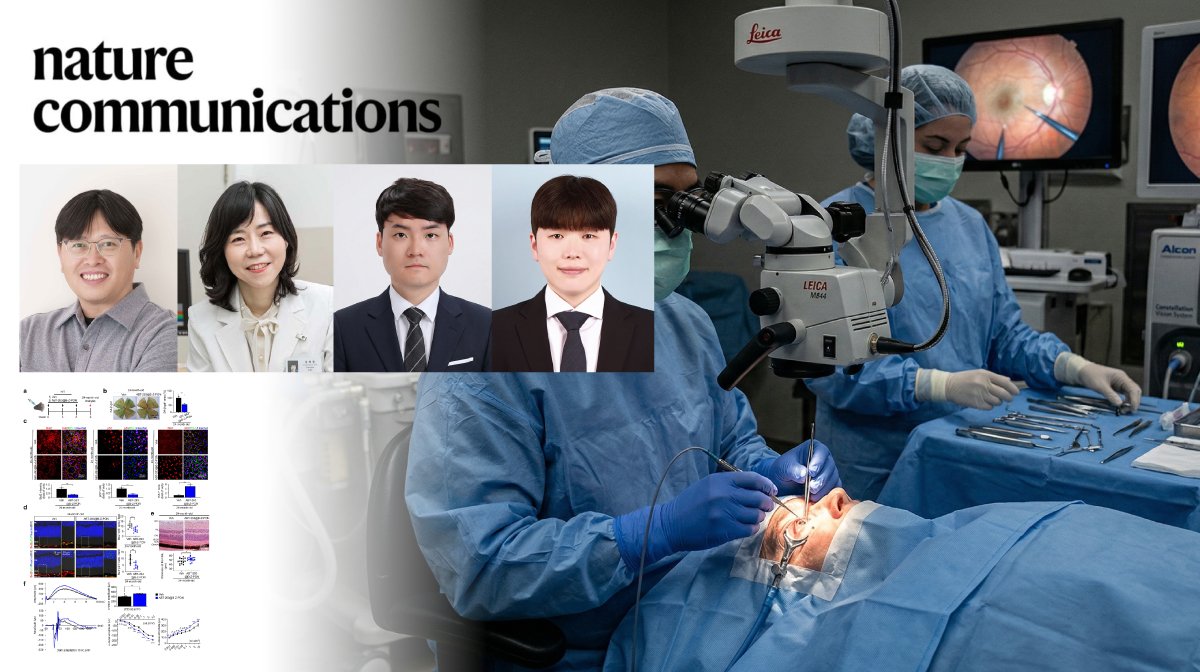
A collaborative team of researchers from UNIST and Konkuk University College of Medicine has introduced an innovative nanotechnology platform that precisely targets and removes aging retinal cells, leading to partial restoration of vision in mouse models. This advancement opens new possibilities for treating age-related macular degeneration (AMD), a leading cause of blindness worldwide.
As the global population ages, the incidence of AMD continues to rise, damaging the central retina and impairing vision. Current treatments primarily address symptoms but do not fundamentally halt disease progression. The new platform specifically eliminates senescent retinal pigment epithelium (RPE) cells—cells that, when aged, secrete harmful substances that exacerbate retinal degeneration.
Led by Professor Ja-Hyoung Ryu from the Department of Chemistry at UNIST and Professor Hyewon Chung from the Department of Ophthalmology at Konkuk University College of Medicine, the research team developed mesoporous silica nanoparticles functionalized with antibodies targeting Bst2, a protein uniquely overexpressed on the surface of senescent RPE cells. These nanoparticles deliver a potent senolytic drug, ABT-263, directly into the aged cells. Once inside, they release the drug, inducing cell death while sparing healthy tissue. The design also ensures safety: even if nanoparticles bind to normal cells, they remain inactive unless exposed to the high-glutathione environment characteristic of senescent cells.
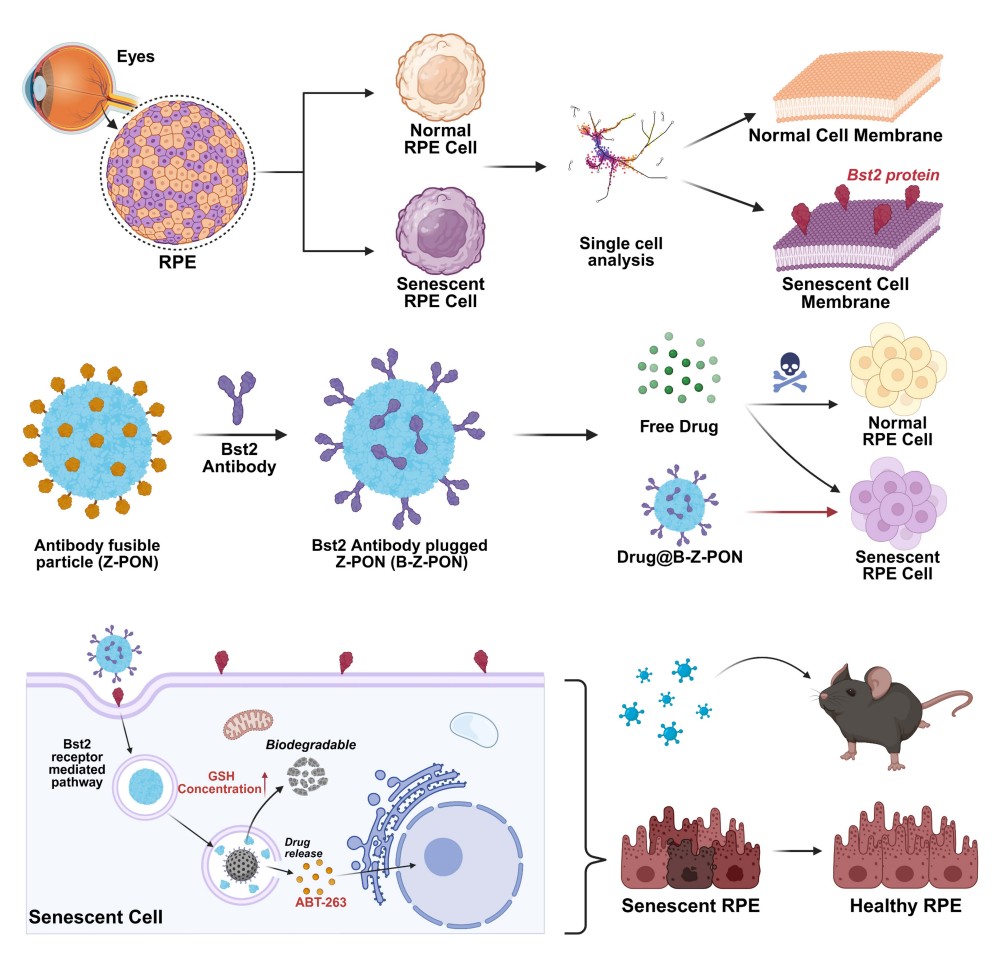
In vivo experiments demonstrated that intravitreal injection of these drug-loaded nanoparticles selectively removed senescent cells without harming healthy tissue, resulting in significant improvements in retinal electrical responses and partial recovery of visual function in mice.
Professor Chung emphasized, “Our targeted approach addresses the disease at its root, moving beyond symptom management. This could revolutionize treatment for dry AMD and other age-related degenerative conditions.” Professor Ryu added, "By identifying a novel marker and engineering targeted nanocarriers, we have paved the way for highly specific therapies that can be adopted to other age-related diseases by simply changing the targeting antibody."
The findings of this research were published in Nature Communications on March 18, 2026. This study has been supported by the Ministry of Science and ICT (MSIT), the National Research Foundation of Korea (NRF), and the Korean ARPA-H Project through the Korea Health Industry Development Institute (KHIDI), funded by the Ministry of Health and Welfare (MOHW).
Journal Reference
Jun Yong Oh, Jae-Byoung Chae, Hyo Kyung Lee, et al., “Bst2-targeted senotherapy restores visual function by eliminating senescent retinal cells,” Nat. Commun., (2026).
Related Links
Related Photo




-
Breakthrough Observation of Transient Intermediate in Nitrite-to-Nitric Oxide Conversion
-
When Chemical Intuition Meets Neural Networks: Hybrid AI Algorithm Predicts Metal–Ligand Coordination Structures
-
UNIST and SKKU Collaborate on Novel Bioelectronics Device Based on Hydrogel-Elastomer Conductive Nanomembranes
-
New Study Unveils Deeply Implantable, Shape-Morphing, 3D MicroLEDs for Pancreatic Cancer Therapy