UNIST site map
- Admissions
-
Academics
- Colleges and Schools
-
Academic Affairs
- Academic Calendar
- Academic Curriculum
- Requirements for Graduation
- Browse Open Courses
- Undergraduate Administration
-
Graduate Academic Affairs
- Tuition Fee Payment
- Academic Leave of Absence/ Academic Return
- Voluntary Withdrawal/ Expulsion
- Change of Major
- Change of Degree Program/ Dropping of Degree Program
- Class Period/ Attendance Period/ Academic Year・Semester
- Course Registration
- Course Drop
- Attendance/ Grade/ Exam
- Credit Transfer/ Credit Carryover
- Academic Forms
- Education Support
-
Research/Industry
- Research Aims
- Research Findings
- Researcher Search
-
Research Organizations
- UNIST Multi-Interdisciplinary Institute
- IBS Research Groups
-
UNIST Labs
- Department of Mechanical Engineering
- School of Energy and Chemical Engineering
- Department of Civil
- Department of Materials Science and Engineering
- Department of Nuclear Engineering
- Department of Industrial Engineering
- Department of Design
- Department of Biomedical Engineering
- Department of Biological Sciences
- Department of Electrical Engineering
- Department of Computer Science and Engineering
- Department of Mathematical Sciences
- Department of Chemistry
- Department of Physics
- School of Business Administration
- Graduate School of Carbon Neutrality
- Graduate School of Artificial Intelligence
- Research Support
- University-Industry Relations
- Campus Life
- News Center
- About UNIST
-
etc
- UNIST Bulletin
- Work-Life Balance Support System
- UNIST Gender Equality Plan
- Faculty Invitation for Tenure Track
- Faculty Invitation for Non-Tenure Track
- Board Meeting Minutes
- University Council Meeting Minutes
- Administrative Service Charter
- Privacy Policy
- Copyright Policy
- Rejection of Unauthorized Email Collection
- Information Disclosure


Connection Points of Knowledge, Everything About UNIST
Try searching.
Recommended search terms


- portal
- U Academics Innovation Center
- Leadership Center
- Dormitory
- Academic Information Center
- International Students Support
- Browse Open Courses
- Course Registration
- Graduation Requirements for Graduation
- Academic Leave of Absence/ Academic Return
- Military Service
- Certificate Issuance
- Academic Calendar
- Scholarships
- Campus Map
- Campus Life Guidebook
- Health Care Center
- Human Rights Center
- portal
- Job Opening
- Announcement for Bid
- UNIST AI Services
- UNIST Daycare Center
- Sports Center
- UI Downloads
- Announcement
- Recruitment of Professors (Non-tenure)
- Faculty Invitation for Tenure Track
- UNIST Academic Information Center
- Office of Research Facilities and Training
- Office of Research Affairs
- Rule Management System
- Academic Calendar


This is a collection of menus necessary for UNIST students .
students
- portal
- U Academics Innovation Center
- Leadership Center
- Dormitory
- Academic Information Center
- International Students Support
- Browse Open Courses
- Course Registration
- Graduation Requirements for Graduation
- Academic Leave of Absence/ Academic Return
- Military Service
- Certificate Issuance
- Academic Calendar
- Scholarships
- Campus Map
- Campus Life Guidebook
- Health Care Center
- Human Rights Center


This is a collection of menus necessary for prospective UNIST Students .
prospective Students


This is a collection of menus necessary for UNIST Faculty & Staff .
Faculty & Staff
- portal
- Job Opening
- Announcement for Bid
- UNIST AI Services
- UNIST Daycare Center
- Sports Center
- UI Downloads
- Announcement
- Recruitment of Professors (Non-tenure)
- Faculty Invitation for Tenure Track
- UNIST Academic Information Center
- Office of Research Facilities and Training
- Office of Research Affairs
- Rule Management System
- Academic Calendar


NEWS CENTER
Discover not only Research Findings and event news, but also the diverse facets of UNIST presented by reporters and writers.
News Center

UNIST News
Sea Surface Temperature Shifts in the Pacific Improve Year-Ahead Winter Climate Predictions
The findings of this research have been published in Nature Communications on March 25, 2026.
- Research
- JooHyeon Heo
- 2026.04.10
- 331
Abstract
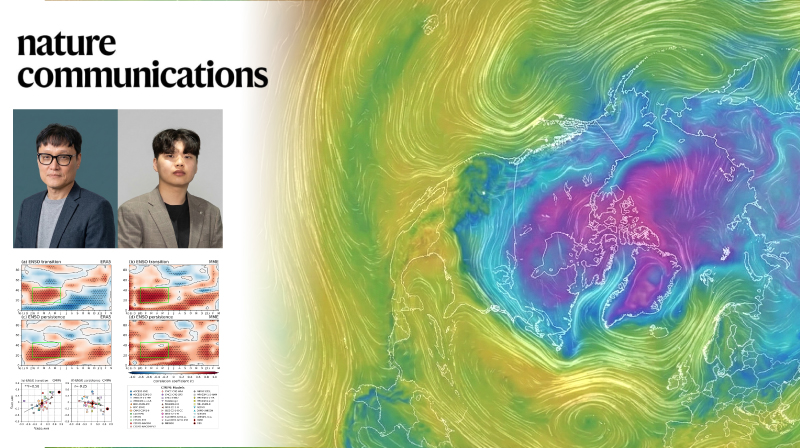
A research team, affiliated with UNIST, in collaboration with the UK Met Office Hadley Centre, has identified that major changes in the equatorial Pacific’s sea surface temperatures—such as transitions between El Niño and La Niña—significantly boost the accuracy of winter weather forecasts in the Northern Hemisphere. Led by Professor Myong-In Lee in the Department of Civil, Urban, Earth, and Environmental Engineering, their findings mark a breakthrough in understanding how tropical Pacific variability influences mid-latitude climate prediction.
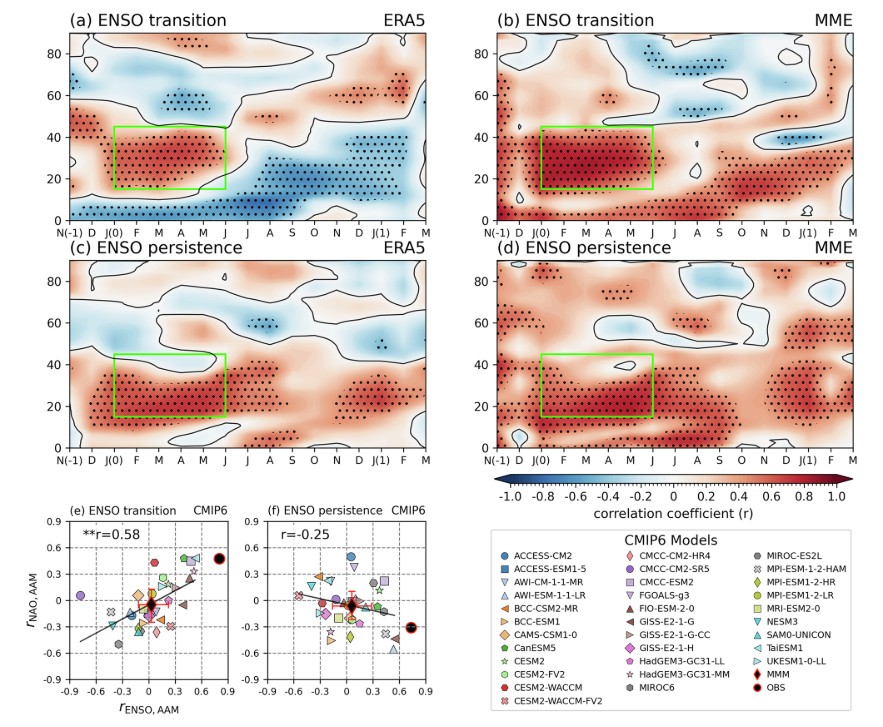
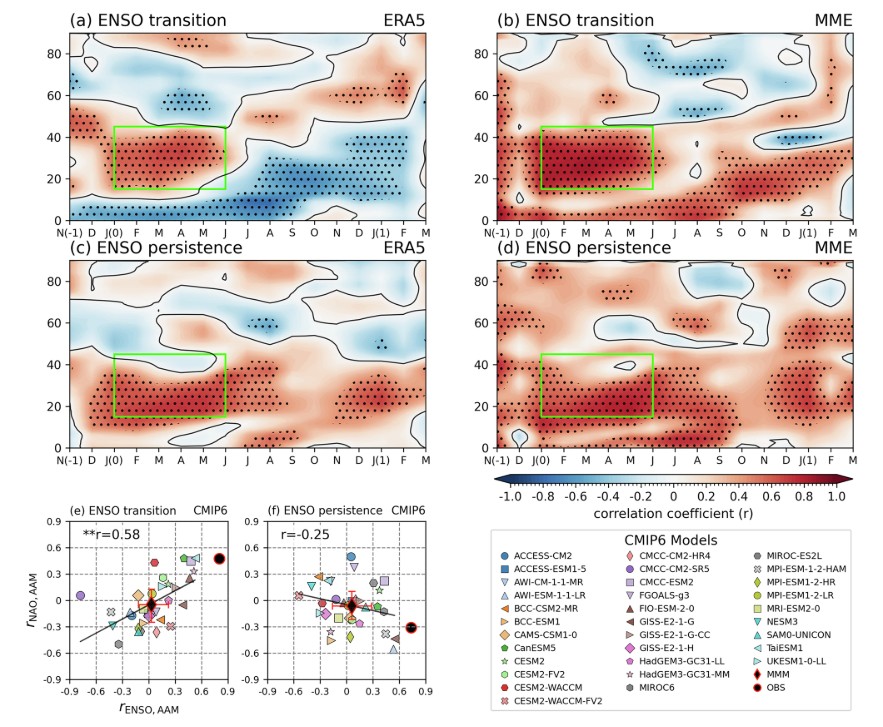
The study reveals that during ENSO transition years, the correlation coefficient for NAO prediction improves markedly—up to 0.60—compared to near-zero correlations in stable ENSO years. This phenomenon occurs because the oceanic temperature changes trigger atmospheric angular momentum shifts that gradually propagate northward, affecting the NAO pattern approximately one year later. The process involves the interaction of delayed effects—initiated by sea surface temperature anomalies—and the rapid transfer of atmospheric signals via Rossby waves, large-scale planetary waves influenced by Earth's rotation.
“During ENSO transition years, the tropical ocean changes significantly influence the atmospheric circulation, strengthening the signals used for long-term forecasting,” explained Professor Myong-In Lee. “This understanding can help improve climate prediction models and support strategic planning in sectors like agriculture and energy.”
These insights provide a crucial step toward enhancing Korea’s climate prediction capabilities and developing more accurate regional models. By understanding the dynamical mechanisms linking tropical Pacific variability to Northern Hemisphere winter patterns, researchers can improve forecasts for long-term climate variability, aiding disaster preparedness and resource management. This research was supported by the Korea Meteorological Administration and the National Institute of Meteorological Sciences, through projects focused on operational climate prediction systems and climate crisis response strategies.
The findings of this research have been published in Nature Communications on March 25, 2026. The study has been supported by the Korea Meteorological Administration (KMA) and the National Institute of Meteorological Sciences (NIMS), through projects focused on operational climate prediction systems and climate crisis response strategies.
Journal Reference
Satyabrat Behera, Jong Sung Moon, Kirlie Iulius Figuera Michal, et al., "Electrical Control of Single Photon Emitters in WSe2 on a Si Nanopyramid Array with a Negligible Stark Effect," Nano Lett., (2026).
Related Links
Related Photo




-
UNIST Unveils AI-Driven Framework for Real-Time Multi-Pollutant Air Quality Monitoring
-
New Simulation Model Provides Accurate Assessment of Urban Spread and Residual Risks of CWAs
-
UNIST Unveils Integrated Framework to Better Assess Air Pollution Health Risks
-
Revolutionary Recycling Technology Extracts 99% Purity of Nickel and Cobalt from Waste Batteries