UNIST site map
- Admissions
-
Academics
- Colleges and Schools
-
Academic Affairs
- Academic Calendar
- Academic Curriculum
- Requirements for Graduation
- Browse Open Courses
- Undergraduate Administration
-
Graduate Academic Affairs
- Tuition Fee Payment
- Academic Leave of Absence/ Academic Return
- Voluntary Withdrawal/ Expulsion
- Change of Major
- Change of Degree Program/ Dropping of Degree Program
- Class Period/ Attendance Period/ Academic Year・Semester
- Course Registration
- Course Drop
- Attendance/ Grade/ Exam
- Credit Transfer/ Credit Carryover
- Academic Forms
- Education Support
-
Research/Industry
- Research Aims
- Research Findings
- Researcher Search
-
Research Organizations
- UNIST Multi-Interdisciplinary Institute
- IBS Research Groups
-
UNIST Labs
- Department of Mechanical Engineering
- School of Energy and Chemical Engineering
- Department of Civil
- Department of Materials Science and Engineering
- Department of Nuclear Engineering
- Department of Industrial Engineering
- Department of Design
- Department of Biomedical Engineering
- Department of Biological Sciences
- Department of Electrical Engineering
- Department of Computer Science and Engineering
- Department of Mathematical Sciences
- Department of Chemistry
- Department of Physics
- School of Business Administration
- Graduate School of Carbon Neutrality
- Graduate School of Artificial Intelligence
- Research Support
- University-Industry Relations
- Campus Life
- News Center
- About UNIST
-
etc
- UNIST Bulletin
- Work-Life Balance Support System
- UNIST Gender Equality Plan
- Faculty Invitation for Tenure Track
- Faculty Invitation for Non-Tenure Track
- Board Meeting Minutes
- University Council Meeting Minutes
- Administrative Service Charter
- Privacy Policy
- Copyright Policy
- Rejection of Unauthorized Email Collection
- Information Disclosure


Connection Points of Knowledge, Everything About UNIST
Try searching.
Recommended search terms


- Portal
- U Academics Innovation Center
- Leadership Center
- Dormitory
- Academic Information Center
- International Students Support
- Browse Open Courses
- Course Registration
- Graduation Requirements for Graduation
- Academic Leave of Absence/ Academic Return
- Military Service
- Certificate Issuance
- Academic Calendar
- Scholarships
- Campus Map
- Campus Life Guidebook
- Health Care Center
- Human Rights Center
- portal
- UNIST AI Services
- Work-Family Balance Support System
- UNIST Daycare Center
- Sports Center
- UI Downloads
- Announcement
- Recruitment of Professors (Non-tenure)
- Faculty Invitation for Tenure Track
- UNIST Academic Information Center
- Pioneers Innovative Education Team
- Office of Research Facilities and Training
- Office of Research Affairs
- Rule Management System
- Academic Calendar


This is a collection of menus necessary for UNIST students .
students
- Portal
- U Academics Innovation Center
- Leadership Center
- Dormitory
- Academic Information Center
- International Students Support
- Browse Open Courses
- Course Registration
- Graduation Requirements for Graduation
- Academic Leave of Absence/ Academic Return
- Military Service
- Certificate Issuance
- Academic Calendar
- Scholarships
- Campus Map
- Campus Life Guidebook
- Health Care Center
- Human Rights Center


This is a collection of menus necessary for prospective UNIST Students .
prospective Students


This is a collection of menus necessary for UNIST Faculty & Staff .
Faculty & Staff
- portal
- UNIST AI Services
- Work-Family Balance Support System
- UNIST Daycare Center
- Sports Center
- UI Downloads
- Announcement
- Recruitment of Professors (Non-tenure)
- Faculty Invitation for Tenure Track
- UNIST Academic Information Center
- Pioneers Innovative Education Team
- Office of Research Facilities and Training
- Office of Research Affairs
- Rule Management System
- Academic Calendar


NEWS CENTER
Discover not only Research Findings and event news, but also the diverse facets of UNIST presented by reporters and writers.
News Center

UNIST News
Advanced Interface Engineering for High-Performance Solar Cells and Green Hydrogen
The findings of this research have been published in Energy & Environmental Science on February 5, 2026.
Achieving 25.10% Power Conversion Efficiency (PCE) and 7.7% Solar-to-Hydrogen (STH) Conversion Efficiency
- Research
- JooHyeon Heo
- 2026.03.27
- 199
Abstract
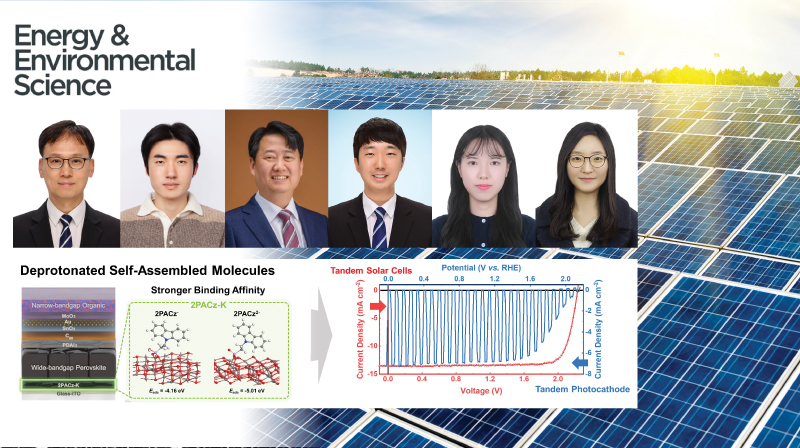
Researchers at UNIST have unveiled a novel interface engineering technique that significantly improves both the performance and durability of perovskite/organic tandem solar cells (POTSCs). Published in the February 2026 issue of Energy & Environmental Science, their study demonstrates how precise control of self-assembled monolayers (SAMs) at the molecular level can lead to more stable, high-efficiency solar devices and open new pathways for solar-driven hydrogen production.
POTSCs are among the most promising photovoltaic technologies, combining different light-absorbing materials to maximize energy conversion. However, instability at the interface between the transparent electrode and the perovskite layer has long hampered their long-term reliability, especially under operational conditions.
Led by Professors Jin-Young Kim and Dong-Seok Kim from the Graduate School of Carbon Neutrality, along with Professor Seung-Jae Shin from the School of Energy and Chemical Engineering, the team developed a method to chemically stabilize this critical interface. They focused on a self-assembled monolayer (SAM) known as 2PACz, which facilitates hole extraction in solar cells.
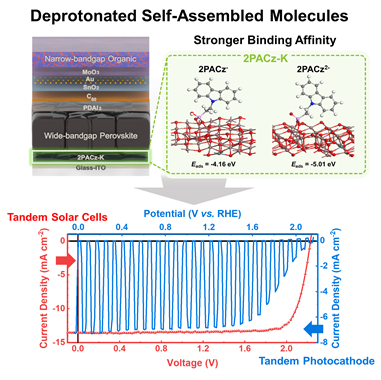
Figure 1. Schematic illustration of the device structure of POTSCs with 2PACz-K and their performance.
By introducing potassium carbonate (K₂CO₃), the team induced a controlled deprotonation of 2PACz molecules—partially removing hydrogen ions from their phosphonic acid groups. This process creates a mixture of mono- and di-deprotonated species (referred to as 2PACz-K), which acquire a negative charge and form stronger, more stable bonds with indium tin oxide (ITO) electrodes. This enhanced bonding results in an interface that is more resistant to solvents used during device fabrication, maintaining uniformity and stability.
Devices fabricated with this chemically tailored interface demonstrated remarkable performance: perovskite solar cells achieved a power conversion efficiency (PCE) of 25.1% and an open-circuit voltage (VOC) of 2.23 V. Moreover, these cells retained over 80% of their initial efficiency after 220 hours of continuous operation under simulated sunlight, indicating substantial improvements in operational stability.
The team also applied this interface engineering approach to photoelectrochemical (PEC) cells designed for water splitting. The resulting tandem PEC device exhibited a high photovoltage of 2.16 V and achieved a solar-to-hydrogen (STH) conversion efficiency of 7.7% without the need for external bias—marking a significant step toward practical, solar-driven hydrogen generation.
Professor Jin-Young Kim stated, "Controlling the chemical state of interfaces at the molecular level allows us to dramatically improve both the efficiency and long-term stability of solar energy devices. This strategy offers a promising avenue for developing integrated systems that convert sunlight directly into electricity and hydrogen, supporting a sustainable energy future."
The study has been supported by the National Research Foundation of Korea (NRF) and the Ministry of Science and ICT (MSIT).
Journal Reference
Jung Geon Son, Ha-eun Koo, Woojin Lee, et al., "Deprotonated self-assembled molecules as robust hole-selective layers for perovskite/organic tandem solar cells and photocathodes," Energy Environ. Sci., (2026).
Related Links
Related Photo


-
New Study Unveils Atomic Disorder Strategy to Enhance Stability and Efficiency of High-Capacity Batteries
-
Innovative Recycling Method to Convert Waste PET into High-Quality Raw Materials and Clean Hydrogen
-
New Study Unveils High-Performance LFP Cathodes to Extend Electric Vehicle Range
-
UNIST Unveils New Organic Semiconductor Photoelectrode for Solar Hydrogen Production