UNIST site map
- Admissions
-
Academics
- Colleges and Schools
-
Academic Affairs
- Academic Calendar
- Academic Curriculum
- Requirements for Graduation
- Browse Open Courses
- Undergraduate Administration
-
Graduate Academic Affairs
- Tuition Fee Payment
- Academic Leave of Absence/ Academic Return
- Voluntary Withdrawal/ Expulsion
- Change of Major
- Change of Degree Program/ Dropping of Degree Program
- Class Period/ Attendance Period/ Academic Year・Semester
- Course Registration
- Course Drop
- Attendance/ Grade/ Exam
- Credit Transfer/ Credit Carryover
- Academic Forms
- Education Support
-
Research/Industry
- Research Aims
- Research Findings
- Researcher Search
-
Research Organizations
- UNIST Multi-Interdisciplinary Institute
- IBS Research Groups
-
UNIST Labs
- Department of Mechanical Engineering
- School of Energy and Chemical Engineering
- Department of Civil
- Department of Materials Science and Engineering
- Department of Nuclear Engineering
- Department of Industrial Engineering
- Department of Design
- Department of Biomedical Engineering
- Department of Biological Sciences
- Department of Electrical Engineering
- Department of Computer Science and Engineering
- Department of Mathematical Sciences
- Department of Chemistry
- Department of Physics
- School of Business Administration
- Graduate School of Carbon Neutrality
- Graduate School of Artificial Intelligence
- Research Support
- University-Industry Relations
- Campus Life
- News Center
- About UNIST
-
etc
- UNIST Bulletin
- Work-Life Balance Support System
- UNIST Gender Equality Plan
- Faculty Invitation for Tenure Track
- Faculty Invitation for Non-Tenure Track
- Board Meeting Minutes
- University Council Meeting Minutes
- Administrative Service Charter
- Privacy Policy
- Copyright Policy
- Rejection of Unauthorized Email Collection
- Operation and Management Policy for Video Information Processing Devices
- Information Disclosure


Connection Points of Knowledge, Everything About UNIST
Try searching.
Recommended search terms


- portal
- U Academics Innovation Center
- Leadership Center
- Dormitory
- Academic Information Center
- International Students Support
- Browse Open Courses
- Course Registration
- Graduation Requirements for Graduation
- Academic Leave of Absence/ Academic Return
- Military Service
- Certificate Issuance
- Academic Calendar
- Scholarships
- Campus Map
- Campus Life Guidebook
- Health Care Center
- Human Rights Center
- portal
- Job Opening
- Announcement for Bid
- UNIST AI Services
- UNIST Daycare Center
- Sports Center
- UI Downloads
- Announcement
- Recruitment of Professors (Non-tenure)
- Faculty Invitation for Tenure Track
- UNIST Academic Information Center
- Office of Research Facilities and Training
- Office of Research Affairs
- Rule Management System
- Academic Calendar


This is a collection of menus necessary for UNIST students .
students
- portal
- U Academics Innovation Center
- Leadership Center
- Dormitory
- Academic Information Center
- International Students Support
- Browse Open Courses
- Course Registration
- Graduation Requirements for Graduation
- Academic Leave of Absence/ Academic Return
- Military Service
- Certificate Issuance
- Academic Calendar
- Scholarships
- Campus Map
- Campus Life Guidebook
- Health Care Center
- Human Rights Center


This is a collection of menus necessary for prospective UNIST Students .
prospective Students


This is a collection of menus necessary for UNIST Faculty & Staff .
Faculty & Staff
- portal
- Job Opening
- Announcement for Bid
- UNIST AI Services
- UNIST Daycare Center
- Sports Center
- UI Downloads
- Announcement
- Recruitment of Professors (Non-tenure)
- Faculty Invitation for Tenure Track
- UNIST Academic Information Center
- Office of Research Facilities and Training
- Office of Research Affairs
- Rule Management System
- Academic Calendar


NEWS CENTER
Discover not only Research Findings and event news, but also the diverse facets of UNIST presented by reporters and writers.
News Center

UNIST News
UNIST to Develop Integrated Security Technologies for Agentic AI
KRW 11 billion project will coordinate defenses across AI models, interfaces, and execution environments.
- News
- JooHyeon Heo
- 2026.09.29
- 785
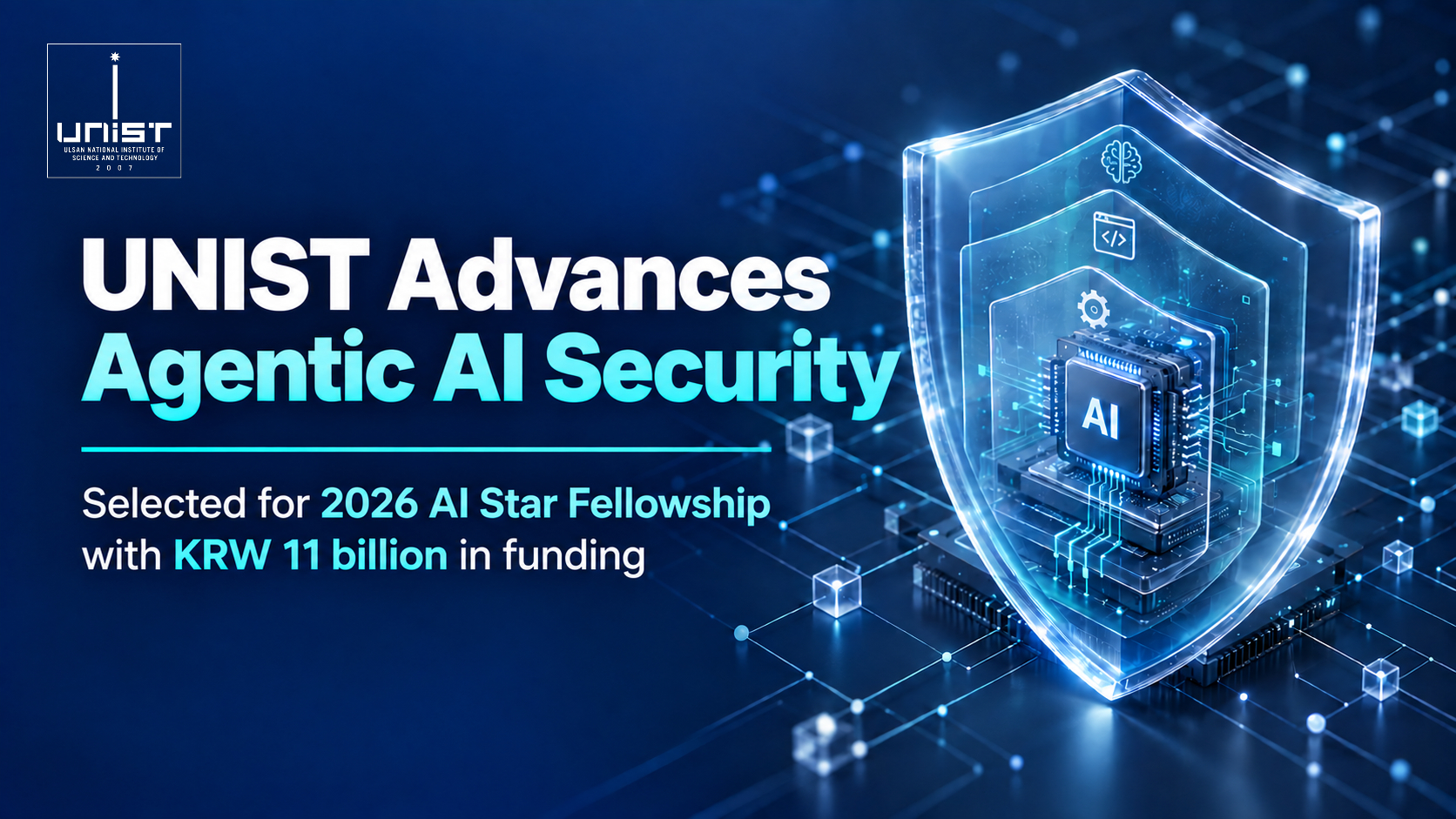
UNIST will lead a five-and-a-half-year research project to develop security technologies for agentic AI, with a focus on preventing malicious inputs from manipulating how AI agents make decisions and carry out tasks.
The project has been selected for the 2026 AI Star Fellowship , supported by the Ministry of Science and ICT (MSIT) and the Institute of Information & Communications Technology Planning & Evaluation (IITP). A consortium, led by UNIST will receive KRW 11 billion in government funding through December 2031, working with Sungkyunkwan University and three AI and cybersecurity companies.
Professor Hyungon Moon, Head of the Department of Computer Science and Engineering, will lead the project. The UNIST team also includes Professors Seongil Wi, Minkyung Park, Saerom Park, and Hyungho Na, alongside researchers from Sungkyunkwan University and industry partners SecuLayer, S2W, and RaonData.

Agentic AI systems can use large language models (LLMs) to read documents, search the web, access external tools, and carry out tasks. These capabilities also introduce security risks: malicious inputs can manipulate an agent's decisions and potentially influence the actions it takes.
Current defenses often protect individual components separately, for example by detecting malicious inputs or isolating execution environments. The research team will instead coordinate safeguards across the model, interface, and execution environment, creating multiple lines of defense so that an attack that bypasses one layer can still be contained at another.
The consortium will pursue three projects addressing security challenges across these layers and test the resulting technologies in services operated by its industry partners. Professor Moon's group brings expertise spanning systems security and AI, including trusted execution environments (TEEs), formal verification, knowledge distillation, and methods for evaluating the performance and limitations of deepfake defenses. Its systems security research has been presented at major international conferences including USENIX Security and the IEEE Symposium on Security and Privacy.
The project will also train early-career researchers working at the intersection of AI and cybersecurity, while seeking to expand the use of AI agents in settings where security concerns have limited their adoption.
“Securing agentic AI requires more than protecting the model itself; the pathways through which inputs enter the system and the environments in which actions are executed must also be protected,” said Professor Moo, Chair of the Department of Computer Science and Engineering. “Through this project, we aim to develop core security technologies spanning all three layers and train researchers who can help advance the safe use of agentic AI.”
Related Links
Related Photo