UNIST site map
- Admissions
-
Academics
- Colleges and Schools
-
Academic Affairs
- Academic Calendar
- Academic Curriculum
- Requirements for Graduation
- Browse Open Courses
- Undergraduate Administration
-
Graduate Academic Affairs
- Tuition Fee Payment
- Academic Leave of Absence/ Academic Return
- Voluntary Withdrawal/ Expulsion
- Change of Major
- Change of Degree Program/ Dropping of Degree Program
- Class Period/ Attendance Period/ Academic Year・Semester
- Course Registration
- Course Drop
- Attendance/ Grade/ Exam
- Credit Transfer/ Credit Carryover
- Academic Forms
- Education Support
-
Research/Industry
- Research Aims
- Research Findings
- Researcher Search
-
Research Organizations
- UNIST Multi-Interdisciplinary Institute
- IBS Research Groups
-
UNIST Labs
- Department of Mechanical Engineering
- School of Energy and Chemical Engineering
- Department of Civil
- Department of Materials Science and Engineering
- Department of Nuclear Engineering
- Department of Industrial Engineering
- Department of Design
- Department of Biomedical Engineering
- Department of Biological Sciences
- Department of Electrical Engineering
- Department of Computer Science and Engineering
- Department of Mathematical Sciences
- Department of Chemistry
- Department of Physics
- School of Business Administration
- Graduate School of Carbon Neutrality
- Graduate School of Artificial Intelligence
- Research Support
- University-Industry Relations
- Campus Life
- News Center
- About UNIST
-
etc
- UNIST Bulletin
- Work-Life Balance Support System
- UNIST Gender Equality Plan
- Faculty Invitation for Tenure Track
- Faculty Invitation for Non-Tenure Track
- Board Meeting Minutes
- University Council Meeting Minutes
- Administrative Service Charter
- Privacy Policy
- Copyright Policy
- Rejection of Unauthorized Email Collection
- Operation and Management Policy for Video Information Processing Devices
- Information Disclosure


Connection Points of Knowledge, Everything About UNIST
Try searching.
Recommended search terms


- portal
- U Academics Innovation Center
- Leadership Center
- Dormitory
- Academic Information Center
- International Students Support
- Browse Open Courses
- Course Registration
- Graduation Requirements for Graduation
- Academic Leave of Absence/ Academic Return
- Military Service
- Certificate Issuance
- Academic Calendar
- Scholarships
- Campus Map
- Campus Life Guidebook
- Health Care Center
- Human Rights Center
- portal
- Job Opening
- Announcement for Bid
- UNIST AI Services
- UNIST Daycare Center
- Sports Center
- UI Downloads
- Announcement
- Recruitment of Professors (Non-tenure)
- Faculty Invitation for Tenure Track
- UNIST Academic Information Center
- Office of Research Facilities and Training
- Office of Research Affairs
- Rule Management System
- Academic Calendar


This is a collection of menus necessary for UNIST students .
students
- portal
- U Academics Innovation Center
- Leadership Center
- Dormitory
- Academic Information Center
- International Students Support
- Browse Open Courses
- Course Registration
- Graduation Requirements for Graduation
- Academic Leave of Absence/ Academic Return
- Military Service
- Certificate Issuance
- Academic Calendar
- Scholarships
- Campus Map
- Campus Life Guidebook
- Health Care Center
- Human Rights Center


This is a collection of menus necessary for prospective UNIST Students .
prospective Students


This is a collection of menus necessary for UNIST Faculty & Staff .
Faculty & Staff
- portal
- Job Opening
- Announcement for Bid
- UNIST AI Services
- UNIST Daycare Center
- Sports Center
- UI Downloads
- Announcement
- Recruitment of Professors (Non-tenure)
- Faculty Invitation for Tenure Track
- UNIST Academic Information Center
- Office of Research Facilities and Training
- Office of Research Affairs
- Rule Management System
- Academic Calendar


NEWS CENTER
Discover not only Research Findings and event news, but also the diverse facets of UNIST presented by reporters and writers.
News Center

UNIST News
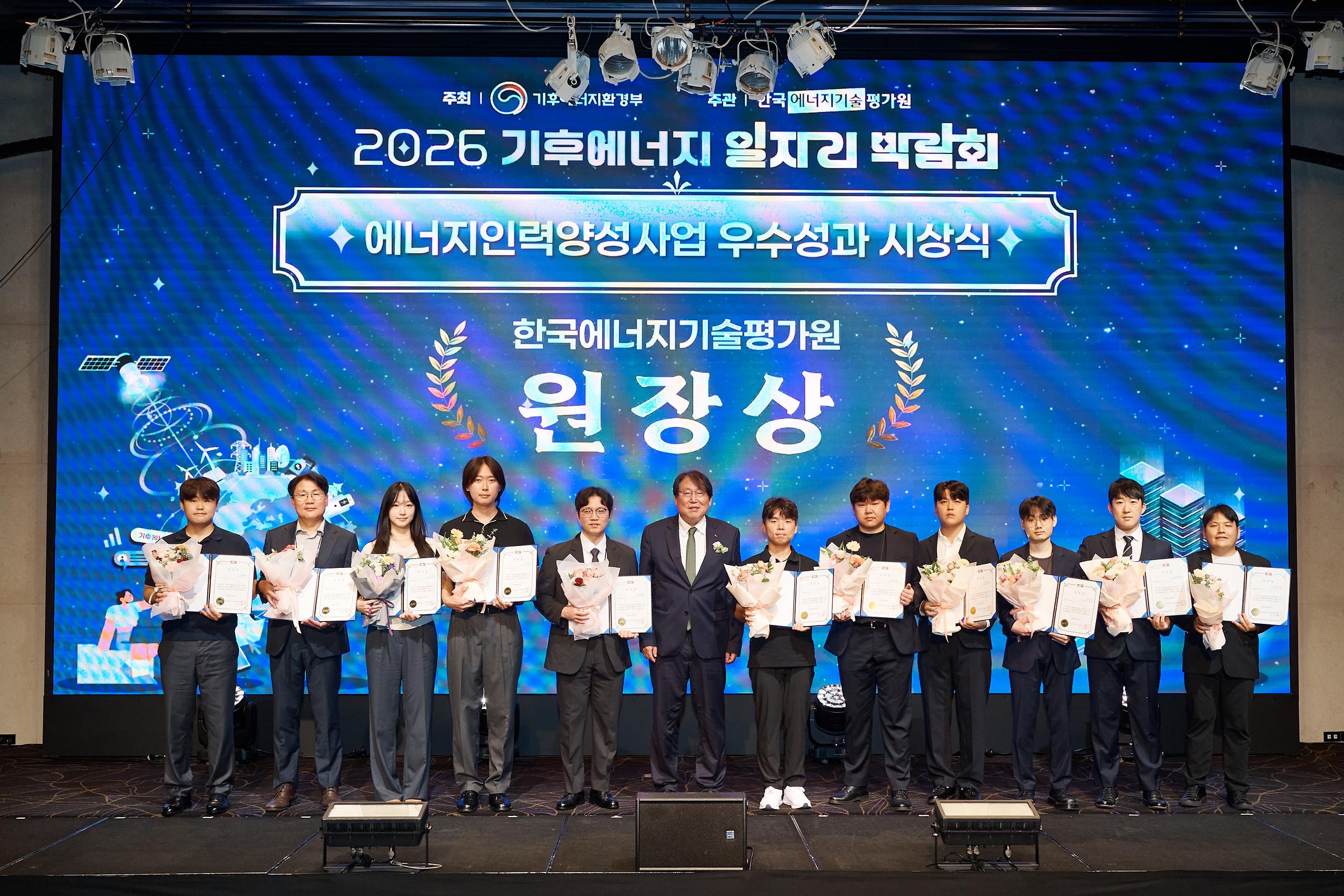
UNIST Nuclear Engineering Recognized for Research and Workforce Development
Two nuclear workforce programs earn recognition, while doctoral researcher DaeHyeon Park honored for spent-fuel storage safety research.
- News
- JooHyeon Heo
- 2026.09.23
- 1462
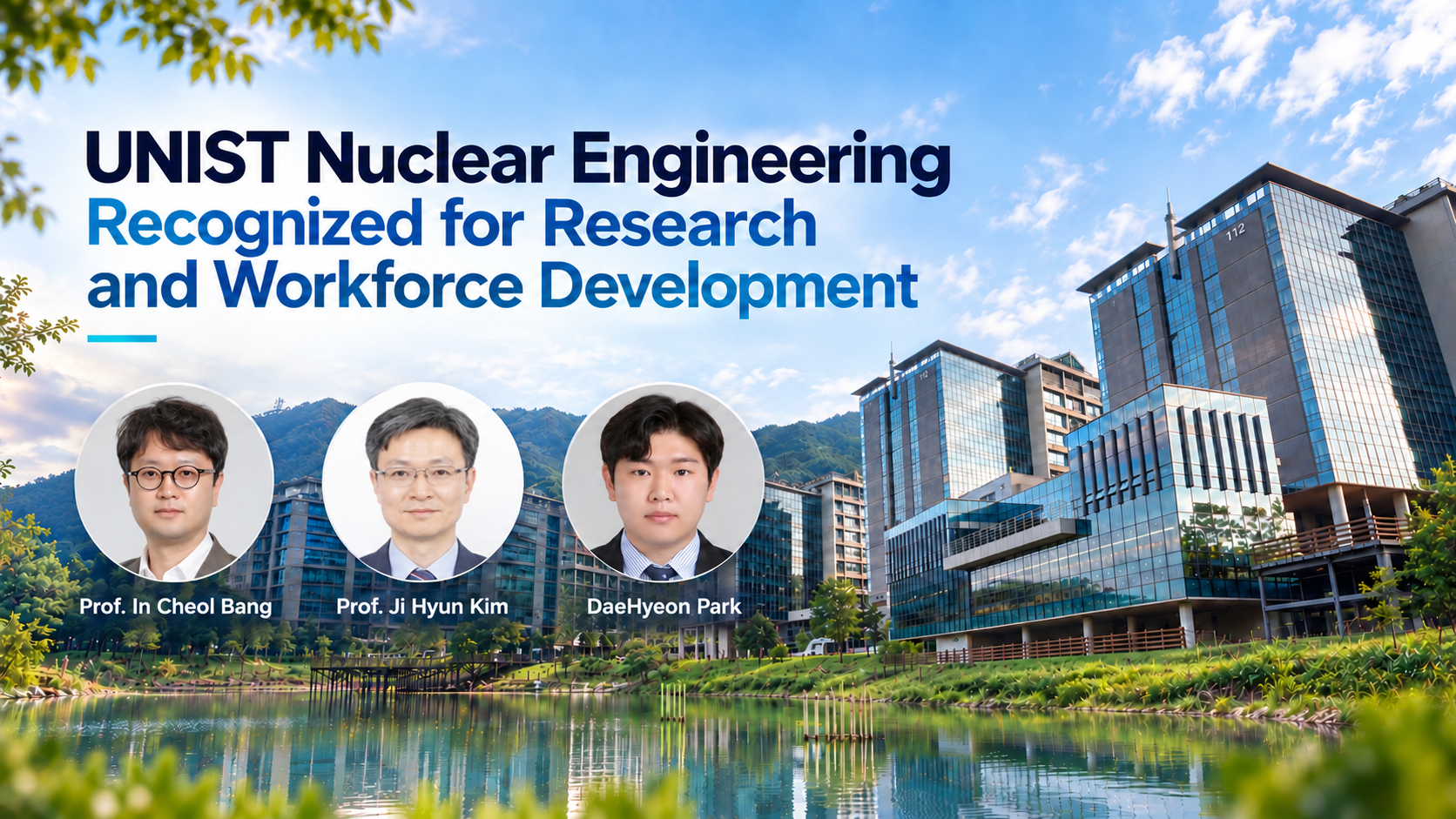
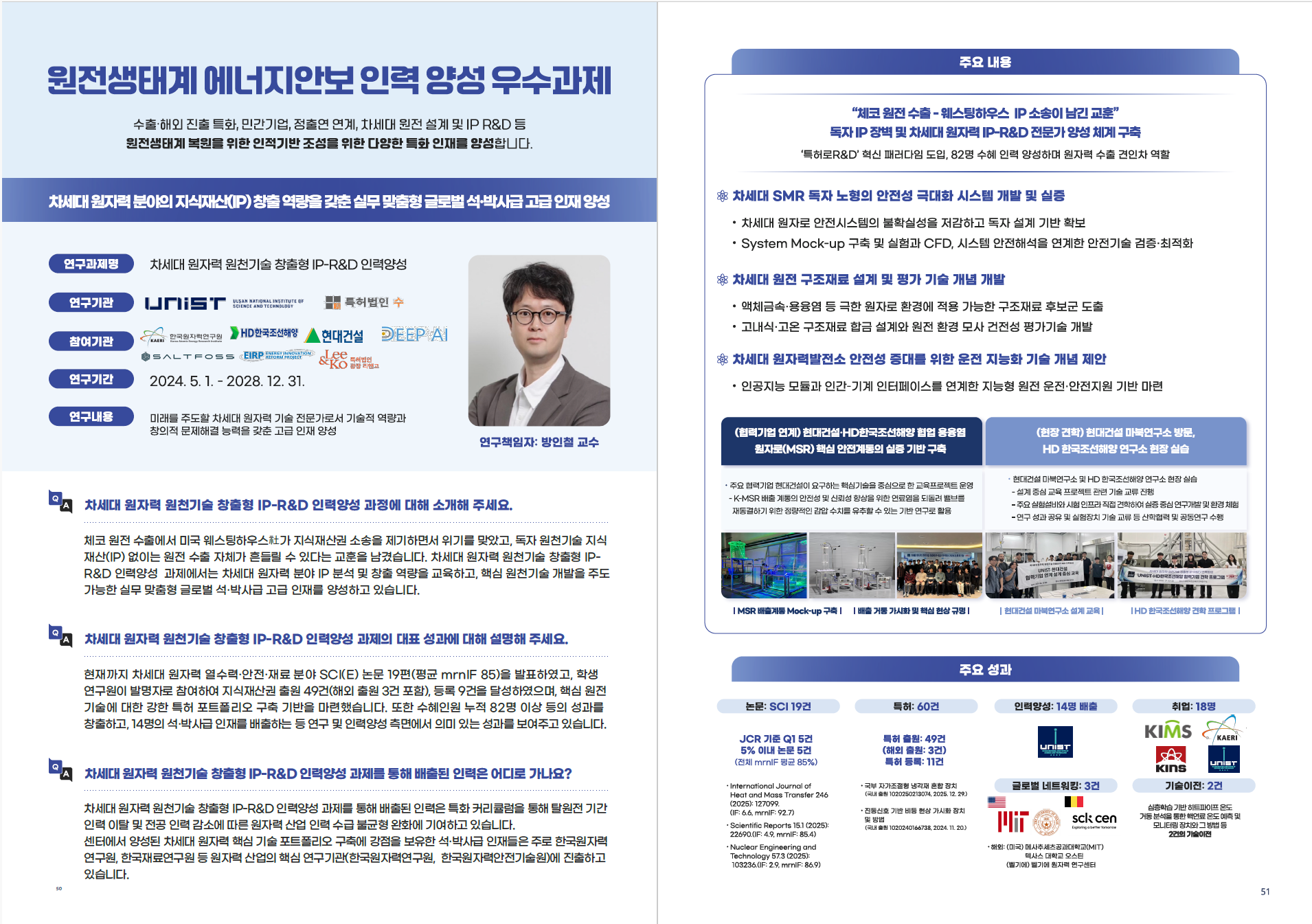
UNIST Department of Nuclear Engineering has earned recognition for both workforce development and student achievement. Two nuclear energy training programs were selected as outstanding projects, while a doctoral researcher was honored for research on the long-term safety of spent-fuel storage materials.
A program, led by Professor In Cheol Bang was recognized for its training of master's and doctoral students in the next-generation nuclear technologies and intellectual property. Students integrate patent analysis and IP strategy into research on advanced reactor safety systems, structural materials for extreme environments, and intelligent operation and safety-support technologies.
Working with industry partners, including Hyundai Engineering & Construction and HD Korea Shipbuilding & Offshore Engineering, the program incorporate industry needs into research and training and provides students with experience at research institutes. To date, it has produced 19 SCI(E)-indexed papers, 49 intellectual property applications, and 14 master's and doctoral graduates.
Another program, involving Professor Ji Hyun Kim's research group was recognized for its approach to nuclear workforce development. Led by Pusan National University, the initiative brings together seven universities across Southeastern Korea, combining shared curriculum with industry research and internships. Training spans advanced reactors, nuclear components and equipment, research reactors and radiation applications, radioactive waste, and environmental remediation.

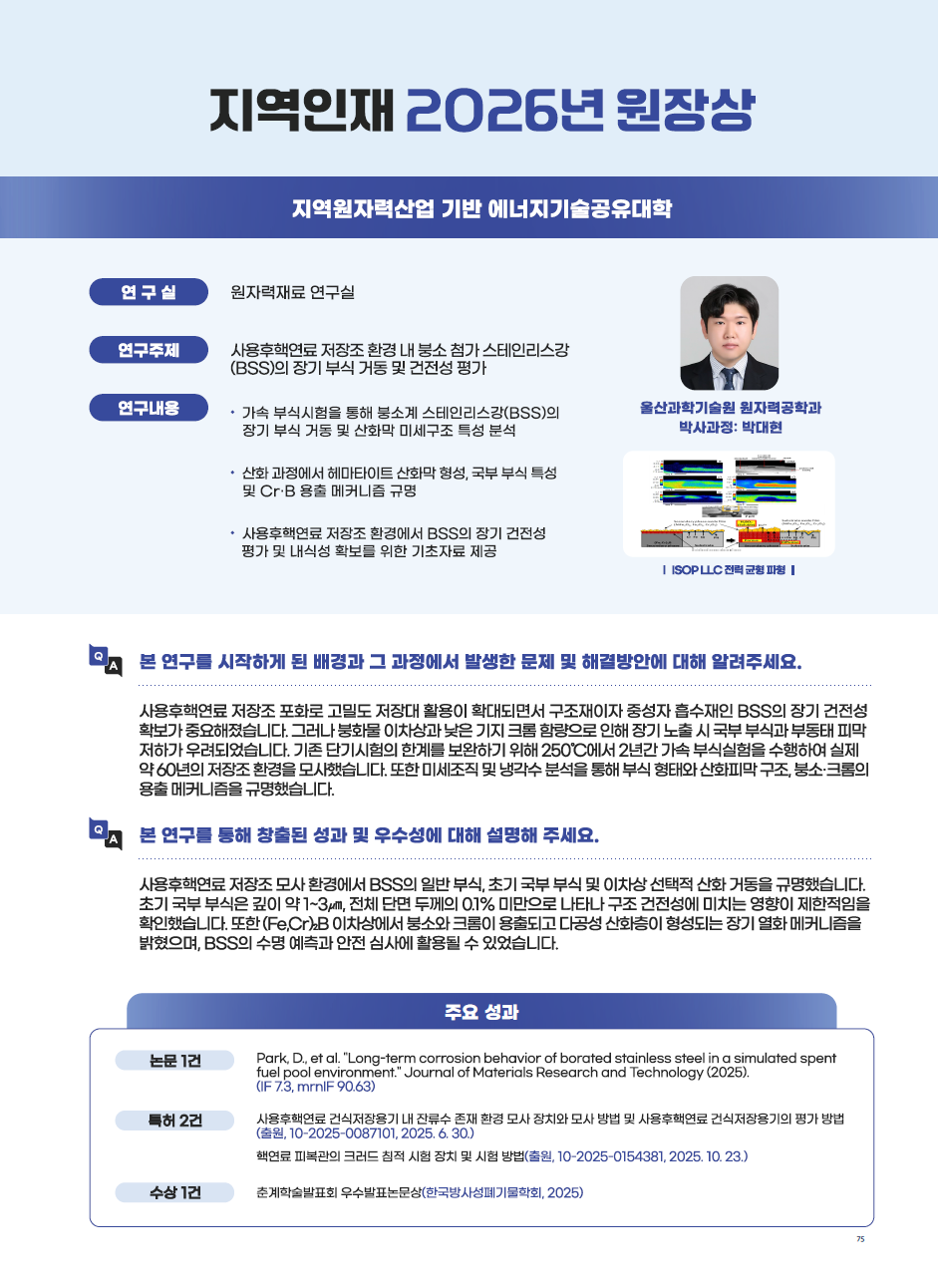
Recognition for Professor Kim's group also extended to student research. DaeHyeon Park, a doctoral researcher in the group, received the Korea Institute of Energy Technology Evaluation and Planning (KETEP) President's Award in the Regional Talent category at the 2026 Climate and Energy Job Fair and Energy Innovation Talent Forum on August 25, 2026.
Park studies borated stainless steel (BSS), a neutron-absorbing material used in spent nuclear fuel storage to prevent criticality accidents. Because storage facilities operate for decades, assessing whether the material retains its function after prolonged corrosion is important to long-term safety.
Park conducted a two-year accelerated corrosion test at 250°C, simulating approximately 60 years of storage conditions. The study identified general surface corrosion, early-stage localized corrosion, and selective oxidation of boron-containing secondary phases. Microstructural analysis also revealed how boron and chromium leach from the material and oxide layers from over time, providing data for assessing the long-term integrity and service life of neutron-absorbing materials.
Park published the research in the Journal of Materials Research and Technology last year and filed two patent applications related to the simulation and evaluation of spent-fuel storage environments. He also received a Best Presentation Paper Award at the Spring Conference of Korean Radioactive Waste Society.
“Spent-fuel storage facilities operate for decades, so it is important to understand not only short-term material performance, but also how materials change over extended periods,” Park said. “This research sought to characterize long-term degradation experimentally and connect those findings to safety assessments of actual storage facilities.”
Professor Kim said the work goes beyond characterizing corrosion to address the long-term integrity and safety of neutron-absorbing materials. “We hope to expand this research from predicting long-term degradation in spent-fuel storage materials to developing new neutron-absorbing structures, contributing to nuclear safety and spent-fuel management.”
Professor Bang's project is supported by KETEP with funding from the Ministry of Trade, Industry and Energy (MOTIE), while the collaborative project involving Professor Kim's group is supported through MOTIE and KETEP's energy workforce development initiative.
Related Links
Related Photo