UNIST site map
- Admissions
-
Academics
- Colleges and Schools
-
Academic Affairs
- Academic Calendar
- Academic Curriculum
- Requirements for Graduation
- Browse Open Courses
- Undergraduate Administration
-
Graduate Academic Affairs
- Tuition Fee Payment
- Academic Leave of Absence/ Academic Return
- Voluntary Withdrawal/ Expulsion
- Change of Major
- Change of Degree Program/ Dropping of Degree Program
- Class Period/ Attendance Period/ Academic Year・Semester
- Course Registration
- Course Drop
- Attendance/ Grade/ Exam
- Credit Transfer/ Credit Carryover
- Academic Forms
- Education Support
-
Research/Industry
- Research Aims
- Research Findings
- Researcher Search
-
Research Organizations
- UNIST Multi-Interdisciplinary Institute
- IBS Research Groups
-
UNIST Labs
- Department of Mechanical Engineering
- School of Energy and Chemical Engineering
- Department of Civil
- Department of Materials Science and Engineering
- Department of Nuclear Engineering
- Department of Industrial Engineering
- Department of Design
- Department of Biomedical Engineering
- Department of Biological Sciences
- Department of Electrical Engineering
- Department of Computer Science and Engineering
- Department of Mathematical Sciences
- Department of Chemistry
- Department of Physics
- School of Business Administration
- Graduate School of Carbon Neutrality
- Graduate School of Artificial Intelligence
- Research Support
- University-Industry Relations
- Campus Life
- News Center
- About UNIST
-
etc
- UNIST Bulletin
- Work-Life Balance Support System
- UNIST Gender Equality Plan
- Faculty Invitation for Tenure Track
- Faculty Invitation for Non-Tenure Track
- Board Meeting Minutes
- University Council Meeting Minutes
- Administrative Service Charter
- Privacy Policy
- Copyright Policy
- Rejection of Unauthorized Email Collection
- Operation and Management Policy for Video Information Processing Devices
- Information Disclosure


Connection Points of Knowledge, Everything About UNIST
Try searching.
Recommended search terms


- portal
- U Academics Innovation Center
- Leadership Center
- Dormitory
- Academic Information Center
- International Students Support
- Browse Open Courses
- Course Registration
- Graduation Requirements for Graduation
- Academic Leave of Absence/ Academic Return
- Military Service
- Certificate Issuance
- Academic Calendar
- Scholarships
- Campus Map
- Campus Life Guidebook
- Health Care Center
- Human Rights Center
- portal
- Job Opening
- Announcement for Bid
- UNIST AI Services
- UNIST Daycare Center
- Sports Center
- UI Downloads
- Announcement
- Recruitment of Professors (Non-tenure)
- Faculty Invitation for Tenure Track
- UNIST Academic Information Center
- Office of Research Facilities and Training
- Office of Research Affairs
- Rule Management System
- Academic Calendar


This is a collection of menus necessary for UNIST students .
students
- portal
- U Academics Innovation Center
- Leadership Center
- Dormitory
- Academic Information Center
- International Students Support
- Browse Open Courses
- Course Registration
- Graduation Requirements for Graduation
- Academic Leave of Absence/ Academic Return
- Military Service
- Certificate Issuance
- Academic Calendar
- Scholarships
- Campus Map
- Campus Life Guidebook
- Health Care Center
- Human Rights Center


This is a collection of menus necessary for prospective UNIST Students .
prospective Students


This is a collection of menus necessary for UNIST Faculty & Staff .
Faculty & Staff
- portal
- Job Opening
- Announcement for Bid
- UNIST AI Services
- UNIST Daycare Center
- Sports Center
- UI Downloads
- Announcement
- Recruitment of Professors (Non-tenure)
- Faculty Invitation for Tenure Track
- UNIST Academic Information Center
- Office of Research Facilities and Training
- Office of Research Affairs
- Rule Management System
- Academic Calendar


NEWS CENTER
Discover not only Research Findings and event news, but also the diverse facets of UNIST presented by reporters and writers.
News Center

UNIST News
Seven Papers from UNIST Accepted to ACM DIS 2026
The research presented at ACM DIS 2026 highlights advances in AI, human-computer interaction, and user experience design.
- News
- JooHyeon Heo
- 2026.07.06
- 1429
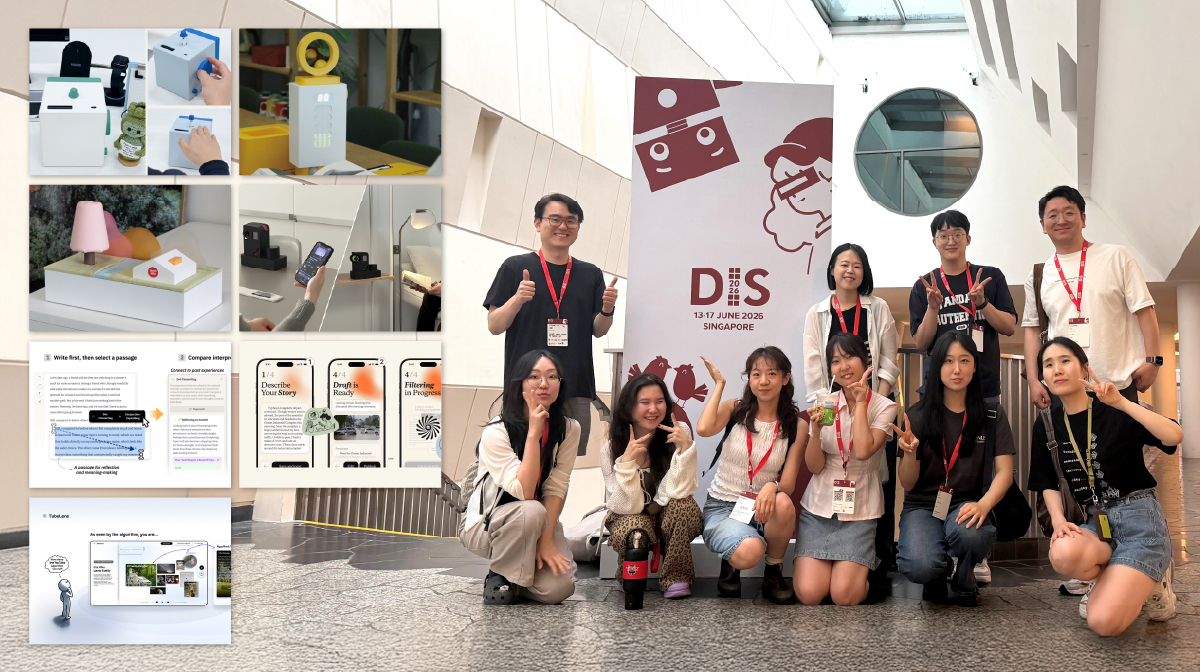
UNIST researchers earned international recognition through seven papers accepted to ACM Designing Interactive Systems (DIS) 2026, one of the world's leading conferences in human-computer interaction (HCI), interactive systems, and user experience (UX) design. Their research explores how emerging technologies—including AI, digital communication, and interactive media—can be designed to better support everyday life, strengthen human relationships, and encourage self-reflection.
Held at the National University of Singapore, ACM DIS brings together researchers from design, computer science, and related disciplines to explore the future of human-centered technologies. Faculty members from the Department of Design at UNIST contributed research spanning embodied interaction, human-centered AI, and algorithmic transparency, demonstrating how thoughtful design can make emerging technologies more intuitive, meaningful, and accessible.
Rethinking Everyday Interaction
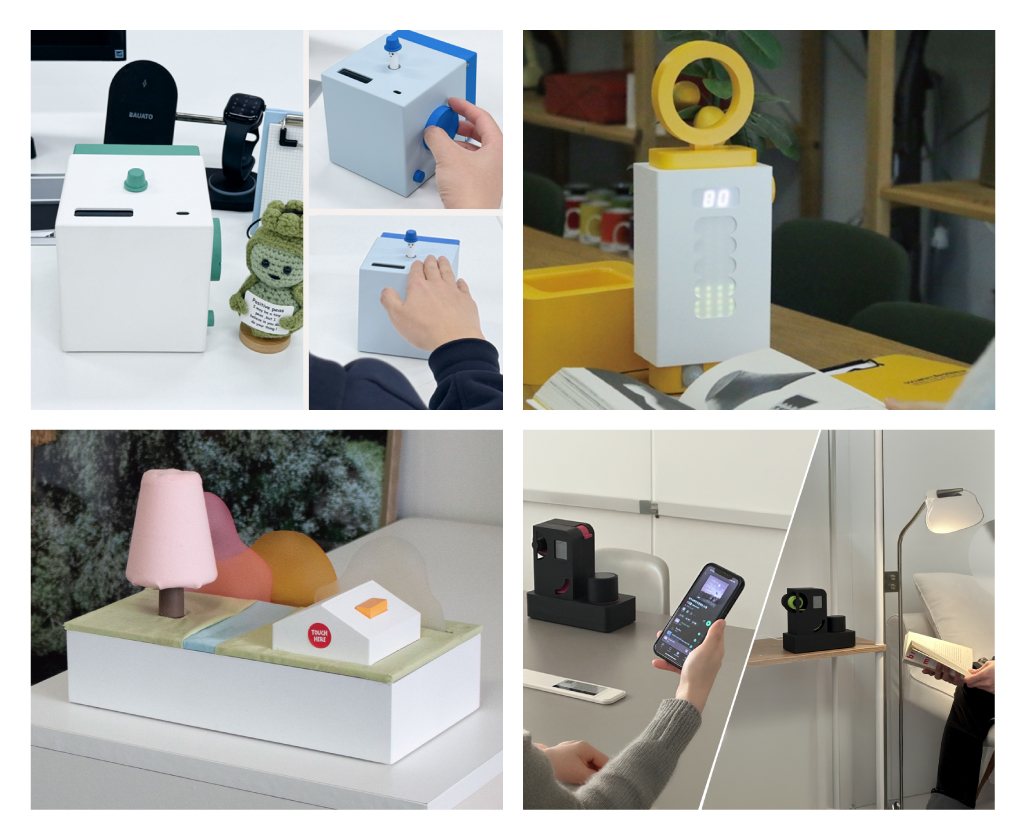
Professor Young-Woo Park's research group presented four papers examining how physical interaction can reshape familiar digital experiences—from notifications and workplace communication to messaging and music sharing.
Together, the four projects demonstrate how subtle changes in interaction design can make everyday technologies more intuitive, expressive, and emotionally engaging. Prepy replaces conventional notification sounds with gentle vertical movement to communicate upcoming events, while SOTATE visualizes a person's social battery to support communication in open-plan offices. Adilet adds a tangible dimension to digital messaging, and Reelee transforms music sharing into an interactive experience that helps people maintain emotional connections across distance.
Human-Centered AI
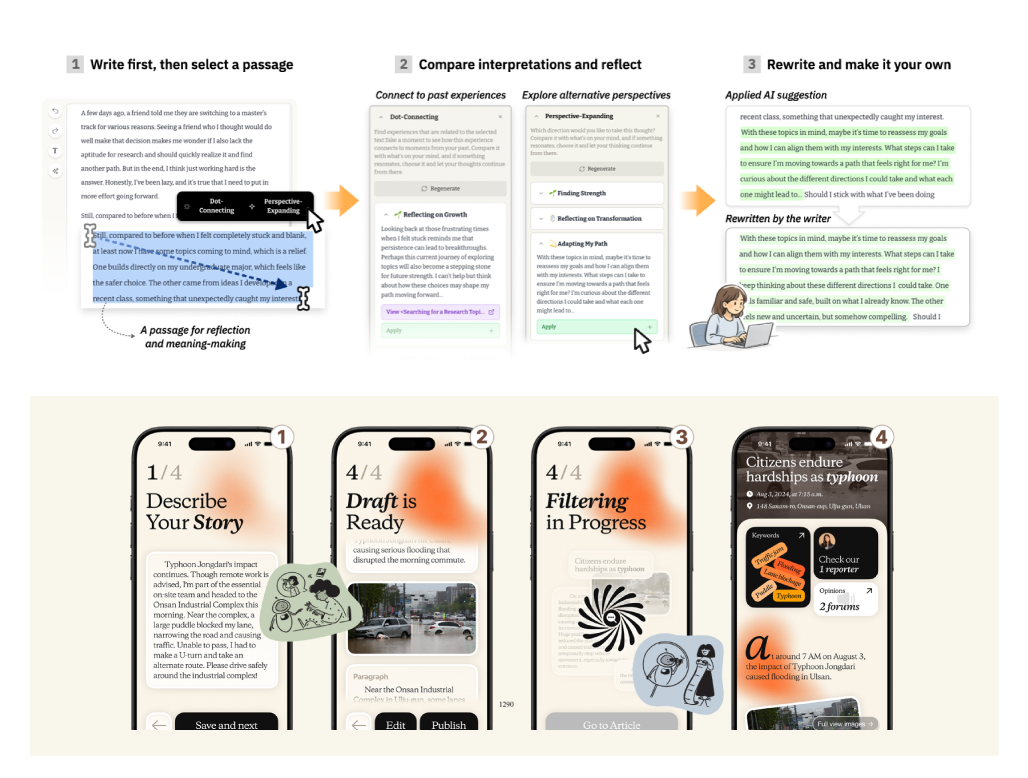
Two papers from Professor Kyungho Lee's group examined how AI can support reflection, creativity, and civic participation while keeping people at the center of decision-making.
Augmentiary uses large language models (LLMs) to support reflective journaling by providing thoughtful feedback that encourages self-reflection while preserving users' agency. Another study presents an AI-assisted platform for local journalism that enables citizens to contribute community news through AI-supported writing combined with collaborative human review, strengthening trust and civic engagement.
Is This the Real Me?
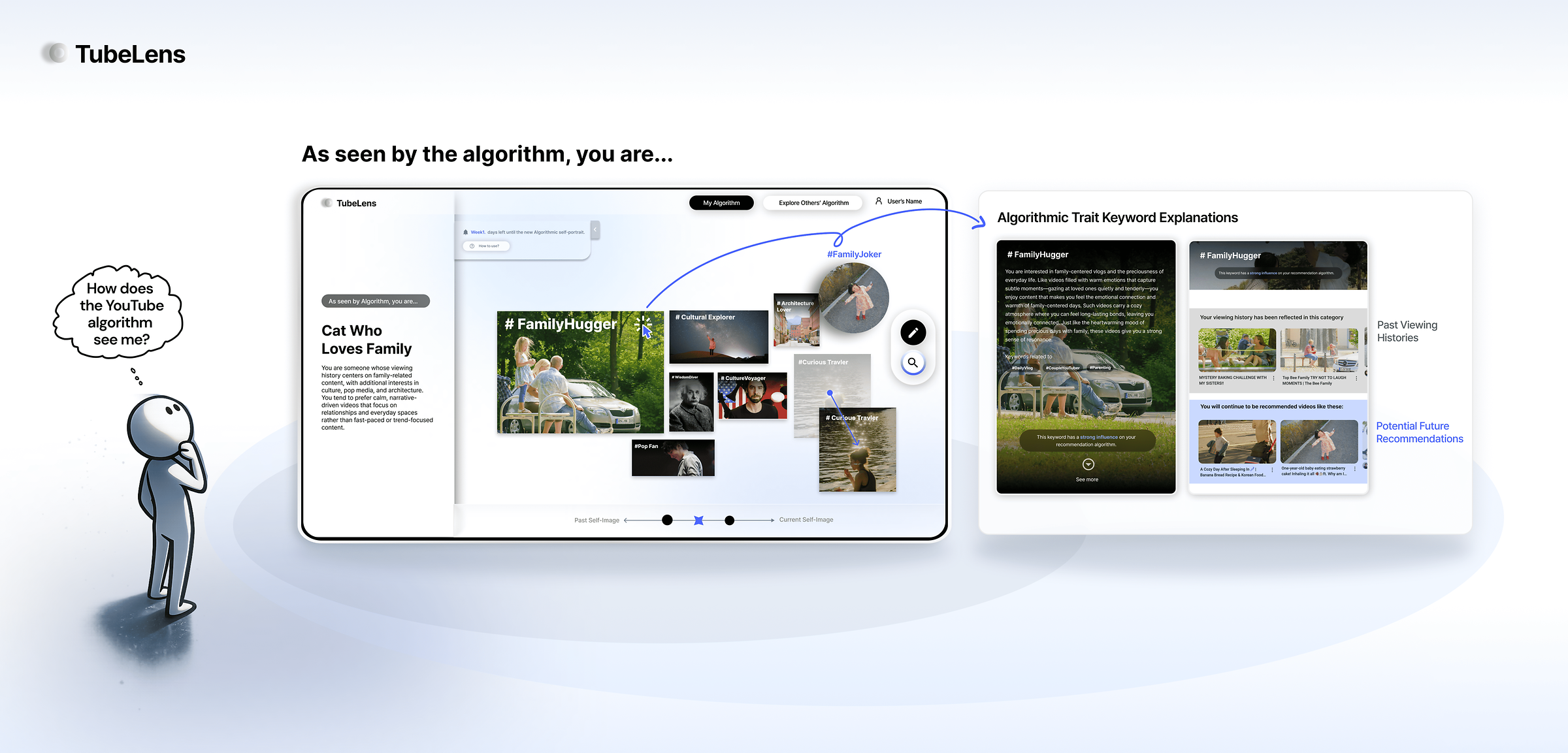
Professor Dajung Kim's research group explored how recommendation algorithms shape digital identity through TubeLens . The project asks a simple but thought-provoking question: " Is This the Real Me?" By transforming a user's YouTube recommendation history into an algorithmic self-portrait, it encourages users to critically examine how recommendation algorithms shape—and sometimes distort—their digital identities.
Although the seven projects span diverse applications, they share a common goal: designing technologies that are more human-centered, transparent, and meaningful. Rather than adding complexity, the research demonstrates how thoughtful interaction design can help people engage with AI and digital systems in more intuitive and empowering ways.
Together, the seven papers reflect the growing international recognition of UNIST's Department of Design in HCI and interactive design research, while highlighting the expanding role of human-centered design in shaping the future of emerging technologies.
Related Links
Related Photo
![[연구진 사진] 'ACM DIS 2026' 학회에서 논문을 발표한 UNIST 디자인학과 연구진들이 기념촬영을 하고 있다.jpg](/app/board/attach/image/589665_1783058342000.do)
![[연구사진1] 프레피(Prepy). 연구에는 이건호, 문진영, 임자하, 김나눔 연구원과 박영우 교수가 참여했다.png](/app/board/attach/image/589666_1783058343000.do)
![[연구사진2] 소테이트(SOTATE). 김나리, 문진영 연구원과 박영우 교수가 연구를 수행했다.png](/app/board/attach/image/589667_1783058343000.do)
![[연구사진3] 아딜렛(Adilet). 연구에는 문진영, 김나눔, 김나리, 이건호 연구원과 박영우 교수가 참여했다.png](/app/board/attach/image/589668_1783058343000.do)
![[연구사진4] 릴리(Reelee). 임자하, 김나리, 이건호 연구원과 박영우 교수가 연구를 이끌었다.png](/app/board/attach/image/589669_1783058343000.do)
![[연구사진5] 어그멘티어리(Augmentiary). 연구에는 황서영, 황수현, 이수환 연구원과 김다정, 이경호 교수가 참여했다.png](/app/board/attach/image/589670_1783058343000.do)
![[연구사진6] AI가 기사 작성과 자료 정리를 돕는 참여형 로컬 저널리즘 참여 모델. 이상윤 연구원과 이경호 교수가 연구를 진행했다.png](/app/board/attach/image/589671_1783058344000.do)
![[연구사진7] 'Is This the Real Me' 논문에서 소개된 튜브렌즈(TubeLens) 시스템. 연구에는 이여원, 김영서, 권유상 연구원과 이경호, 김다정 교수가 참여했다.png](/app/board/attach/image/589672_1783058344000.do)