UNIST site map
- Admissions
-
Academics
- Colleges and Schools
-
Academic Affairs
- Academic Calendar
- Academic Curriculum
- Requirements for Graduation
- Browse Open Courses
- Undergraduate Administration
-
Graduate Academic Affairs
- Tuition Fee Payment
- Academic Leave of Absence/ Academic Return
- Voluntary Withdrawal/ Expulsion
- Change of Major
- Change of Degree Program/ Dropping of Degree Program
- Class Period/ Attendance Period/ Academic Year・Semester
- Course Registration
- Course Drop
- Attendance/ Grade/ Exam
- Credit Transfer/ Credit Carryover
- Academic Forms
- Education Support
-
Research/Industry
- Research Aims
- Research Findings
- Researcher Search
-
Research Organizations
- UNIST Multi-Interdisciplinary Institute
- IBS Research Groups
-
UNIST Labs
- Department of Mechanical Engineering
- School of Energy and Chemical Engineering
- Department of Civil
- Department of Materials Science and Engineering
- Department of Nuclear Engineering
- Department of Industrial Engineering
- Department of Design
- Department of Biomedical Engineering
- Department of Biological Sciences
- Department of Electrical Engineering
- Department of Computer Science and Engineering
- Department of Mathematical Sciences
- Department of Chemistry
- Department of Physics
- School of Business Administration
- Graduate School of Carbon Neutrality
- Graduate School of Artificial Intelligence
- Research Support
- University-Industry Relations
- Campus Life
- News Center
- About UNIST
-
etc
- UNIST Bulletin
- Work-Life Balance Support System
- UNIST Gender Equality Plan
- Faculty Invitation for Tenure Track
- Faculty Invitation for Non-Tenure Track
- Board Meeting Minutes
- University Council Meeting Minutes
- Administrative Service Charter
- Privacy Policy
- Copyright Policy
- Rejection of Unauthorized Email Collection
- Operation and Management Policy for Video Information Processing Devices
- Information Disclosure


Connection Points of Knowledge, Everything About UNIST
Try searching.
Recommended search terms


- portal
- U Academics Innovation Center
- Leadership Center
- Dormitory
- Academic Information Center
- International Students Support
- Browse Open Courses
- Course Registration
- Graduation Requirements for Graduation
- Academic Leave of Absence/ Academic Return
- Military Service
- Certificate Issuance
- Academic Calendar
- Scholarships
- Campus Map
- Campus Life Guidebook
- Health Care Center
- Human Rights Center
- portal
- Job Opening
- Announcement for Bid
- UNIST AI Services
- UNIST Daycare Center
- Sports Center
- UI Downloads
- Announcement
- Recruitment of Professors (Non-tenure)
- Faculty Invitation for Tenure Track
- UNIST Academic Information Center
- Office of Research Facilities and Training
- Office of Research Affairs
- Rule Management System
- Academic Calendar


This is a collection of menus necessary for UNIST students .
students
- portal
- U Academics Innovation Center
- Leadership Center
- Dormitory
- Academic Information Center
- International Students Support
- Browse Open Courses
- Course Registration
- Graduation Requirements for Graduation
- Academic Leave of Absence/ Academic Return
- Military Service
- Certificate Issuance
- Academic Calendar
- Scholarships
- Campus Map
- Campus Life Guidebook
- Health Care Center
- Human Rights Center


This is a collection of menus necessary for prospective UNIST Students .
prospective Students


This is a collection of menus necessary for UNIST Faculty & Staff .
Faculty & Staff
- portal
- Job Opening
- Announcement for Bid
- UNIST AI Services
- UNIST Daycare Center
- Sports Center
- UI Downloads
- Announcement
- Recruitment of Professors (Non-tenure)
- Faculty Invitation for Tenure Track
- UNIST Academic Information Center
- Office of Research Facilities and Training
- Office of Research Affairs
- Rule Management System
- Academic Calendar


NEWS CENTER
Discover not only Research Findings and event news, but also the diverse facets of UNIST presented by reporters and writers.
News Center

UNIST News
UNIST Hosts 2026 Korea Industrial AI Forum to Advance Manufacturing Transformation
Industry leaders and researchers discuss practical strategies for accelerating AI adoption in manufacturing.
- News
- JooHyeon Heo
- 2026.06.15
- 2489

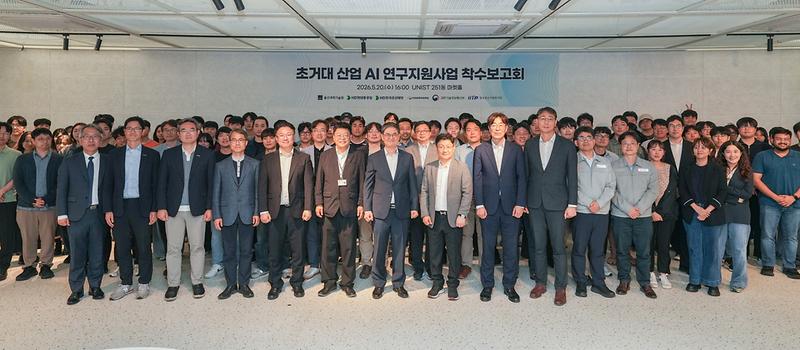
UNIST brought together leaders from industry and academia to explore the future of artificial intelligence (AI) in manufacturing at the 2026 Korea Industrial AI Forum , held on June 9 at the Peace & Park Convention Royal Hall in Seoul.
The forum was jointly organized by UNIST, the Korea Industrial Technology Association (KOITA), LS ELECTRIC, LG AI Research, and POSCO Holdings under the theme "Designing the Manufacturing AI Advantage in the Era of AI Transformation." More than 200 participants attended to discuss strategies for deploying AI in manufacturing, industry applications, and collaboration models to strengthen industrial competitiveness.
In opening remarks, Vice President Hyun Sil Ahn for Research Affairs at UNIST noted that AI is evolving beyond generative systems toward technologies capable of autonomous decision-making and interaction with the physical world. “AI is no longer an optional technology—it has become essential infrastructure for industrial competitiveness,” said Vice President Ahn. “The challenge is not how much AI an organization possesses, but how effectively it can apply AI to create industrial value.”
The keynote address was delivered by WooHyung Lim, Head of LG AI Research, who introduced the company's AI strategy and industrial applications under the theme “ The Industrial Ecosystem Evolving Through AI .”
The first session, “ Korean Manufacturing AI 2030: Strategy and Execution ,” focused on pathways for accelerating AI adoption across manufacturing industries. Boseon Yu, Chief Technology Office of INEEJI , presented strategies for AI-driven manufacturing innovation, while YoungOk Kim, Executive Director of HD Hyundai, shared the company's experience implementing AI technologies in industrial settings.
INEEJI, founded by Professor Jaesik Choi during his tenure at UNIST, specializes in industrial data analytics and manufacturing process optimization. Its participation highlighted how university-based AI research can translate into practical industrial solutions.
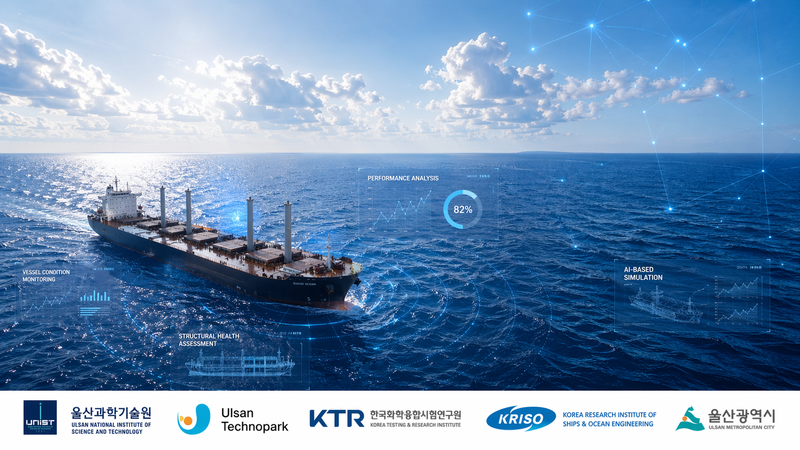
The forum also highlighted UNIST's collaboration with HD Hyundai in advancing AI transformation in shipbuilding. UNIST currently leads the shipbuilding component of the Ministry of Science and ICT's national initiative for large-scale industrial AI research in partnership with HD Hyundai Heavy Industries, HD Korea Shipbuilding & Offshore Engineering, and CrowdWorks.
Supported by KRW 40.3 billion in funding, the initiative aims to develop multimodal AI foundation models that integrate design, production, quality-control, video, and sensor data generated across shipbuilding operations, while validating these technologies in real industrial environments.
The second session, “AI Transformation in Industrial Settings,” featured Young-Sin Heo, Chief Business Officer (CBO) at MakinaRocks Co. Ltd., who discussed the emerging impact of agentic AI in manufacturing, and Vice President Hyundong Lee of Superb AI Inc., who examined key requirements for implementing physical AI technologies in industry.
The forum concluded with a panel discussion examining one of the central questions facing industry today: how to bridge the gap between AI strategy and implementation. Participants emphasized that sustained collaboration among universities, technology developers, and manufacturers will be critical to ensuring that advances in AI translate into tangible industrial outcomes.
“Manufacturing AI will be a defining driver of Korea’s industrial competitiveness,” Ahn said. “UNIST remains committed to advancing AI transformation through collaborative research with industry, large-scale demonstrations, and the cultivation of AI talent equipped to address real-world challenges.”
Related Links
Related Photo