UNIST site map
- Admissions
-
Academics
- Colleges and Schools
-
Academic Affairs
- Academic Calendar
- Academic Curriculum
- Requirements for Graduation
- Browse Open Courses
- Undergraduate Administration
-
Graduate Academic Affairs
- Tuition Fee Payment
- Academic Leave of Absence/ Academic Return
- Voluntary Withdrawal/ Expulsion
- Change of Major
- Change of Degree Program/ Dropping of Degree Program
- Class Period/ Attendance Period/ Academic Year・Semester
- Course Registration
- Course Drop
- Attendance/ Grade/ Exam
- Credit Transfer/ Credit Carryover
- Academic Forms
- Education Support
-
Research/Industry
- Research Aims
- Research Findings
- Researcher Search
-
Research Organizations
- UNIST Multi-Interdisciplinary Institute
- IBS Research Groups
-
UNIST Labs
- Department of Mechanical Engineering
- School of Energy and Chemical Engineering
- Department of Civil
- Department of Materials Science and Engineering
- Department of Nuclear Engineering
- Department of Industrial Engineering
- Department of Design
- Department of Biomedical Engineering
- Department of Biological Sciences
- Department of Electrical Engineering
- Department of Computer Science and Engineering
- Department of Mathematical Sciences
- Department of Chemistry
- Department of Physics
- School of Business Administration
- Graduate School of Carbon Neutrality
- Graduate School of Artificial Intelligence
- Research Support
- University-Industry Relations
- Campus Life
- News Center
- About UNIST
-
etc
- UNIST Bulletin
- Work-Life Balance Support System
- UNIST Gender Equality Plan
- Faculty Invitation for Tenure Track
- Faculty Invitation for Non-Tenure Track
- Board Meeting Minutes
- University Council Meeting Minutes
- Administrative Service Charter
- Privacy Policy
- Copyright Policy
- Rejection of Unauthorized Email Collection
- Operation and Management Policy for Video Information Processing Devices
- Information Disclosure


Connection Points of Knowledge, Everything About UNIST
Try searching.
Recommended search terms


- portal
- U Academics Innovation Center
- Leadership Center
- Dormitory
- Academic Information Center
- International Students Support
- Browse Open Courses
- Course Registration
- Graduation Requirements for Graduation
- Academic Leave of Absence/ Academic Return
- Military Service
- Certificate Issuance
- Academic Calendar
- Scholarships
- Campus Map
- Campus Life Guidebook
- Health Care Center
- Human Rights Center
- portal
- Job Opening
- Announcement for Bid
- UNIST AI Services
- UNIST Daycare Center
- Sports Center
- UI Downloads
- Announcement
- Recruitment of Professors (Non-tenure)
- Faculty Invitation for Tenure Track
- UNIST Academic Information Center
- Office of Research Facilities and Training
- Office of Research Affairs
- Rule Management System
- Academic Calendar


This is a collection of menus necessary for UNIST students .
students
- portal
- U Academics Innovation Center
- Leadership Center
- Dormitory
- Academic Information Center
- International Students Support
- Browse Open Courses
- Course Registration
- Graduation Requirements for Graduation
- Academic Leave of Absence/ Academic Return
- Military Service
- Certificate Issuance
- Academic Calendar
- Scholarships
- Campus Map
- Campus Life Guidebook
- Health Care Center
- Human Rights Center


This is a collection of menus necessary for prospective UNIST Students .
prospective Students


This is a collection of menus necessary for UNIST Faculty & Staff .
Faculty & Staff
- portal
- Job Opening
- Announcement for Bid
- UNIST AI Services
- UNIST Daycare Center
- Sports Center
- UI Downloads
- Announcement
- Recruitment of Professors (Non-tenure)
- Faculty Invitation for Tenure Track
- UNIST Academic Information Center
- Office of Research Facilities and Training
- Office of Research Affairs
- Rule Management System
- Academic Calendar


NEWS CENTER
Discover not only Research Findings and event news, but also the diverse facets of UNIST presented by reporters and writers.
News Center

UNIST News
Two UNIST Graduate Students Selected for 2026 Presidential Science Scholarship
Their research spans sunlight-driven green hydrogen production and AI that understands visual context across video and 3D environments.
- Community
- JooHyeon Heo
- 2026.08.24
- 82
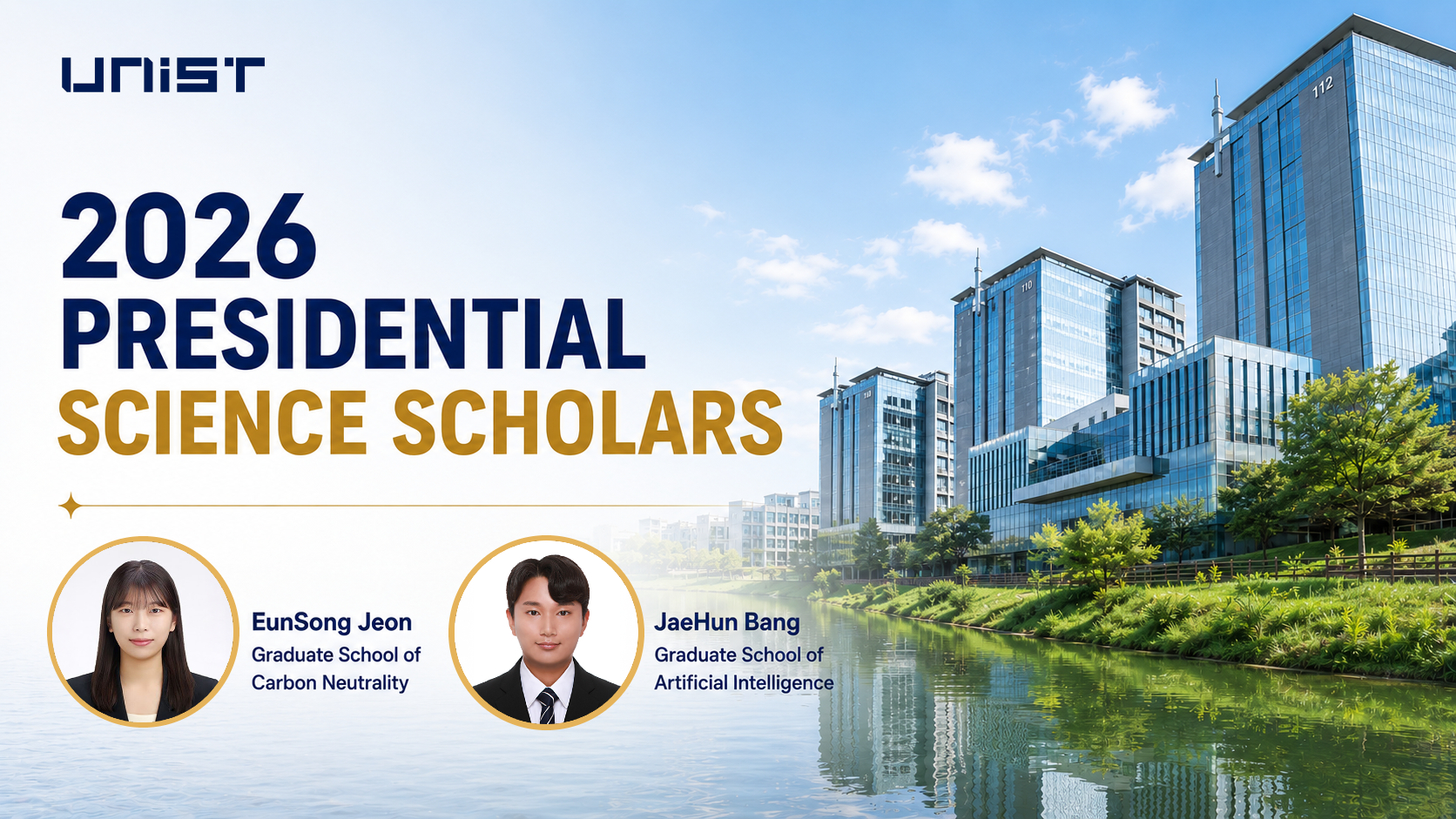
Two UNIST graduate students have been selected for the 2026 Presidential Science Scholarship for research in green hydrogen production and artificial intelligence (AI).
EunSong Jeon, a Ph.D. student in the Graduate School of Carbon Neutrality, is developing a photoelectrochemical system that produces green hydrogen using sunlight. Her work combines an organic semiconductor photoanode and photocathode in a single cell, enabling water splitting without an external voltage.
Organic semiconductor photoelectrodes offer broad light absorption and solution processability, but their performance can decline over time. Her research focuses on improving conversion efficiency and extending cell lifetime, with the longer-term goal of advancing solar hydrogen technologies for carbon-neutral energy systems.
“Receiving this scholarship is especially meaningful because it recognizes both my research and its potential for further development,” Jeon said. “I am grateful to Professor Han Hee Cho for his guidance and to my colleagues for their support throughout the research.”
JaeHun Bang, a master's student in the Graduate School of Artificial Intelligence, develops AI that can interpret visual context and connect natural-language requests with objects and events in its surroundings.
His research on video retrieval addresses a limitation of existing models, which often focus on prominent subjects while missing background details and changes over time. By segmenting videos at scene transitions and incorporating descriptions of both key subjects and surrounding context, he identified where current models struggle with complex contextual and temporal questions. The resulting paper, “Beyond the Highlights,” was accepted at WACV 2026.
He has since extended this work to 3D environments. LightSplat , accepted at CVPR 2026, allows users to locate objects using natural-language descriptions such as white sofa or egg on ramen, without relying on predefined object categories. The method requires about five seconds of preprocessing and, depending on the comparison, runs 50 to 400 times faster while using one sixty-fourth of the memory. Potential applications range from robots responding to spoken instructions to natural-language interaction in AR and VR and equipment or hazard searches in digital twins.
He previously conducted research on 3D scene understanding at Carnegie Mellon University and is currently an intern at LG AI Research, where he develops vision-language models for EXAONE. His goal is to combine fine-grained video understanding with language-based 3D perception to develop AI that can better interpret context and human intent.
“This scholarship gives me greater momentum to build on my research,” Bang said. “I am grateful to Professor Kyungdon Joo for his guidance, and I hope to develop AI that can communicate and collaborate naturally with people in unfamiliar environments.”
This year's Presidential Science Scholarship drew approximately 22 applicants for each available award. Selected master's students receive KRW 1.5 million per month, while doctoral students receive KRW 2 million per month.
Related Links
Related Photo