UNISTUNIST

ADMISSIONS

발전기금 알림마당
모바일메뉴 열기
 

UNIST site map

전체 메뉴 닫기
STUDENT
 
Scroll Down

UNIST Today

we are all

pioneers!

UNIque & beST

Nexus

UNIST Today

we are all

pioneers!

UNIque & beST

Nexus

Information for UNISTar

WHY UNIST

star

Global
Campus for
Future
Innovators

Research AREA

중점연구분야

Research
AREA

에너지·AI·미래산업에 집중하다

UNIST는 에너지 전환, AI, 미래산업이라는
대한민국의 핵심 과제에 연구 역량을 집중합니다.

  • 에너지 전환
  • 이차전지 · 수소 · 탄소중립
  • Ai 기반 산업 혁신
  • 반도체 · 소재 · 양자
EDUCATION INNOVATION

교육혁신프로그램

EDUCATION
INNOVATION

이론을 배우는 것을 넘어 직접
연구하며 성장하다

UNIST의 학부생부터 대학원생까지 연구의
보조가 아닌 주체로 성장하는 경험을 제공합니다.

  • 학부생 연구참여
  • 국제학회·논문참여
  • 소수정예 밀착 연구지도
industry collaboration

산학협력

industry
collaboration

연구에서 산업까지, 현장과 가장
가까운 UNIST

대한민국 최대 산업도시 울산에 위치한
UNIST는 연구 성과가 기업과 산업 현장으로
가장 빠르게 연결되는 구조를 갖추고 있습니다.

  • 기술사업화·창업지원
  • 울산 산업단지
  • 대기업 · 공기업과의 공동연구
Research support

연구지원

Research
support

젊은 UNIST, 연구에 최적화된
유연한 캠퍼스

UNIST는 가장 늦게 출범한 과기원으로,
관행에 얽매이지 않는 유연한 연구·교육 시스템을
갖추고 있습니다.

  • 빠른 신흥 분야 대흥
  • 단일 캠퍼스 기반
  • 생활.연구 일체형 구조
  • 개방형 연구 공간

Research Impact

star

DNA와 단백질 결합 보려 붙인 형광 꼬리표가 되레 단백질 떼어냈다!

DNA가 손상되면 복구 단백질들이 DNA 위를 돌아다니며 손상된 곳을 찾고, 손상 부위를 잘라내거나 고친다. 질병과 밀접한 DNA 손상 복구 기전을 이해하려면 DNA와 단백질의 ‘만남’ 과정을 살펴봐야 하는 이유다. 그런데 이 과정을 관찰하기 위해 쓰는 형광 ‘꼬리표’가 오히려 단백질을 DNA에서 떼어낼 수 있다는 사실을 국내 연구진이 밝혀냈다. 연구팀은 이러한 간섭을 줄일 수 있는 기준도 찾아내, 더 정확한 단분자 관찰로 DNA 손상 복구 기전을 밝히는 데 도움이 될 것으로 기대된다. UNIST 생명과학과 이자일 교수와 바이오메디컬공학과 박종남 교수 공동연구팀은 상용 양자점 표면의 폴리에틸렌글리콜(Polyethylene Glycol, PEG)이 단백질과 DNA의 결합을 방해한다는 사실을 규명하고, 이를 막을 수 있는 양자점 표면 설계 기준을 제시했다고 9일 밝혔다. 양자점은 일반 형광 염료보다 밝고 빛을 오래 내기 때문에, 관찰 대상 단백질에 형광 꼬리표처럼 붙여 움직임을 추적할 수 있는 나노 물질이다. 연구에 따르면, 양자점 표면에 PEG가 과도하게 입혀지면 단백질과 DNA 사이의 결합이 약해진다. PEG는 양자점을 수용액에 분산시키고 항체를 연결하기 위해 양자점 표면에 입히는 고분자 중 하나지만, 표면에서 차지하는 비율이 지나치게 높으면 관찰 대상의 결합까지 방해하는 것이다. 항체는 양자점이 관찰 대상 단백질과만 붙도록 해주는 물질이다. 연구팀은 DNA 손상 복구 단백질인 XPA와 DNA 간의 결합을 양자점으로 관찰하던 중, 상용 양자점의 농도가 높아질수록 XPA가 DNA에서 떨어지는 현상을 발견해 이번 연구를 시작했다. 양자점의 종류와 크기, 연결된 항체와 DNA 구조를 바꿔도 같은 현상이 나타났다. 양자점 표면 성분을 나눠 실험해본 결과, 원인은 PEG였다. 분자 크기가 다른 PEG를 직접 넣어도 XPA가 DNA에서 떨어진 반면, 다른 고분자인 덱스트란은 결합을 방해하지 않았다. 또 다른 DNA 손상 인식 단백질인 UV-DDB에서도 같은 현상이 확인됐는데, 이는 다양한 단백질-DNA 연구에서 유사한 간섭이 발생할 수 있음을 시사한다. 연구팀은 양자점 표면에서 PEG 계열 성분이 차지하는 비율을 조절한 결과, 7% 미만일 때 단백질-DNA 결합이 유지된다는 기준도 찾아냈다. PEG 비율을 낮춘 양자점은 밝기와 수용액 내 안정성도 유지해 단분자 관찰에 활용할 수 있었다. 새 양자점을 이용해 XPA가 DNA 손상 부위를 찾는 방식도 밝혔다. XPA는 DNA에 붙은 채 가닥을 따라 움직이는 ‘1차원 확산’과 용액 속을 돌아다니다가 벌어진 DNA 구조에 직접 부딪혀 결합하는 ‘3차원 충돌’을 모두 이용하는 것으로 나타났다. 단백질 농도가 낮을 때는 1차원 확산이 표적을 찾는 데 유리한 것으로 알려져 있지만, 세포 내부에서 농도가 높은 XPA는 3차원 충돌이 주된 탐색 방식이었다. 이번 연구에는 UNIST 생명과학과 김영서 연구원과 에너지화학공학과 김혜림 연구원이 공동 제1저자로 참여했다. 박종남 교수는 “양자점 표면을 덮는 물질의 종류와 비율을 정밀하게 조절해 밝기와 안정성은 유지하면서 생체분자에 미치는 간섭은 줄였다”며 “이 같은 설계 방식은 양자점뿐 아니라 다양한 나노입자 기반 생물학 연구 도구를 개발하는 데도 활용할 수 있을 것”이라고 설명했다. 이자일 교수는 “상용 양자점이 단순한 관찰 도구가 아니라 단백질과 DNA의 결합 자체를 흔들 수 있다는 점을 처음으로 체계적으로 확인했다”며 “이번에 개발한 양자점은 생체분자의 원래 상호작용을 유지하면서 단분자의 움직임을 더 정확하게 관찰하는 데 활용할 수 있을 것”이라고 말했다. 이번 연구는 한국연구재단(NRF), 기초과학연구원(IBS), 산업통상부 기술혁신사업의 지원을 받아 수행됐다. 연구 결과는 국제학술지 ‘나노 컨버전스(Nano Convergence)’에 6월 3일 온라인 게재됐다.

2026.07.25

  • DNA
  • DNA손상복구
  • 단분자이미징
  • 바이오메디컬공학과
  • 생명과학과
  • 양자점
  • 퀀텀닷
  • 형광표지자

구부리면 숨겨진 그림 나타나는 투명 보안 필름 개발

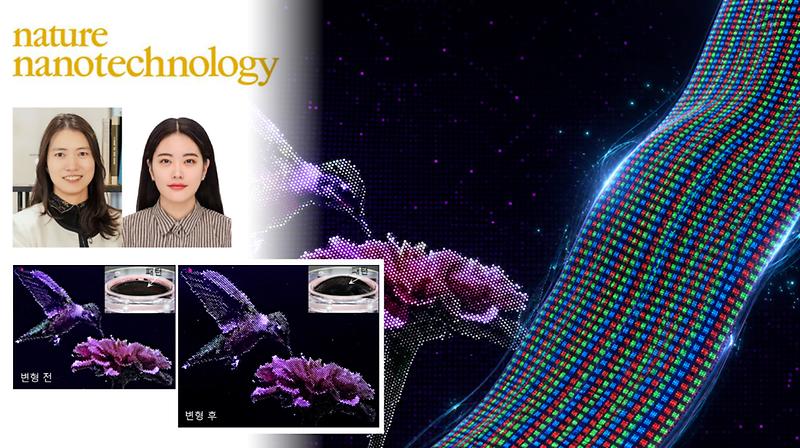
평소에는 투명했다가 구부리면 숨겨진 이미지가 드러나는 보안 필름이 새롭게 개발됐다. 보는 각도를 1도만 바꿔도 색이 또렷하게 변해 같은 각도 범위 안에 더 많은 보안정보를 담을 수 있고, 정품 여부도 더 쉽게 확인할 수 있게 됐다. UNIST 기계공학과 김태성 교수팀은 기하학적으로 설계한 주름 구조를 활용해 평소에는 보이지 않던 이미지가 구부렸을 때 보는 각도에 따라 다채로운 구조색으로 나타나는 ‘광학 보안 필름’을 개발했다고 8일 밝혔다. 구조색은 염료가 아닌 표면의 미세구조가 빛을 반사하거나 회절시켜 나타나는 색이다. 연구팀이 개발한 필름은 표면의 주름이 미세구조 역할을 한다. 주름은 필름을 구부린 상태에서만 생기기 때문에 평소에는 보이지 않던 이미지가 구부렸을 때 색을 띠며 나타나는 보안 표식으로 쓸 수 있다. 이 필름은 표면에 생기는 주름의 간격은 일정하게 유지하면서도 주름의 진행 방향은 다양하게 만든 덕분에 보는 각도를 살짝 틀어도 색 변화가 또렷하다. 연구팀은 주름의 진행 방향을 바꾸기 위해 표면의 주름층 일부를 원형으로 비워내는 기술을 고안했다. 원형 공간에서 먼 곳에는 직선 주름이 생기지만, 원형 공간 주변에서는 주름이 부채살이 펼쳐지듯 여러 방향으로 퍼지며 휘어진다. 직선 주름과 방향이 서로 다른 곡선 주름이 함께 만들어지면서 빛을 여러 방향으로 회절시켜, 필름을 조금만 돌려도 색이 바뀌게 된다. 실험에서 보라색부터 빨간색까지 가시광선 영역의 색을 모두 나타내는 데 필요한 각도 변화는 약 7도에 불과했다. 기존 직선형 주름 필름은 색을 또렷하게 바꾸려면 약 5도, 가시광선 영역의 색을 모두 나타내려면 약 30도 정도 각도를 바꿔야 했다. 연구팀은 이 기술로 구부렸을 때만 앵무새 그림이 보이는 보안 필름을 만들었다.새로운 기술을 적용한 필름은 특정 방향에서만 앵무새 그림이 나타나던 기존 필름과 달리, 0도부터 90도까지 돌리는 동안에도 이미지와 구조색이 계속 관찰됐다. 같은 보안 이미지가 보이는 필름이라도 주름이 갈라지거나 끝나는 위치는 미세하게 달라지는데, 이를 제품마다 고유한 광학 지문으로도 활용할 수 있다. 내구성도 뛰어나 필름을 500차례 반복해서 구부린 뒤에도 같은 방향의 주름과 구조색 반응이 안정적으로 되살아났다. 한편, 개발된 필름은 부드럽고 투명한 실리콘 소재인 폴리다이메틸실록세인(PDMS) 위에 키토산 막을 얇게 입혀 만들었다. 그 위에 원형 포토마스크를 올린 뒤 자외선을 쬐면, 가려지지 않은 부분은 단단하게 굳고 포토마스크가 입혀진 부분은 굳지 않아 물로 씻겨 나간다. 부드러운 PDMS 위에 단단하게 굳은 키토산 막이 얹힌 필름을 구부리면 두 소재의 강성 차이로 인해 키토산 막이 압축되면서 표면에 미세 주름이 잡힌다. 김태성 교수는 “주름이 여러 방향에서 잡히도록 설계해 작은 각도 변화에도 색이 빠르게 달라지도록 했다”며 “화폐와 신분증, 고가 제품과 의약품 포장 등의 위조방지 표식뿐 아니라 작은 움직임을 색으로 감지하는 광학 센서와 유연 디스플레이에도 활용할 수 있을 것”이라고 말했다. 이번 연구는 UNIST 칼리안난 티야가라잔(Kaliannan Thiyagarajan) 박사와 지성준 연구원이 제1저자로 참여했으며, 기능성 소재 분야 국제학술지 ‘어드밴스드 펑셔널 머티리얼스(Advanced Functional Materials)’에 6월 25일 출판됐다. 연구 수행은 과학기술정보통신부 한국연구재단과 울산과학기술원의 지원을 받아 이뤄졌다.

2026.07.21

  • 감응형디스플레이
  • 구조색
  • 기계공학과
  • 나노구조
  • 나노구조설계
  • 나노주름
  • 보안필름
  • 주름

양자컴퓨팅으로 ‘강인한 AI’ 학습 부담 최대 80% 줄였다

양자 컴퓨팅을 활용해 돌발 환경에서도 잘 작동하는 강인한 인공지능(AI)을 기존보다 훨씬 효율적으로 학습시키는 기법이 개발됐다. 양자의 강력한 연산 능력을 통해 계산 비용은 기존의 최대 5분의 1 수준으로 줄이는 데 성공하면서 환경 변화적응력이 뛰어난 ‘강인한 AI’ 상용화에 대한 기대감이 높아지고 있다. UNIST 인공지능대학원 윤성환 교수팀과 고려대학교 전기전자공학부 김중헌 교수팀은 양자 알고리즘을 이용한 ‘강인한 강화학습’의 계산 비용을 획기적으로 줄인 학습 기법인 ‘QRIM(Quantum Robust Inner Minimization)’을 개발했다고 6일 밝혔다. 이번 연구는 세계 3대 인공지능 학회인 국제머신러닝학회(International Conference on Machine Learning, ICML) 2026에 채택됐다. 올해 ICML에 채택된 양자 인공지능 논문 중, 국내 연구기관이 주도한 논문은 이 연구가 유일하다. 강화학습은 AI가 시행착오를 거치며 스스로 행동 전략을 찾아간다는 점에서 인간에 가까운 학습 방식이지만, 실제 환경이 학습한 상황과 조금만 달라져도 성능이 급격히 떨어진다. 예를 들어 맑은 날의 도로만 학습한 자율주행차는 비나 눈이 내려 노면이 미끄러워지면 제대로 대응하지 못할 수 있다. 이를 보완하기 위해 등장한 것이 ‘강인한 강화학습’이다. 학습 과정에서 발생할 수 있는 최악의 상황을 미리 찾아내고, 이에 대비하도록 AI를 훈련하는 것이다. 문제는 이 ‘최악의 상황’을 찾는 과정이 매우 비효율적이라는 점이다. 가능한 모든 경우의 수를 하나씩 확인해야 해서, 환경 변화의 가능성이 많아질수록 계산 비용이 폭증한다. 이런 계산 부담은 강인한 강화학습을 실제 현장에 적용하는 데 큰 걸림돌로 지적돼 왔다. 연구팀은 이 문제를 양자 컴퓨팅의 ‘중첩(superposition)’ 원리로 풀어냈다. 양자 컴퓨팅 기술은 여러 경우의 수를 동시에 표현할 수 있는데, 연구팀이 개발한 QRIM은 이 특성을 활용해 최악의 시나리오를 빠르게 찾아낸다. 예를 들어 만 개의 시나리오를 검토할 때, 기존에는 만 번의 계산이 필요했지만 QRIM은 백 번의 확인만으로 같은 결과를 얻을 수 있다. 실제 실험에서 QRIM은 기존 방식 대비 약 20~30% 수준의 계산량만으로 더 강인한 성능을 보였다. 또 QRIM을 실제 IBM의 양자컴퓨터에서 돌려 검증하는 실험에서도 정상적으로 작동했으며, 양자 하드웨어 잡음(noise)이 있는 환경에서도 강인성을 유지하는 것으로 나타났다. 제1저자인 이현규 연구원은 "강인한 강화학습의 가장 큰 병목인 '최악의 상황 탐색' 과정을 양자 알고리즘으로 가속할 수 있는 구조로 새롭게 설계한 기술"이라며, "기존 강화학습 알고리즘은 그대로 두고 이 탐색 부분만 양자 모듈로 교체할 수 있어, 다양한 강화학습 분야에 폭넓게 적용할 수 있다"고 설명했다. 윤성환 교수는 "이번 연구는 양자 컴퓨팅이 기존 인공지능의 한계를 어떻게 보완할 수 있는지를 구체적으로 보여준 사례"라며, "환경 변화에 대한 적응이 필수적인 로보틱스, 자율주행 등 분야에 활용될 수 있을 것"이라고 기대했다. 한편, ICML(International Conference on Machine Learning)은 ICLR, NeurIPS와 더불어 세계 3대 AI 학회로 꼽힌다. ICML 2026은 7월 6일부터 11일까지 서울 코엑스에서 개최되며, 전 세계에서 23,918편의 논문이 제출되어 6,352편이 채택됐다. 이번 연구는 과학기술정보통신부의 재원으로 한국연구재단(NRF)의 ‘중견연구사업’및 정보통신기획평가원(IITP)의 ‘인공지능대학원지원사업’, ‘AI 스타펠로우십사업’, ‘지역지능화혁신인재양성사업’, ‘SW Star Lab’ 사업의 지원을 받아 수행됐다.

2026.07.21

  • Robust AI
  • 강건성
  • 강인한AI
  • 강화학습
  • 알고리즘
  • 양자컴퓨팅
  • 인공지능대학원
  • 중첩

유기 반도체 미세 회로 정밀도·안정성 높인 ‘분자 접착제’ 개발

유기 반도체 ‘잉크’로 그려낸 회로를 더 미세하고 반듯하게 만들 수 있는 물질이 개발됐다. 가볍고 휘어지는 디스플레이와 웨어러블 전자기기에 들어가는 유기 반도체 회로를 보다 정밀하게 패터닝하는 데 도움이 될 기술이다. UNIST 화학과 김봉수 교수팀은 연세대학교 조정호 교수팀과 공동으로 유기 반도체 고분자와 잘 섞이면서 고분자 사슬을 효율적으로 연결해주는 새로운 광가교제인 ‘Diazo-6Bx’를 개발했다고 2일 밝혔다. 광가교제는 유기 반도체 용액공정에 쓰이는 물질이다. 광가교제가 들어간 반도체 잉크를 기판에 바른 뒤 회로 모양대로 자외선을 쬐면, 빛을 받은 부분의 잉크가 단단하게 굳어 고정되는데, 이를 용매로 씻어내면 나머지가 씻겨 나가면서 자외선을 쬔 부분만 회로 형태로 남게 된다. 개발된 광가교제는 탄화수소 계열 유기 반도체와도 잘 섞이고, 고분자 사슬을 촘촘하고 균일하게 연결할 수 있다. 덕분에 세척할 때 회로 가장자리가 덜 깎여 나가고, 빛을 받은 영역과 받지 않은 영역의 경계도 또렷해진다. 기존 광가교제인 6Bx는 플루오린이 많이 붙은 형태의 광가교제라 탄화수소 기반 유기 반도체와 잘 섞이지 않았다. 이 때문에 가교제가 뭉치거나 고르지 않게 퍼져 회로 가장자리가 깎여 나가기 쉬웠다. 또 소자 성능을 떨어뜨리는 ‘전하 트랩’도 잘 생겼다. 전하 트랩은 회로 내부 물질에 생긴 결함 등으로 인해 반도체 내 전하 흐름이 방해받는 현상이다. 연구팀은 기존 6Bx의 테트라플루오로페닐 아지드기를 플루오린이 없는 페닐 다이아조 에스터기로 바꿔서 새로운 광가교제를 개발했다. 다이아조기는 자외선을 받으면 반응성이 높은 카벤으로 바뀌어 고분자의 탄소-수소 결합 사이로 들어가 사슬들을 3차원 그물망 형태로 연결해 준다. 실제 개발된 광가교제를 넣어 직선을 패터닝한 결과, 설계한 선폭에서 벗어나는 정도인 선폭 편차가 기존 10.3마이크로미터(㎛)에서 2.5㎛로 약 4분의 1 수준으로 줄었다. 가장자리 각도도 67.9도에서 수직에 가까운 87도로 높아졌다. 전하 트랩으로 인한 소자 성능 저하도 줄어들어, 트랜지스터에 4,000초 동안 일정한 전압을 가한 뒤에도 기존 광가교제를 쓴 트랜지스터보다 전류 감소와 문턱전압 변화가 작았다. 또 연구팀은 이 물질로 p형 및 n형 고분자 반도체를 패턴화했으며, 이를 바탕으로 기판 위에 84개의 트랜지스터 소자로 구성된 유기 박막 트랜지스터(OTFT) 어레이 및 상보형 논리 회로(NOT, NAND, NOR 게이트)를 만드는 데까지 성공했다. 김봉수 교수는 “이번 광가교제는 유기 반도체 회로를 더 미세하고 균일하게 만들면서도 소자의 작동 안정성을 높일 수 있는 물질”이라며 “같은 용매로 p형과 n형 반도체를 연속해서 패터닝할 수 있어 용매 선택과 공정 설계의 부담을 줄이고, 대면적 유연 디스플레이와 웨어러블 전자기기의 생산 공정을 단순화하는 데 도움이 될 것”이라고 기대했다. 이번 연구는 ‘삼성미래기술육성사업’과 과학기술정보통신부 및 한국연구재단(NRF)의 지원을 받아 수행됐으며, 연구 결과는 세계적인 나노분야 학술지인 ‘에이씨에스 나노(ACS Nano)’에 지난달 23일 출판됐다.

2026.07.17

  • 6Bx
  • 광가교제
  • 유기반도체
  • 전하트랩
  • 직접패터닝
  • 화학과

AI가 뭘 배웠는지 척 보면 딱 안다

AI 모델에 대한 설명서인 메타데이터 없이도 모델 내부의 학습 흔적만을 분석해 무엇을 학습한 모델인지를 가려내는 기술이 새롭게 개발됐다. 홍수처럼 쏟아져 나오는 수백만 개의 공개 AI 모델 가운데 원하는 분야의 데이터를 학습한 모델을 정확하고 빠르게 찾아낼 수 있게 됐다. 인공지능대학원 유재준 교수팀은 AI 모델의 가중치를 네 가지 관점에서 분석해 해당 모델이 어떤 종류의 데이터를 학습했는지 식별하는 기술인 ‘MVProbe(Multi-view Probe)’를 개발했다. 최근에는 AI모델을 처음부터 새로 학습시키기보다 이미 공개된 모델 가운데 필요한 것을 찾아 재사용하는 경우가 늘고 있다. 이처럼 AI 모델을 부품처럼 찾아 다시 쓰거나 서로 다른 능력을 조합하려면, 설명서인 메타데이터가 없는 모델도 어떤 자료를 학습했는지 알아낼 수 있어야 한다. 모델을 일일이 실행하지 않고 내부에 남은 학습 흔적인 가중치를 분석 이를 알아내는 ‘가중치 공간 학습’ 기술이 주목받는 이유다. 연구팀의 기술은 한 레이어의 가중치 행렬만으로도 모델의 학습 데이터 범주를 정확히 판별할 수 있다. AI는 입력된 정보를 여러 단계의 층, 즉 레이어를 거쳐 처리하는 데, 각 레이어에는 학습하면서 조정된 수많은 숫자가 표 형태의 가중치 행렬로 저장된다. 개발된 기술은 가중치의 개별 값 뿐만 아니라 숫자들이 서로 맺고 있는 관계까지 함께 읽기 때문에, 기존 방식에서는 비슷하게 보이던 서로 다른 모델도 구분할 수 있다. 또 어떤 레이어를 골라 분석하느냐에 따라 성능이 바뀌던 기존 기술과 달리, 여러 레이어에서 안정적인 판별 성능을 보였다. 연구팀은 기존 기술이 가중치 행렬을 한 방향에서만 분석해 서로 다른 모델을 구분하지 못할 수 있다는 근본적인 한계를 수학적으로 증명해 이 같은 분석법을 개발했다. 또 가중치 행렬을 네 가지 관점에서 분석할 때, 각 분석 결과의 크기 차이까지 보정하도록 설계해 모든 정보가 반영되도록 했다. 개발된 모델을 대형 모델들로 구성된 벤치마크에서 검증한 결과, 기존 최고 성능 방법 대비 최대 5.96%p 높은 정확도를 달성하며 모든 실험 대상에서 최고 성능을 기록했다. 특히 레이어 선택에 민감하게 반응하던 기존 방법과 달리, MVProbe는 전 구간에 걸쳐 안정적으로 높은 성능을 유지했다. 이번 연구는 UNIST 인공지능대학원 허은우, 서경국 연구원이 제1저자로 참여했으며, , 머신러닝 분야 최고 권위 학회인 ICML 2026에 채택됐다. 유재준 교수는 “공개된 모델을 제대로 골라 재사용하면 모델을 처음부터 다시 학습시키는 데 드는 비용과 에너지도 줄일 수 있으며, 어떤 모델에서 파생됐는지 추적하거나 저작권과 보안 문제를 점검하는 데도 활용할 수 있다”며 “이번 기술은 모델을 직접 실행하지 않고도 내부에 남은 학습 흔적을 읽어 대규모 모델 저장소를 검색하고 관리하는 데 활용할 수 있다”고 설명했다. 연구 수행은 과학기술정보통신부 정보통신기획평가원, 한국연구재단의 지원을 받아 이뤄졌다.

2026.07.16

  • ICML
  • 가중치공간학습
  • 리니어프로브
  • 메타데이터
  • 인공지능대학원
  • 프로브

"부정맥부터 가스 위험 감지까지"… 패치 안에서 바로 판단하는 온칩 AI 기술 개발

심전도, 혈압과 같은 생체 신호와 대기 가스 정보를 동시에 분석해 질병이나 위험 상황을 알 수 있는 부착형 패치가 개발됐다. 대기오염에 민감한 기저질환자, 노약자의 맞춤형 건강관리나, 밀폐 공간 작업자 모니터링에 쓸 수 있는 기술이다. UNIST 전기전자공학과 김재준 교수팀과 기계공학과 정훈의 교수팀은 심전도, 혈압과 같은 생체 정보와 함께 주변 유해 가스를 동시에 감지해 심혈관 질병이나 이상 상태를 즉시 판별할 수 있는 가슴 부착형 패치를 개발했다고 30일 밝혔다. 이 패치는 아날로그 연산 기반 온칩 인공지능 회로를 이용해 센서가 측정한 측정 데이터를 외부로 보내지 않고 패치 내부에서 바로 분석해 낸다. 판단 결과를 블루투스를 통해 외부로 전송할 수 있어, 관리자가 여러 명을 동시에 원격으로 모니터링할 수 있다. 무거운 원시 데이터(Raw data) 대신 칩이 자체 판단한 가벼운 결괏값만 전송하므로 통신 끊김과 지연은 최소화하고, 통신 자체에 드는 전력 소모를 줄였다. 또 광학 센서를 선택적으로 작동시키는 저전력 회로 설계 기술이 적용돼 한 번 충전으로 장시간 착용할 수 있다. 광학 센서는 혈류 정보를 얻는 역할을 하는데, 기기에서 전력 소모가 가장 많다. 연구진은 심전도 신호 주기에 맞춰 센서를 켜고 끄는 저전력 기술(RPT-PW)을 적용한 결과, 기존 대비 해당 센서부의 전력 소모가 약 83%나 줄었다. 개발된 패치는 고혈압이나 부정맥을 90% 이상의 정확도로 진단했으며, 유해가스 혼합물 분류 실험에서, 92.46%의 진단 정확도를 기록했다. 패치 접착면에 미세 구조 기술이 적용돼, 거친 피부에도 잘 접착되며, 패치를 떼어낼 때는 한쪽 방향으로 쉽게 떨어져 잔여물이 남지 않는다. UNIST 전기전자공학과 조상현 연구원과 김현중 연구원이 제1저자로 참여한 이번 연구는 회로 설계 분야 최고 학술지인 ‘IEEE 저널 오브 솔리드 스테이트 서킷스(Journal of Solid-State Circuits)’ 7월호에 정식 게재될 예정이다. 한편 연구진이 공동 창업한 ㈜앤빅스랩(Anvix Lab)은 개발된 기술을 이전받아 온칩 AI 기반의 차세대 바이오일렉트로넥스 패치 플랫폼 상용화를 추진 중이다. 이번 연구는 산업통상부, 교육부, 과학기술정보통신부의 지원을 받아 수행되었다.

2026.07.15

  • 고혈압진단
  • 기계공학과
  • 반도체회로설계
  • 부정맥
  • 온칩AI
  • 위험가스감지
  • 전기전자공학과
  • 헬스케어기기

더보기

Research Impact

star

Designing Smarter Communication for Multi-Agent AI

Abstract Communication is a key component in multi-agent reinforcement learning (MARL) for mitigating partial observability, yet prior approaches often rely on inefficient information exchange or fail to transmit sufficient state information. To address this, we propose LLM-driven Multi-Agent Communication (LMAC), which leverages an LLM's reasoning capability to design a communication protocol that enables all agents to reconstruct the underlying state as accurately and uniformly as possible. LMAC iteratively refines the protocol using an explicit state-awareness criterion, improving state recovery while narrowing differences in agents' knowledge. Experiments on diverse MARL benchmarks show that LMAC improves state reconstruction across agents and yields substantial performance gains over prior communication baselines. Multi-agent AI systems must make decisions based on incomplete information. Researchers at UNIST have developed a new approach that uses a large language model (LLM) to help AI agents to build a more accurate and consistent understanding of their shared environment, improving coordination in complex collaborative tasks. Led by Professor Seungyeol Han of the Graduate School of Artificial Intelligence, the team developed LLM-driven Multi-Agent Communication (LMAC), a framework that designs and refines communication protocols for multi-agent reinforcement learning (MARL). Rather than manually specifying what information agents should exchange, LMAC determines what information is essential for cooperation and how it should be shared so that every agent can reconstruct the underlying state of the environment as accurately as possible. The framework is intended for environments where no individual agent has access to the complete picture, such as drone swarms, collaborative robots, and autonomous vehicles. Users describe the task objective, the role of each agent, and the meaning of available observations in natural language. Based on this description, the LLM generates a communication protocol that specifies what information each agent should transmit and to whom. LMAC further improves the protocol through an interactive feedback process. An evaluation module measures how accurately each agent reconstructs the hidden state after receiving messages from teammates while identifying differences in the agents' understanding of the environment. The LLM uses this feedback to refine the communication protocol by incorporating missing contextual information and eliminating unnecessary information exchange. Rather than increasing the amount of communication, the framework improves the quality and consistency of information shared across the team. For example, in a drone surveillance mission, only a reconnaissance drone may be able to observe a target. Simply reporting that " [T]he target is to my right " provides little value if the rest of the team does not know the scout's position. LMAC automatically recognizes this ambiguity and revises the communication protocol to include additional context, such as the scout's location, movement, teammate identities, or a shared coordinate system, allowing all agents to infer the target's position more accurately. Unlike approaches that repeatedly invoke an LLM during deployment, LMAC uses the model only while designing the communication protocol. During execution, the completed protocol directly converts each agent's observations into messages, enabling efficient real-time communication without the computational overhead of continuous LLM inference. The researchers also developed a learning architecture that helps agents make better use of incoming messages. Rather than treating all transmitted information equally, each agent learns to extract the information most relevant to the task while estimating the reliability of its own understanding of the environment. In a cooperative StarCraft II benchmark, LMAC achieved a 96.2% win rate in a scenario where a single reconnaissance unit guided ten attack units that could not directly observe enemy positions. Under the same learning architecture, existing communication methods achieved win rates of 59.0% and 25.2%, respectively. “Previous multi-agent communication research has focused primarily on how agents exchange messages, but has been limited in determining what information is fundamentally necessary for cooperation,” said Professor Han. "LMAC enables a large language model to reason about the relationship between observations and the underlying environment, automatically design communication protocols, and continuously refine them through data-driven feedback. Because the LLM is used only during protocol design rather than execution, the framework also remains computationally efficient during deployment." He further added that the approach could support collaborative AI systems operating under limited information, including autonomous drone swarms, robot teams, smart factories, and cooperative autonomous driving. Professor Han added that the approach could provide a foundation for collaborative AI systems operating under limited information, including autonomous drone swarms, robot teams, smart factories, and cooperative autonomous driving. The study has been accepted for presentation at the International Conference on Machine Learning (ICML) 2026, which took place in Seoul from July 6 to 11, 2026. The research was supported by the Ministry of Science and ICT (MSIT), the Institute for Information & Communications Technology Planning & Evaluation (IITP), and the National Research Foundation of Korea (NRF). Journal Reference Sangjun Bae, Yisak Park, Sanghyeon Lee, and Seungyul Han, "LLM-Guided Communication for Cooperative Multi-Agent Reinforcement Learning," ICML '26 , (2026).

2026.07.27

  • AI
  • AIGS
  • Communication Protocol
  • Cooperative AI
  • Graduate School of Artificial Intelligence
  • LMAC
  • Multi-Agent Reinforcement Learning
  • Seungyul Han

New Surface Design Makes QDs More Reliable for Single-Molecule Imaging

Abstract Quantum dots (QDs) are fluorescent nanoparticles widely used for single-molecule imaging because of their exceptional brightness and photostability. However, the impact of QD surface chemistry on biomolecular interactions has not been systematically investigated. Here, we report that commercial QDs unexpectedly destabilize protein-DNA complexes by inducing protein dissociation from DNA. Using the human nucleotide excision repair protein, xeroderma pigmentosum complementation group A (XPA) as a model system, we demonstrate that antibody-conjugated QDs promote dissociation of XPA from DNA substrates, independently of sizes and surface modification of QDs, antibody types, epitope tags, buffer conditions, or DNA structures. We find that polyethylene glycol (PEG), a common polymer coating on QD surfaces, is the primary factor responsible for this effect. To tackle this problem, we engineered QDs with precisely controlled surface polymer compositions. By systematically changing the ratio of anchoring, hydrophilic, and PEG-based functional groups, we find that reducing PEG density below a critical threshold effectively suppresses protein dissociation while maintaining excellent colloidal stability and brightness. Furthermore, antibodies conjugated via click chemistry between azide groups and DBCO enabled specific labeling of XPA without perturbing the DNA binding activity. Using these optimized QDs, we conducted single-molecule DNA curtain assays to visualize XPA-DNA interactions. QD-labeled XPA exhibits one-dimensional diffusion with frequent pausing on undamaged DNA. DNA curtain assays revealed that XPA preferentially binds DNA bubbles and searches for bubble structures through both one-dimensional diffusion and three-dimensional collision. Quantitative analysis showed that three-dimensional collision is the dominant pathway for bubble recognition. Taken together, our results uncover a previously unrecognized limitation of PEG-coated QDs in single-molecule studies and provide an improved surface-engineering strategy to preserve native protein-DNA interactions. Newly engineered QDs establish robust platforms for accurate single-molecule visualization of biomolecular processes. Quantum dots (QDs) are widely used as fluorescent probes for single-molecule imaging because they are brighter and more photostable than conventional fluorescent dyes. Researchers at UNIST have now discovered that the surface chemistry of many commercially available QDs can unintentionally disrupt the protein–DNA interactions they are intended to observe. The team also established a surface-engineering strategy that minimizes this interference without compromising their imaging performance. Led by Professor Jaeil Lee of the Department of Biological Sciences and Professor Jongnam Park of the Department of Energy and Chemical Engineering, the researchers identified polyethylene glycol (PEG), a polymer widely used to coat commercial QDs, as the source of the interference. When PEG occupied too great a proportion of the particle surface, protein–DNA interactions became destabilized, revealing a previously unrecognized limitation of a widely used imaging probe. The finding arose while the team was investigating xeroderma pigmentosum complementation group A (XPA), a DNA repair protein involved in nucleotide excision repair. As the concentration of commercially available QDs increased, XPA unexpectedly dissociated from DNA. The same behavior persisted regardless of quantum dot size, antibody type, surface modification, buffer conditions, or DNA structure, indicating that the disruption originated from the probe itself rather than the biological system. To address this limitation, the researchers systematically redesigned the quantum dot surface by adjusting the proportions of anchoring, hydrophilic, and PEG-derived functional groups. They found that reducing the PEG-derived surface composition below approximately 7% preserved native protein–DNA interactions while maintaining the brightness and colloidal stability required for single-molecule imaging. Using the redesigned QDs, the researchers visualized how XPA searches for sites of DNA damage without perturbing its natural behavior. Single-molecule DNA curtain experiments showed that XPA locates DNA bubble structures through both one-dimensional diffusion along DNA and three-dimensional collisions from solution. Quantitative analysis revealed that three-dimensional collisions are the dominant pathway for recognizing damaged DNA under physiologically relevant protein concentrations. “Commercial quantum dots have long been regarded as passive fluorescent probes,” said Professor Lee. "Our study shows that their surface chemistry can directly influence the molecular interactions being observed. By identifying the source of this interference, we established a practical strategy for preserving native protein–DNA interactions during single-molecule imaging." Professor Park added, "Careful control of surface polymer composition allowed us to reduce molecular interference without compromising brightness or colloidal stability. We expect these design principles to support the development of more reliable nanoparticle-based probes for biological imaging." The study also included contributions from Youngseo Kim of the Department of Biological Sciences and Hyerim Kim of the Department of Energy and Chemical Engineering at UNIST. The findings were published online in Nano Convergence on June 3, 2026. The research was supported by the National Research Foundation of Korea (NRF), the Institute for Basic Science (IBS), and the Ministry of Trade, Industry and Energy (MOTIE). Journal Reference Youngseo Kim, Hyerim Kim, Munryul Choi, et al ., "Engineering quantum dot surfaces to preserve protein-DNA interactions for single-molecule visualization," Nano Converg ., (2026).

2026.07.23

  • Bio
  • Department of Biological Sciences
  • DNA Curtain
  • ECE
  • ECHE
  • Ja Yil Lee
  • Jongnam Park
  • Nano Convergence
  • PEG
  • Polyethylene Glycol
  • QD
  • Quantum Dots
  • School of Energy and Chemical Engineering
  • XPA

New Wrinkle Architecture Broadens Optical Responses for Advanced Security Films

Abstract Wrinkle-based diffraction gratings offer a scalable route to pigment-free structural coloration, yet most platforms are limited by globally aligned, linear wrinkles that provide limited spatial programmability and narrow angular selectivity. Here, we report geometrically programmed wrinkle architectonics in a UV-curable chitosan (UVCC)/polydimethylsiloxane (PDMS) bilayer, where lithography-defined, “geometric voids” serve as boundary constraints and stress concentrators to deterministically steer wrinkle trajectories during mechanical deformation. Simple geometric primitives effectively reshape the local stress field through geometrically incompatible confinement, transforming 1D gratings into shape-specific, spatially bifurcated domains characterized by curvilinear orientation and straight-wrinkle fields. We quantify these trajectory fields using the curvature metric and map critical design levers, such as inter-pattern spacing, UVCC thickness, and pattern asymmetry, that modulate curvature magnitude and steering range without altering diffraction periodicity. Circular perimeters sustain extended semi-circular trajectories, whereas polygonal vertices concentrate stress to induce aggressive local curvature. This programmed orientation dramatically amplifies angular dispersion: symmetric circular arrays achieve peak viewing-angle responsivity nearly three times higher than that of unpatterned thin films. A macaw security motif confirms wide-angle azimuthal readability and the formation of device-unique optical fingerprints for anti-counterfeiting. This work transforms a ubiquitous mechanical instability into a geometry-addressable photonic platform for high-level authentication and advanced displays. Hidden optical images that appear only when a transparent film is bent could provide a new generation of anti-counterfeiting technologies. Researchers at UNIST have demonstrated a strategy for programming the microscopic wrinkle patterns responsible for structural color, enabling optical films with enhanced viewing-angle sensitivity and unique optical fingerprints. Led by Professor Taesung Kim of the Department of Mechanical Engineering, the researchers discovered that simple geometric patterns can precisely control how microscopic wrinkles form as the film bends. By reshaping local mechanical stresses, the patterned boundaries guide wrinkle growth into both straight and curved domains while preserving the regular spacing responsible for structural color. This independent control over wrinkle orientation expands the film's optical capabilities. The enhanced wrinkle architecture translated directly into a broader optical response. The engineered films required only seven degrees of viewing-angle change to display the full visible color spectrum, compared with approximately thirty degrees for conventional wrinkle-based films. Distinct color changes also appeared with angular shifts as small as one degree, allowing substantially more optical information to be encoded within the same viewing range. To demonstrate these capabilities, the team fabricated a transparent security film featuring a hidden macaw image that appeared only when the film was bent. Unlike conventional wrinkle-based security films, which are visible only over a narrow range of viewing angles, the new design maintains clear image visibility and vivid structural colors across viewing angles from 0° to 90°. Each film also developed subtle variations in wrinkle branching, creating device-specific optical fingerprints that provide an additional layer of authentication beyond the visible security image. The films also showed excellent mechanical durability, maintaining stable wrinkle patterns and optical performance after 500 repeated bending cycles. “Instead of treating wrinkles as an unavoidable mechanical instability, we showed that they can be programmed through geometric design,” said Professor Kim. “By controlling wrinkle orientation while preserving wrinkle periodicity, we significantly broadened the optical response of wrinkle-based structural color films.” He added, "The approach could be applied to anti-counterfeiting technologies for banknotes, identification cards, luxury goods, and pharmaceutical packaging, while also providing a versatile platform for optical sensors and flexible display technologies." The findings were published in Advanced Functional Materials on June 25, 2026. Dr. Kaliannan Thiyagarajan and Sungjoon Ji from UNIST served as co-first authors of the study. The research was supported by the National Research Foundation of Korea (NRF) and UNIST. Journal Reference Kaliannan Thiyagarajan, Sungjoon Ji, Jiseok Han, et al ., “Geometrically Programmed Wrinkle Architectonics for High Angle-Dependent Structural Coloration,” Adv. Funct. Mater. , (2026).

2026.07.22

  • Advanced Functional Materials
  • Anti Counterfeiting
  • Department of Mechanical Engineering
  • Flexible Electronics
  • ME
  • Optics
  • Structural Color
  • Taesung Kim

Quantum Algorithm Cuts the Cost of Training Robust AI by 80%

Abstract Robust reinforcement learning (RRL) aims to tackle unexpected environmental changes by optimizing policies against the worst case. However, RRL remains impractical due to the cost of the Max-Min optimization, where it suffers from the exhaustive query complexity for finding the worst-case (dubbed 'Min') within the environmental uncertainty set U , ie, O (|U|). By viewing this via a lens of quantum perspective, we raise a pivotal question: If we can query from the environment with quantum superpositions, is it possible to accelerate the Max-Min optimization of RRL? Our answer is 'Yes'. Our method, called quantum robust inner minimization (QRIM), encodes the uncertainty set with quantum superposition and amplifies low-return cases, thus enabling RL for solving the robust (ie, worst-case) Bellman equation. Importantly, QRIM achieves a quadratic speed-up in query complexity without altering the outer RL pipeline, ie, O (|U|). Validated through classical simulations to real quantum hardware execution, QRIM learns more robust policies with quadratically reduced queries than classical RL. Artificial intelligence systems deployed in the real world must continue to make reliable decisions even when conditions differ from those encountered during training. Robust reinforcement learning (RRL) addresses this challenge by preparing AI agents for the worst-case scenarios they may face. However, identifying those worst-case conditions requires searching a large uncertainty space, making training increasingly expensive as the number of possible environmental variations grows. To this bottleneck, Professor Sung Whan Yoon of the Graduate School of Artificial Intelligence at UNIST, in collaboration with Professor Joongheon Kim of Korea University, developed Quantum Robust Inner Minimization (QRIM), a method that replaces only the inner optimization responsible for identifying worst-case environments, while leaving the overall reinforcement learning pipeline unchanged. QRIM exploits quantum superposition to evaluate many possible environmental conditions simultaneously rather than examining each one individually. By amplifying the worst-case scenarios through a quantum search routine, the method reduces the number of required environment queries from N to √N—a quadratic improvement in query complexity—without modifying the surrounding reinforcement learning procedure. Across a series of experiments, QRIM learned more robust policies while requiring only 20–30% of the computation used by conventional methods. The researchers validated the algorithm through both classical simulations and experiments on IBM's 127-qubit quantum processor, demonstrating that the quadratic speed-up remained effective even in the presence of hardware noise. “QRIM redesigns the most computationally demanding component of RRL—the search for worst-case environments—using a quantum algorithm,” said first author Hyun Kyu Lee. "Because only the inner optimization is replaced, existing reinforcement learning algorithms can be readily incorporate the quantum module, making the approach broadly applicable across robust reinforcement learning." “This study demonstrates how quantum computing can complement artificial intelligence by addressing a well-defined computational bottleneck,” said Professor Yoon. "As quantum hardware continues to advance, approaches like QRIM could help make RRL practical for applications that require reliable decision-making under uncertainty, including robotics and autonomous driving." The findings have been accepted for presentation at the International Conference on Machine Learning (ICML) 2026, one of the world's leading conferences on machine learning. Among the quantum AI papers accepted to ICML 2026, QRIM is the only study led by a Korean research institution. The research was supported by the National Research Foundation of Korea (NRF) and the Institute for Information & Communications Technology Planning & Evaluation (IITP) through programs funded by the Ministry of Science and ICT (MSIT). Journal Reference Hyun Kyu Lee, Joongheon Kim, and Sung Whan Yoon, “Quantum Robust Inner Minimization for Reinforcement Learning with Quadratic Speed-Up in Query Complexity,” ICML, (2026) .

2026.07.21

  • AI
  • AIGS
  • Graduate School of Artificial Intelligence
  • ICML
  • Machine Learning
  • QRIM
  • Quantum Computing
  • Quantum Robust Inner Minimization
  • Robust Reinforcement Learning
  • Robustness
  • RRL
  • Sung Whan Yoon
  • Superposition

Understanding What AI Models Have Learned

Abstract The explosive growth of open-source model repositories has created a Model Jungle, where checkpoints are frequently shared without adequate documentation or metadata. While weight-space learning offers a pathway to identify and analyze these models directly from their parameters, processing full-scale weights is computationally prohibitive. Probing-based methods have emerged as a lightweight alternative, extracting permutation-equivariant representations via learnable probe vectors. However, existing probing methods are limited by a single-view design: they capture first-order structures but fail to encode the rich, higher-order correlation patterns inherent in row-column interactions. To bridge this gap, we introduce MVProbe, a multi-perspective probing framework that synthesizes first-order signals with interaction-aware (Gram-based) views. Our approach is theoretically grounded; We analyze the scaling laws of different probing orders to derive a principled standardization and fusion strategy that ensures balanced contributions from all branches. On the Model Jungle benchmark, MVProbe consistently outperforms the state-of-the-art ProbeX across diverse architectures, including discriminative backbones (ResNet, SupViT, MAE, DINO) and large-scale generative LoRA adapters (Stable Diffusion LoRA). Not every AI model comes with a manual. As open-source model repositories continue to grow, many checkpoints are shared with little information about how they were trained or what data they learned from. As a result, identifying suitable models for reuse—or tracing where they came from—is becoming increasingly difficult. To address this challenge, Professor Jaejun Yoo and his team at the UNIST Graduate School of Artificial Intelligence developed MVProbe (Multi-view Probe), a method that identifies what an AI model has learned by analyzing its internal parameters alone, without relying on metadata or executing the model itself. Conventional probing methods analyze model weights from only a single perspective, limiting their ability to distinguish between closely related models. MVProbe overcomes this limitation by examining neural network parameters from four complementary perspectives, capturing not only individual parameter values but also the relationships among them to build a more complete representation of a model. The researchers also showed why existing probing methods struggle to distinguish similar models, demonstrating mathematically that important information embedded in model parameters is overlooked when weights are analyzed from only a single perspective. By integrating multiple complementary views, MVProbe overcomes this limitation while remaining reliable regardless of which neural network layer is analyzed. The team evaluated MVProbe on the Model Jungle benchmark, a large collection of modern AI models spanning image recognition networks and large generative models. Across all evaluated architectures, the method consistently outperformed the previous state-of-the-art approach, improving identification accuracy by as much as 5.96 percentage points while maintaining stable performance across different network layers. Beyond making large model repositories easier to search and organize, MVProbe could support a wide range of applications, including model reuse, provenance analysis, copyright verification, and AI security auditing—all without requiring models to be executed. “As more pretrained AI models become publicly available, the ability to identify and reuse the right one is becoming increasingly important,” said Professor Yoo. "MVProbe makes it possible to search and manage large model repositories by reading the information already encoded in a model's parameters, without running the model itself." The study was co-first authored by Eunwoo Heo and Kyungguk Seo of the UNIST Graduate School of Artificial Intelligence. It has been accepted for presentation at the International Conference on Machine Learning (ICML) 2026. This work was supported by the Institute for Information & Communications Technology Planning & Evaluation (IITP) and the National Research Foundation of Korea (NRF). Journal Reference Eunwoo Heo, Kyeongkook Seo, and Jaejun Yoo, "What Linear Probes Miss: Multi-View Probing for Weight-Space Learning,"

2026.07.20

  • AIGS
  • Computer Vision
  • Foundation Models
  • Graduate School of Artificial Intelligence
  • ICML
  • Jaejun Yoo
  • Linear Probes
  • Machine Learning
  • Metadata
  • Model Jungle
  • MVProbe
  • Pattern Recognition
  • Weight-Space Learning

New Material Enables More Precise Patterning of Organic Electronics

Abstract Direct photopatterning with photoactivated cross-linkers provides a powerful route to highly integrated, solution-processed electronics. We introduce Diazo-6Bx, a six-branched diazo-based cross-linker that combines high miscibility with organic semiconductors and efficient C–H insertion reactivity. Comparative studies with azide-functionalized cross-linkers (phenyl- and tetrafluorophenyl-based structural analogues, namely, Ph-6Bx and 6Bx, respectively) reveal that the fluorine-free structure of Diazo-6Bx and its superior compatibility with host materials enable highly uniform cross-linking. This results in high-fidelity photopatterning with steep taper angles, excellent pattern retention, and minimal line-width variation. In solution-processed organic thin-film transistors (OTFTs), Diazo-6Bx enables the fabrication of unit devices that outperform those based on 6Bx, as well as large-area, high-resolution transistor arrays and logic circuits with excellent operational stability and scalability. These results demonstrate that a careful cross-linker design will play a crucial role in patterning next-generation electronic materials in extremely high fidelity. Printing electronic circuits from solution offers a promising route to lightweight, flexible electronics, but producing fine circuit patterns without sacrificing device performance remains a persistent manufacturing challenge. Professor BongSoo Kim and his research team in the Department of Chemistry at UNIST, working with collaborators at Yonsei University, have developed a new photo-crosslinker that enables more precise patterning of organic semiconductor circuits while improving the stability of the resulting devices. The material, Diazo-6Bx, was designed to blend more uniformly with hydrocarbon-based organic semiconductors than existing photo-crosslinkers. During ultraviolet patterning, it forms cross-linked networks that preserve circuit geometry, producing cleaner edges and more consistent feature sizes. In photopatterning experiments, Diazo-6Bx reduced line-width variation from 10.3 μm to 2.5 μm—roughly one quarter that of a widely used conventional photo-crosslinker. Circuit edges also became significantly sharper, with taper angles increasing from 67.9° to 87°, approaching nearly vertical sidewalls. The improved material compatibility also reduced charge-trapping defects, resulting in more stable transistor performance during prolonged operation. Organic thin-film transistors fabricated using Diazo-6Bx maintained more stable electrical characteristics under prolonged operation than devices produced with conventional crosslinking materials. The researchers also demonstrated that both p-type and n-type organic semiconductors could be patterned sequentially using the same solvent process. Using the same process, the researchers fabricated an 84-transistor organic thin-film transistor (OTFT) array together with complementary NOT, NAND, and NOR logic gates, demonstrating the scalability of the approach for complex organic electronic circuits. “This photo-crosslinker improves both patterning precision and device stability,” said Professor BongSoo Kim of the Department of Chemistry at UNIST. "Its compatibility with both p-type and n-type organic semiconductors simplifies solution processing and could help simplify manufacturing of large-area flexible displays and wearable electronic devices." The study was conducted in collaboration with Professor Jeong Ho Cho of Yonsei University. The findings were published in ACS Nano on June 23, 2026. The research was supported by the Samsung Future Technology Incubation Program and the National Research Foundation of Korea (NRF) through funding from the Ministry of Science and ICT (MSIT). Journal Reference Hyobin Ham, In Cheol Kwak, Daeyeon Lee, et al. , “Diazo-6Bx, a Six-Branched Diazo Cross-Linker, Enables High-Fidelity Patterning for Solution-Processed Electronics with Stable Operation,” ACS Nano, (2026).

2026.07.16

  • ACS Nano
  • BongSoo Kim
  • Chemistry
  • Department of Chemistry
  • Diazo-6Bx
  • Direct Photopatterning
  • GIWAXS
  • Organic Thin-Flim Transistor
  • OTFT
  • Photo-Crosslinker

더보기

UNIST Insight

star

UNISTAR Voices 
Shaping Futures, 
Inspiring the 
World

더보기

Life at UNIST

star

더보기