UNIST site map
- Admissions
-
Academics
- Colleges and Schools
-
Academic Affairs
- Academic Calendar
- Academic Curriculum
- Requirements for Graduation
- Browse Open Courses
- Undergraduate Administration
-
Graduate Academic Affairs
- Tuition Fee Payment
- Academic Leave of Absence/ Academic Return
- Voluntary Withdrawal/ Expulsion
- Change of Major
- Change of Degree Program/ Dropping of Degree Program
- Class Period/ Attendance Period/ Academic Year・Semester
- Course Registration
- Course Drop
- Attendance/ Grade/ Exam
- Credit Transfer/ Credit Carryover
- Academic Forms
- Education Support
-
Research/Industry
- Research Aims
- Research Findings
- Researcher Search
-
Research Organizations
- UNIST Multi-Interdisciplinary Institute
- IBS Research Groups
-
UNIST Labs
- Department of Mechanical Engineering
- School of Energy and Chemical Engineering
- Department of Civil
- Department of Materials Science and Engineering
- Department of Nuclear Engineering
- Department of Industrial Engineering
- Department of Design
- Department of Biomedical Engineering
- Department of Biological Sciences
- Department of Electrical Engineering
- Department of Computer Science and Engineering
- Department of Mathematical Sciences
- Department of Chemistry
- Department of Physics
- School of Business Administration
- Graduate School of Carbon Neutrality
- Graduate School of Artificial Intelligence
- Research Support
- University-Industry Relations
- Campus Life
- News Center
- About UNIST
-
etc
- UNIST Bulletin
- Work-Life Balance Support System
- UNIST Gender Equality Plan
- Faculty Invitation for Tenure Track
- Faculty Invitation for Non-Tenure Track
- Board Meeting Minutes
- University Council Meeting Minutes
- Administrative Service Charter
- Privacy Policy
- Copyright Policy
- Rejection of Unauthorized Email Collection
- Operation and Management Policy for Video Information Processing Devices
- Information Disclosure


Connection Points of Knowledge, Everything About UNIST
Try searching.
Recommended search terms


- portal
- U Academics Innovation Center
- Leadership Center
- Dormitory
- Academic Information Center
- International Students Support
- Browse Open Courses
- Course Registration
- Graduation Requirements for Graduation
- Academic Leave of Absence/ Academic Return
- Military Service
- Certificate Issuance
- Academic Calendar
- Scholarships
- Campus Map
- Campus Life Guidebook
- Health Care Center
- Human Rights Center
- portal
- Job Opening
- Announcement for Bid
- UNIST AI Services
- UNIST Daycare Center
- Sports Center
- UI Downloads
- Announcement
- Recruitment of Professors (Non-tenure)
- Faculty Invitation for Tenure Track
- UNIST Academic Information Center
- Office of Research Facilities and Training
- Office of Research Affairs
- Rule Management System
- Academic Calendar


This is a collection of menus necessary for UNIST students .
students
- portal
- U Academics Innovation Center
- Leadership Center
- Dormitory
- Academic Information Center
- International Students Support
- Browse Open Courses
- Course Registration
- Graduation Requirements for Graduation
- Academic Leave of Absence/ Academic Return
- Military Service
- Certificate Issuance
- Academic Calendar
- Scholarships
- Campus Map
- Campus Life Guidebook
- Health Care Center
- Human Rights Center


This is a collection of menus necessary for prospective UNIST Students .
prospective Students


This is a collection of menus necessary for UNIST Faculty & Staff .
Faculty & Staff
- portal
- Job Opening
- Announcement for Bid
- UNIST AI Services
- UNIST Daycare Center
- Sports Center
- UI Downloads
- Announcement
- Recruitment of Professors (Non-tenure)
- Faculty Invitation for Tenure Track
- UNIST Academic Information Center
- Office of Research Facilities and Training
- Office of Research Affairs
- Rule Management System
- Academic Calendar


NEWS CENTER
Discover not only Research Findings and event news, but also the diverse facets of UNIST presented by reporters and writers.
News Center

UNIST News
Faculty Honors & Awards: From Human Senses to Theoretical Physics
Two UNIST professors have been honored for breakthroughs that bridge human experience and fundamental science.
- Community
- JooHyeon Heo
- 2026.04.30
- 288

Across disciplines ranging from human‑inspired engineering to the frontiers of theoretical physics, UNIST scholars are earning distinction for work that broadens the reach of scientific understanding and innovation.
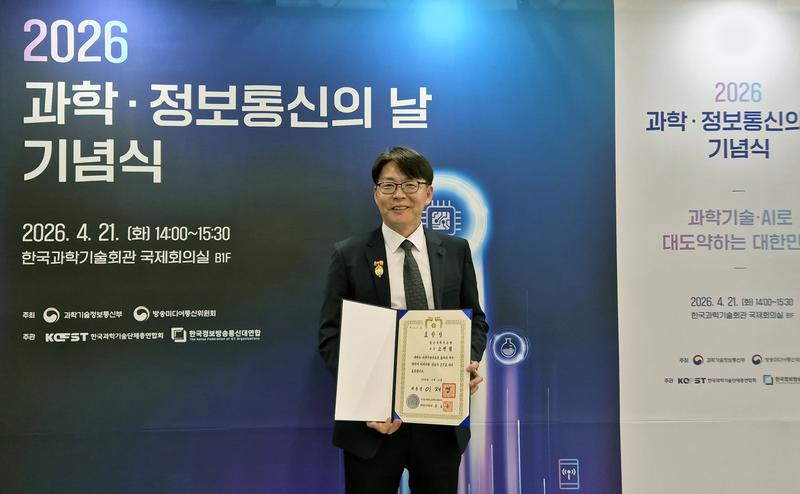
Engineering Human Senses | Professor Hyunhyub Ko Honored with Presidential Commendation
Professor Hyunhyub Ko, Head of the School of Energy and Chemical Engineering, has received a Presidential Commendation at the commemorative ceremony of the 2026 Science and ICT Day for his groundbreaking work in bio-inspired electronic systems.
Professor Ko's research translates human sensory functions—touch, taste, and hearing—into flexible electronic platforms. His team developed electronic skin capable of detecting pressure, fine texture, and temperature, as well as artificial sensory systems, such as electronic tongues and cochlea-inspired acoustic sensors. They also introduced ultrathin, skin-attachable speakers and microphones that expand possibilities for wearable interfaces.
Beyond devices, his lab designs functional materials inspired by nature, including MXene-based nanochannels and temperature-responsive adhesives. These technologies are regarded as enabling components for next-generation wearable healthcare, tactile robotics, immersive AR/VR, and the Internet of Things (IoTs).
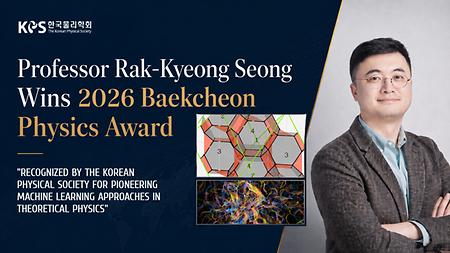
AI Meets Fundamental Physics | Professor Rak-Kyeong Seong Wins 2026 Baekcheon Physics Award
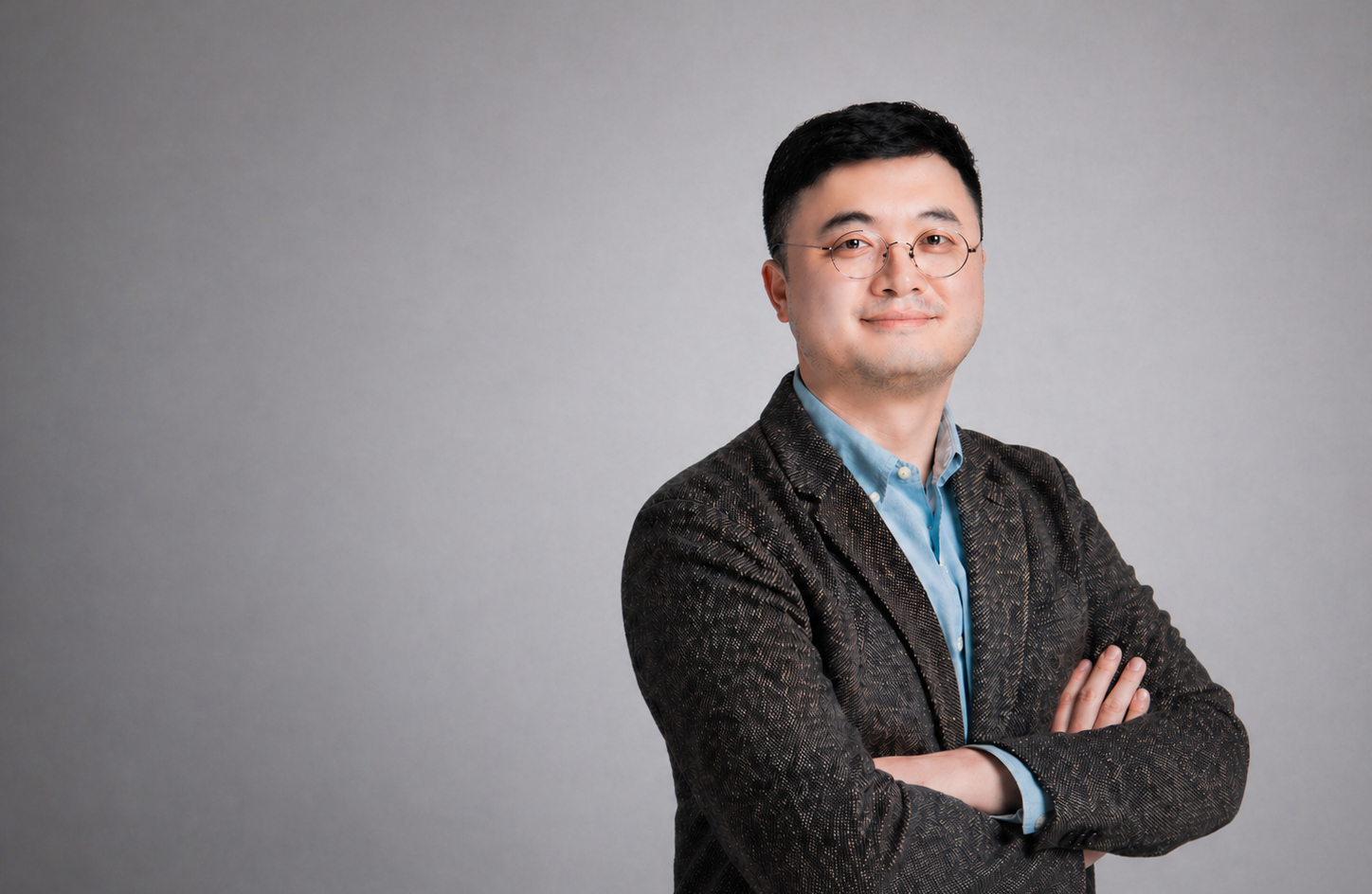
Professor Rak-Kyeong Seong from the Department of Mathematical Sciences has received the 2026 Baekcheon Physics Award from the Korean Physical Society (KPS), recognizing his pioneering contributions to theoretical particle physics.
Professor Seong introduced machine learning to tackle non-perturbative problems in quantum field theory and string theory—long viewed as analytically intractable. His early work, using AI to predict the complex geometry of Calabi–Yau manifolds remain a cornerstone in bridging data science and mathematical physics.
Invited talks at major international forums—including the University of Cambridge, the California Institute of Technology (Caltech), and Kyoto University—underscore the global impact of his research. His work embodies a new paradigm in fundamental science, where the boundaries between physics and artificial intelligence (AI) grow increasingly porous.
Related Links
Related Photo
![[썸네일] 고현협 교수 2026년 과학의 날 기념 정부포상 대통령표창.jpg](/app/board/attach/image/575165_1777531500000.do)