UNIST site map
- Admissions
-
Academics
- Colleges and Schools
-
Academic Affairs
- Academic Calendar
- Academic Curriculum
- Requirements for Graduation
- Browse Open Courses
- Undergraduate Administration
-
Graduate Academic Affairs
- Tuition Fee Payment
- Academic Leave of Absence/ Academic Return
- Voluntary Withdrawal/ Expulsion
- Change of Major
- Change of Degree Program/ Dropping of Degree Program
- Class Period/ Attendance Period/ Academic Year・Semester
- Course Registration
- Course Drop
- Attendance/ Grade/ Exam
- Credit Transfer/ Credit Carryover
- Academic Forms
- Education Support
-
Research/Industry
- Research Aims
- Research Findings
- Researcher Search
-
Research Organizations
- UNIST Multi-Interdisciplinary Institute
- IBS Research Groups
-
UNIST Labs
- Department of Mechanical Engineering
- School of Energy and Chemical Engineering
- Department of Civil
- Department of Materials Science and Engineering
- Department of Nuclear Engineering
- Department of Industrial Engineering
- Department of Design
- Department of Biomedical Engineering
- Department of Biological Sciences
- Department of Electrical Engineering
- Department of Computer Science and Engineering
- Department of Mathematical Sciences
- Department of Chemistry
- Department of Physics
- School of Business Administration
- Graduate School of Carbon Neutrality
- Graduate School of Artificial Intelligence
- Research Support
- University-Industry Relations
- Campus Life
- News Center
- About UNIST
-
etc
- UNIST Bulletin
- Work-Life Balance Support System
- UNIST Gender Equality Plan
- Faculty Invitation for Tenure Track
- Faculty Invitation for Non-Tenure Track
- Board Meeting Minutes
- University Council Meeting Minutes
- Administrative Service Charter
- Privacy Policy
- Copyright Policy
- Rejection of Unauthorized Email Collection
- Operation and Management Policy for Video Information Processing Devices
- Information Disclosure


Connection Points of Knowledge, Everything About UNIST
Try searching.
Recommended search terms


- portal
- U Academics Innovation Center
- Leadership Center
- Dormitory
- Academic Information Center
- International Students Support
- Browse Open Courses
- Course Registration
- Graduation Requirements for Graduation
- Academic Leave of Absence/ Academic Return
- Military Service
- Certificate Issuance
- Academic Calendar
- Scholarships
- Campus Map
- Campus Life Guidebook
- Health Care Center
- Human Rights Center
- portal
- Job Opening
- Announcement for Bid
- UNIST AI Services
- UNIST Daycare Center
- Sports Center
- UI Downloads
- Announcement
- Recruitment of Professors (Non-tenure)
- Faculty Invitation for Tenure Track
- UNIST Academic Information Center
- Office of Research Facilities and Training
- Office of Research Affairs
- Rule Management System
- Academic Calendar


This is a collection of menus necessary for UNIST students .
students
- portal
- U Academics Innovation Center
- Leadership Center
- Dormitory
- Academic Information Center
- International Students Support
- Browse Open Courses
- Course Registration
- Graduation Requirements for Graduation
- Academic Leave of Absence/ Academic Return
- Military Service
- Certificate Issuance
- Academic Calendar
- Scholarships
- Campus Map
- Campus Life Guidebook
- Health Care Center
- Human Rights Center


This is a collection of menus necessary for prospective UNIST Students .
prospective Students


This is a collection of menus necessary for UNIST Faculty & Staff .
Faculty & Staff
- portal
- Job Opening
- Announcement for Bid
- UNIST AI Services
- UNIST Daycare Center
- Sports Center
- UI Downloads
- Announcement
- Recruitment of Professors (Non-tenure)
- Faculty Invitation for Tenure Track
- UNIST Academic Information Center
- Office of Research Facilities and Training
- Office of Research Affairs
- Rule Management System
- Academic Calendar


NEWS CENTER
Discover not only Research Findings and event news, but also the diverse facets of UNIST presented by reporters and writers.
News Center

UNIST News
UNIST to Serve as Technology Hub for Southeastern Quantum Sensing Cluster
New regional initiative will bring quantum sensing research closer to industrial applications across southeastern Korea.
- News
- JooHyeon Heo
- 2026.09.15
- 2628

UNIST will serve as a technology hub for South Korea's new Southeastern Quantum Sensing Cluster, a national initiative designed to accelerate the use of quantum technologies in industry.
On September 1, the Ministry of Science and ICT (MSIT) designated three national quantum clusters, with Seoul focusing on quantum computing, Gwangju and Jeonnam on quantum communications, and Busan, Ulsan, and Gyeongnam on quantum sensing.
Running from 2027 to 2030, the Southeastern Quantum Sensing Cluster is a joint initiative spanning Busan, Ulsan, and Gyeongnam. UNIST and Pusan National University (PNU) will serve as its two technology hubs, leading R&D and providing technical support.
The cluster will connect quantum research with applications across shipbuilding and maritime industries, ports and logistics, aerospace and defense, and mobility and energy. By linking technology development with industry needs, the initiative will support validation, field testing, and commercialization. The broader goal is to accelerate the adoption of quantum technologies across the region's established industries, a transition the program describes as quantum transformation, or QX.
At UNIST, research will range from fundamental quantum sensing technologies to device fabrication and testing with industry partners. The university will help translate laboratory-scale technologies into devices that can be evaluated for performance and practical use in industrial settings.
A key resource will be the UNIST Quantum-Nano FAB, a KRW 30 billion facility that opened in March. The facility supports quantum device development from fabrication and characterization through validation and demonstration, providing the infrastructure needed to move promising technologies beyond the laboratory.
Built on UNIST’s existing nanofabrication infrastructure, which serves more than 60 institutions nationwide and handles approximately 33,000 research processes each year, the Quantum-Nano FAB adds specialized equipment and technical support for quantum device fabrication. Through the cluster, it will support device fabrication and packaging, performance evaluation, and field testing in collaboration with industry partners.

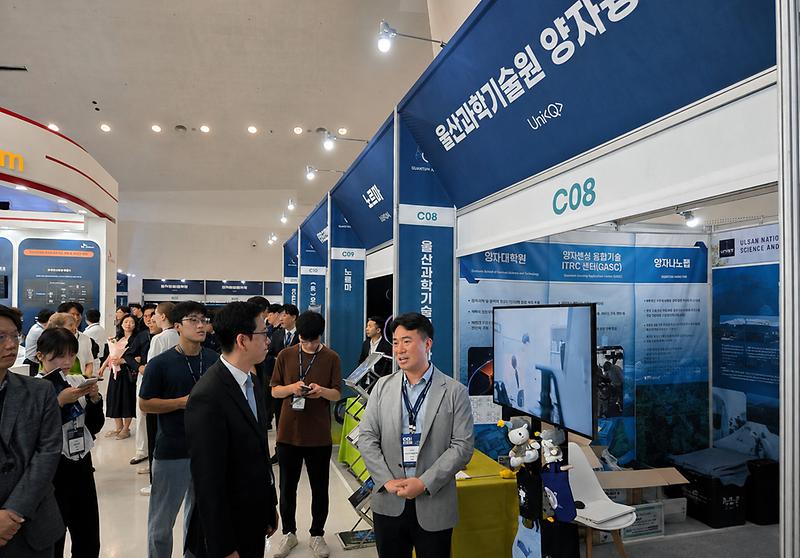
UNIST has also expanded its research and training capabilities in quantum science and engineering. This year, the university launched the Graduate School of Quantum Engineering and Uni<Q>, a hub connecting academic research with industry. Together with the Quantum-Nano FAB, these initiatives link quantum research and device development with advanced training and industry collaboration.
The university plans to expand joint training with cluster partners and pursue research in quantum materials, components, equipment, and algorithms in response to industrial needs.

“The designation is a starting point, not the end goal,” said Byung-Gi Seo, Director of the U Institute for Future Strategy, which coordinates the initiative in Ulsan. “We want to connect UNIST’s quantum technologies with manufacturing across Ulsan and southeastern Korea, accelerating their adoption in established industries while creating new business opportunities.”
“UNIST has the research capabilities and infrastructure to connect fundamental quantum science with industrial applications,” said Kibog Park, Dean of the Graduate School of Quantum Engineering. “Our goal is to develop practical applications of quantum technology that address the needs of companies in the region while strengthening collaboration between research institutions and industry.”
“Quantum sensing can provide information that is difficult to obtain with conventional measurement technologies,” said Professor Je-Hyung Kim of the Graduate School of Quantum Science and Technology. “By connecting UNIST’s fundamental research with Ulsan’s manufacturing base, we aim to demonstrate how quantum technologies can move beyond the laboratory and contribute to industrial competitiveness.”
The cluster will provide UNIST with a new platform to bring its quantum sensing research and device technologies into closer collaboration with industry across southeastern Korea.
Related Links
Related Photo